Fed's recap: A cautious hold with a clear warning on inflation

The Federal Reserve (Fed) held its policy rate steady at 3.75%-4.00%, but it wasn’t a unanimous decision. Among two officials who wanted a 25-basis-point hike were Lisa Cook and Beth Hammack, while Chair Kevin Warsh said the Fed would use the coming flow of information to decide whether further action is needed.
The statement presented a resilient economy.
Activity is expanding at a strong pace, domestic spending remains firm, job gains are keeping pace with the workforce, and unemployment has changed little. Productivity growth and capital investment are also strong, giving policymakers room to keep their focus on inflation.
Warsh said third-quarter GDP was likely to grow by more than 3%, while business investment appeared to be rising at a double-digit pace. Credit conditions have tightened, but he said the Fed was unwilling to describe overall financial conditions as restrictive. Employment conditions remain positive, leaving the central bank concentrated primarily on its price-stability mandate.
Inflation, however, is still too high. Warsh said recent data had not changed the underlying picture and stressed that relative price increases must not broaden into a wider inflation problem. The Fed’s 2% PCE target remains firm, with no “soft” alternative, although longer-term inflation expectations still suggest that households and businesses have confidence in the central bank’s commitment.
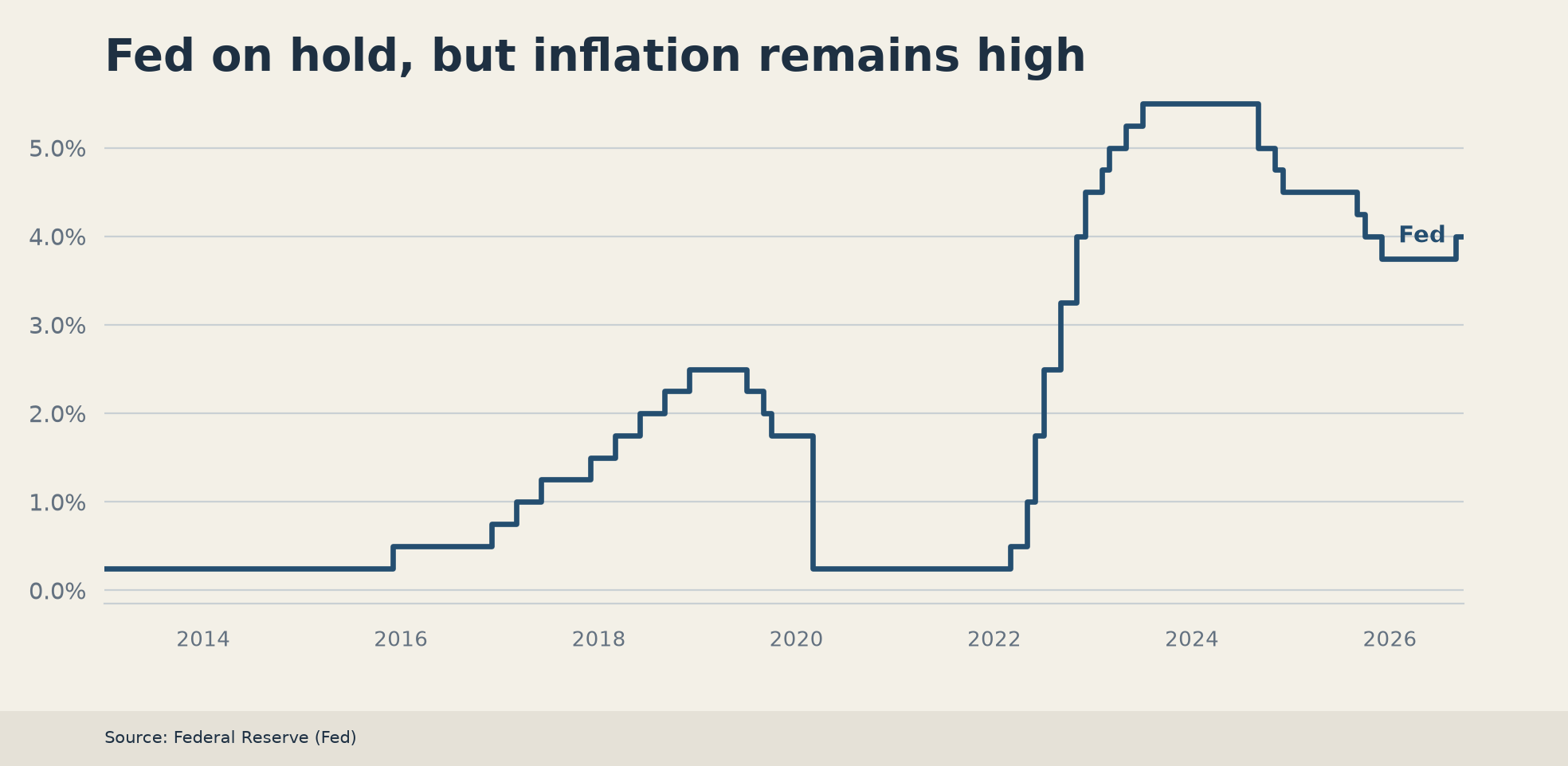
Overall, this was a cautious hold with a hawkish undertone. The Fed believes its September rate increase has begun to work, but it has kept the door open to further tightening if inflation fails to move lower. Warsh repeatedly avoided pre-judging future meetings, arguing that the next few months should provide valuable information before the Fed decides where policy needs to go.
Fed FAQs
Monetary policy in the US is shaped by the Federal Reserve (Fed). The Fed has two mandates: to achieve price stability and foster full employment. Its primary tool to achieve these goals is by adjusting interest rates. When prices are rising too quickly and inflation is above the Fed’s 2% target, it raises interest rates, increasing borrowing costs throughout the economy. This results in a stronger US Dollar (USD) as it makes the US a more attractive place for international investors to park their money. When inflation falls below 2% or the Unemployment Rate is too high, the Fed may lower interest rates to encourage borrowing, which weighs on the Greenback.
The Federal Reserve (Fed) holds eight policy meetings a year, where the Federal Open Market Committee (FOMC) assesses economic conditions and makes monetary policy decisions. The FOMC is attended by twelve Fed officials – the seven members of the Board of Governors, the president of the Federal Reserve Bank of New York, and four of the remaining eleven regional Reserve Bank presidents, who serve one-year terms on a rotating basis.
In extreme situations, the Federal Reserve may resort to a policy named Quantitative Easing (QE). QE is the process by which the Fed substantially increases the flow of credit in a stuck financial system. It is a non-standard policy measure used during crises or when inflation is extremely low. It was the Fed’s weapon of choice during the Great Financial Crisis in 2008. It involves the Fed printing more Dollars and using them to buy high grade bonds from financial institutions. QE usually weakens the US Dollar.
Quantitative tightening (QT) is the reverse process of QE, whereby the Federal Reserve stops buying bonds from financial institutions and does not reinvest the principal from the bonds it holds maturing, to purchase new bonds. It is usually positive for the value of the US Dollar.
Author

Pablo Piovano
FXStreet
Born and bred in Argentina, Pablo has been carrying on with his passion for FX markets and trading since his first college years.















