Dow Jones Industrial Average climbs with the AI trade, led by a bank
- DJIA climbs to near 52,800, its highest close since early September, as AI stocks rally.
- Goldman Sachs and Caterpillar supply more than half of the gain.
- IBM adds more points than Nvidia before reporting after the close.


The Dow Jones Industrial Average got most of its share of Wednesday's artificial intelligence (AI) rally from a bank and a bulldozer maker. The index closed near 52,800, its highest close since early September. Elon Musk's SpaceX (SPCX) reported 161% revenue growth and the Nasdaq Composite rose more than 1%, but under price weighting the gains that counted most belonged to Goldman Sachs (GS) and Caterpillar (CAT), the two most expensive shares in the index.
Nvidia rose more than Goldman Sachs and counted for under a third as much
The Dow adds up share prices rather than company values, so a stock's weight is its dollar price. Goldman Sachs closed near $900 a share and Nvidia (NVDA) near $220, which made Goldman's rise of just over 2% worth more than 100 index points and Nvidia's larger rise, above 2.5%, worth about 33.
Caterpillar, at about $740 the second-priciest share in the index, rose about 2% and added nearly 90 points, and the two together supplied more than half of the Dow's gain. International Business Machines (IBM) rose more than 3% into its results and added about 55. The company at the centre of the AI trade gave the Dow fewer points than IBM did before IBM had reported anything.
Apple (AAPL) and American Express (AXP) each added about 30 points, Apple two days before a phone launch and American Express two days before its results. Microsoft (MSFT) and Amazon (AMZN), the index's other AI spenders, ended near flat.
The session's biggest stories happened outside the index
SpaceX rose almost 8% after the results, and Musk said SpaceX and Tesla (TSLA) have formed special committees to discuss a merger. Neither company is a Dow member, and neither are Advanced Micro Devices (AMD), Micron Technology (MU) or Marvell Technology (MRVL), which carried the chip rally alongside Nvidia. Netflix (NFLX) fell more than 5% after its revenue forecast for the final quarter came in short and it cut its advertising guidance for the year, and it isn't a member either.
The biggest drag inside the index was Alphabet (GOOGL), down about 1.6% and worth more than 30 points, which joined the Dow on June 29. Procter & Gamble (PG), Johnson & Johnson (JNJ) and UnitedHealth (UNH) took off more than 35 points between them. The Dow's newest member fell on the day the AI trade came back.
Four earnings reports carry about one Goldman Sachs between them
IBM was due to report after the close, with its call at 21:00 GMT. Procter & Gamble and Honeywell Technologies (HON) report before the open on Thursday, and American Express before the open on Friday. Under price weighting, a 1% move in each of the four adds up to about 56 points, roughly what a 1% move in Goldman Sachs is worth on its own.
The macro calendar is light by comparison. Weekly jobless claims on Thursday at 12:30 GMT are forecast at 200K after 199K, and S&P Global's preliminary business surveys and University of Michigan sentiment follow on Friday. The 10-year Treasury yield ended above 5.1%, and prediction markets put a Fed hold at 3.75%-4.00% on October 28 near 86%. The Fed is in its quiet period before that meeting, so no Fed official will comment on any of the week's data before the decision.
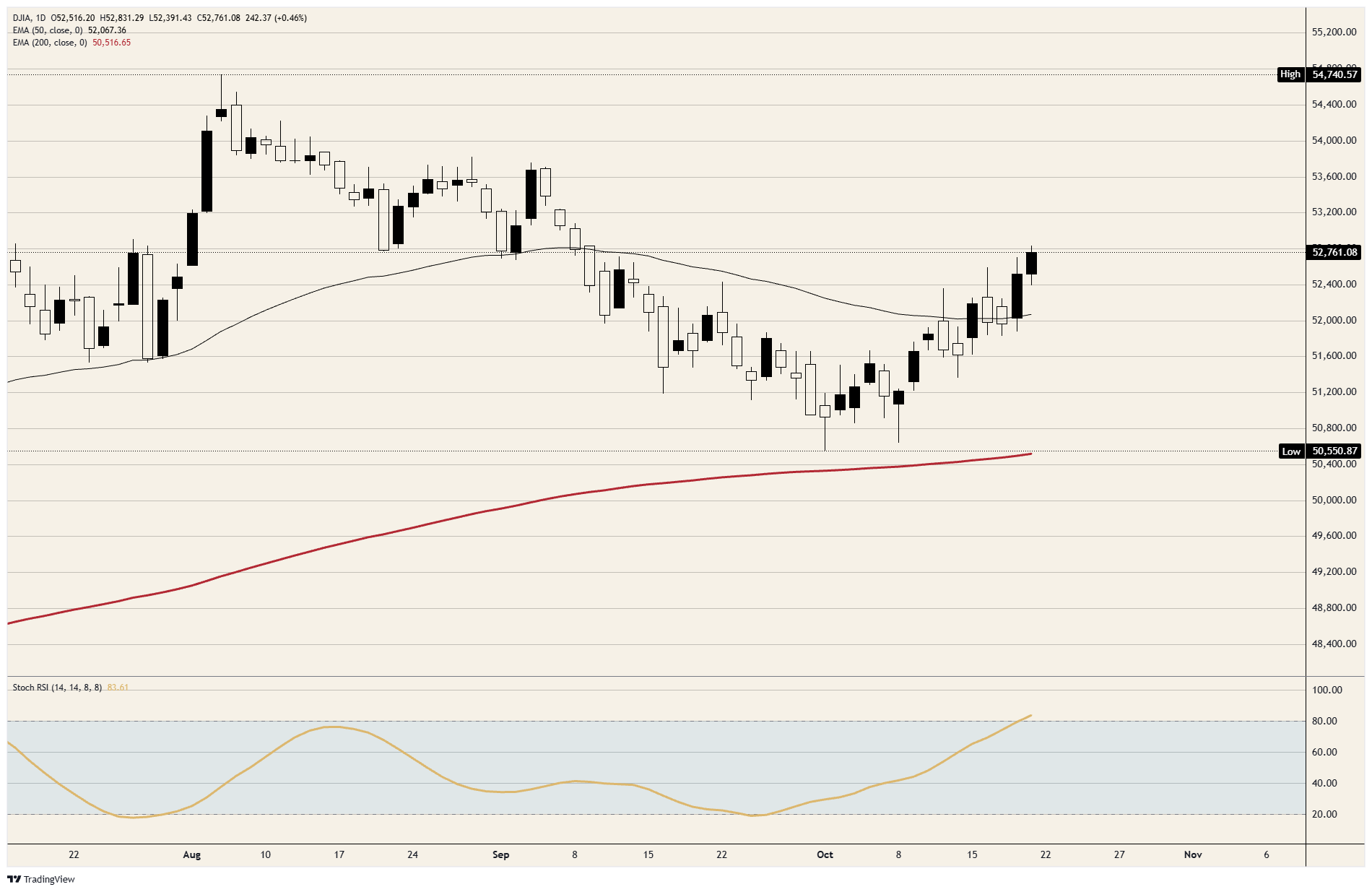
Dow Jones Industrial Average levels back above the 50-day average
Resistance: Wednesday's high just above 52,800 is the highest level since early September. 53,100 was the high on September 8, the day before the September slide gathered pace, and the 53,750 area was the top of the early-September bounce.
Support: Wednesday's low near 52,400 is the first level. The 50-day Exponential Moving Average (EMA), just above 52,000, held as a ceiling for most of the stretch from September 10 to October 19, and Tuesday and Wednesday are the first two closes in a row above it since early September.
Bias: Lean long while the 50-day EMA holds on a closing basis, with 53,100 the first objective and 53,750 the second. The daily Stochastic Relative Strength Index (Stoch RSI) is near 84, its highest reading since at least mid-July, so the two-day run is stretched. A daily close under 52,000 ends the long.
DJIA daily chart
Dow Jones FAQs
The Dow Jones Industrial Average, one of the oldest stock market indices in the world, is compiled of the 30 most traded stocks in the US. The index is price-weighted rather than weighted by capitalization. It is calculated by summing the prices of the constituent stocks and dividing them by a factor, currently 0.152. The index was founded by Charles Dow, who also founded the Wall Street Journal. In later years it has been criticized for not being broadly representative enough because it only tracks 30 conglomerates, unlike broader indices such as the S&P 500.
Many different factors drive the Dow Jones Industrial Average (DJIA). The aggregate performance of the component companies revealed in quarterly company earnings reports is the main one. US and global macroeconomic data also contributes as it impacts on investor sentiment. The level of interest rates, set by the Federal Reserve (Fed), also influences the DJIA as it affects the cost of credit, on which many corporations are heavily reliant. Therefore, inflation can be a major driver as well as other metrics which impact the Fed decisions.
Dow Theory is a method for identifying the primary trend of the stock market developed by Charles Dow. A key step is to compare the direction of the Dow Jones Industrial Average (DJIA) and the Dow Jones Transportation Average (DJTA) and only follow trends where both are moving in the same direction. Volume is a confirmatory criteria. The theory uses elements of peak and trough analysis. Dow’s theory posits three trend phases: accumulation, when smart money starts buying or selling; public participation, when the wider public joins in; and distribution, when the smart money exits.
There are a number of ways to trade the DJIA. One is to use ETFs which allow investors to trade the DJIA as a single security, rather than having to buy shares in all 30 constituent companies. A leading example is the SPDR Dow Jones Industrial Average ETF (DIA). DJIA futures contracts enable traders to speculate on the future value of the index and Options provide the right, but not the obligation, to buy or sell the index at a predetermined price in the future. Mutual funds enable investors to buy a share of a diversified portfolio of DJIA stocks thus providing exposure to the overall index.
Author
Joshua Gibson
FXStreet
Joshua joins the FXStreet team as an Economics and Finance double major from Vancouver Island University with twelve years' experience as an independent trader focusing on technical analysis.

















