Democratic sweep: A threat to the Dollar and AI but a boon for Gold?
- Democrats seize control of Congress as Iran war crushes Republicans.
- A legislative gridlock or a Democratic agenda?
- Dollar risks losing its shine, but gold could restore its crown.
- But AI and cryptos might be biggest losers.

A big thumbs down
The 2026 midterm elections in the United States delivered a decisive outcome for Washington’s political establishment, handing Democrats a resounding victory over incumbent Republicans. Most of all, voters gave their withering verdict on President Trump’s policies, particularly his war on Iran.
Soaring energy prices that have pushed up the cost of fuel for American consumers, as well as higher prices more broadly from the ‘Liberation Day’ tariffs, have been detrimental to Trump’s popularity, hurting the Republican party in key states that were long considered strongholds.
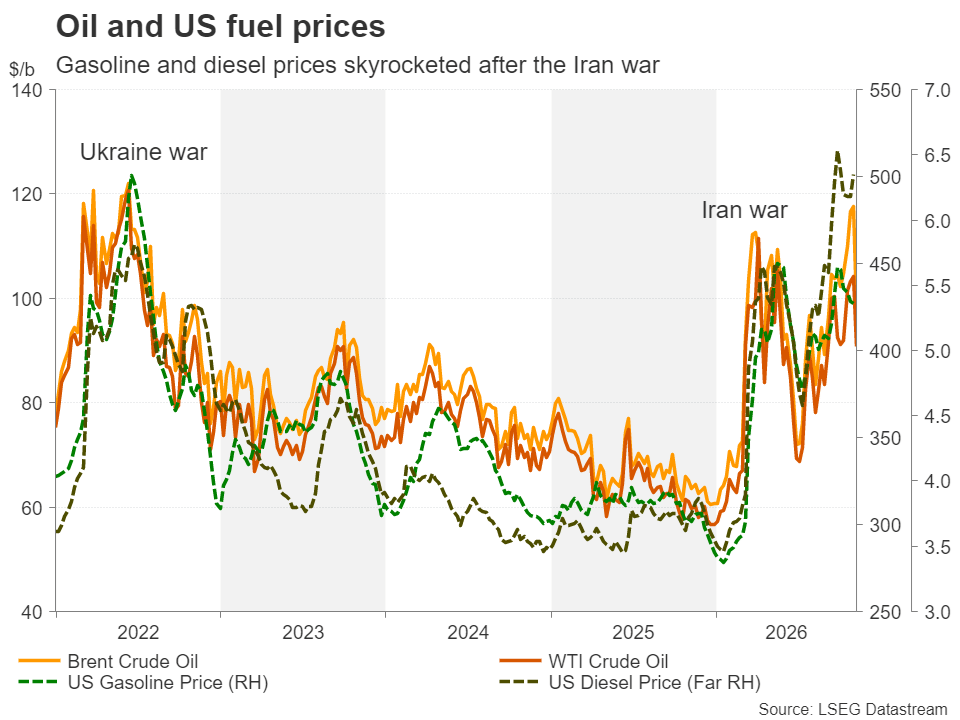
It’s ironic that the very thing that secured Trump’s landslide election victory in 2024 – the high cost of living – is the reason why voters abandoned the Republicans in this week’s midterms. The scale of Republican losses was so big that not even the most optimistic Democrats predicted they would clinch such a strong majority in both the Senate and the House of Representatives, securing overall control of Congress for Trump’s remaining two years in office.
Lame duck Trump
Lame duck presidents are from being the worst outcome for the markets and often tend to be the preferred scenario. However, this is truer when Congress is split, which curtails the legislative agenda of both parties, not just the losing side. With a blue wave now sweeping through Capitol Hill, investors are wary about what this means for the US economy, which despite the tariff turmoil and the energy crisis, has benefited from tax cuts and deregulation under the Republicans.
Although the President retains the power to veto major legislation and the Democrats will need to reach consensus with Republicans on some level, the balance of power has nevertheless shifted toward the blue party. Democrats can use their majority in both houses to make changes to taxation such as raise the corporate tax rate, increase health care spending by restoring expired Affordable Care Act subsidies, and roll back some of Trump’s climate policies by reintroducing tax credits for renewable energy.
Still, Democrats would likely only be able to secure Trump’s approval on their big priorities in exchange for some concessions to the Republicans, particularly when it comes to Medicare. And despite the historic wins, the midterms have effectively brought in a new era of divided government for the next two years.
Good for bonds
For financial markets, the most pressing issue is the implication on US Treasuries, amid lingering concerns about America’s mounting debt problem. The war in Iran has pushed up energy costs, reviving inflation and rate hike expectations.
Bond markets suffered their worst rout in years in September, lifting long-term borrowing costs to the highest since 2002. Pressured by the combination of rising inflation and a flood of debt issuance, both by government and corporations, high yields have sparked volatility across FX, equity and commodity markets, not just in bonds. But the US dollar, being the world’s reserve currency, was immune from the selloff and revelled in its safe-haven status.
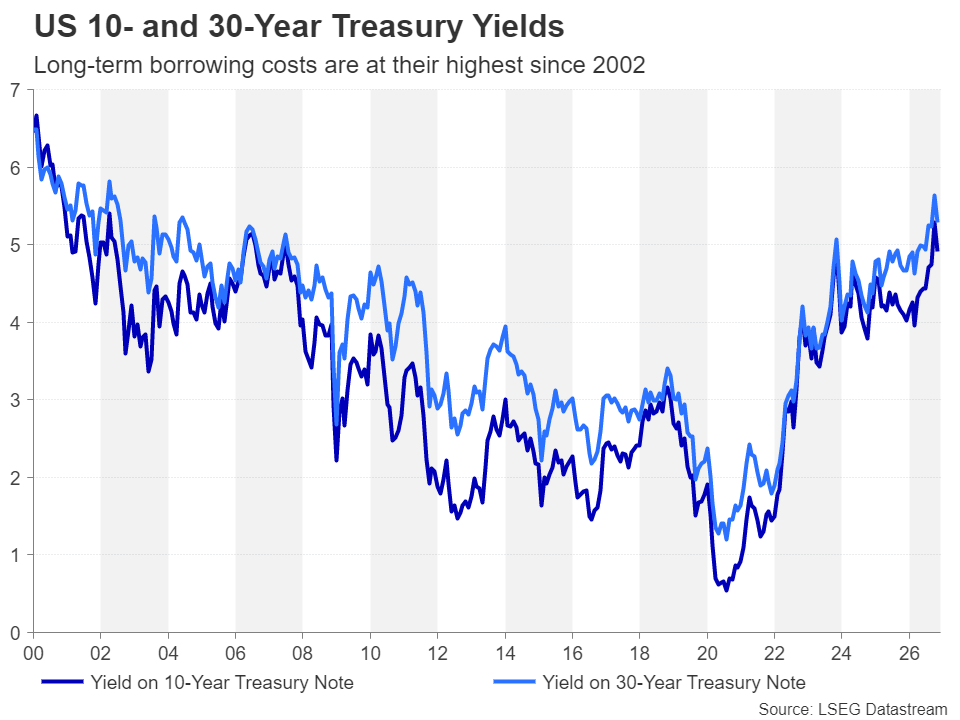
With the Democrats now running the show in Congress, it will be difficult for the Trump administration to push for tax giveaways that go beyond the Big Beautiful Bill. At the same time, Democrats won’t be able to get too carried away with spending increases.
Fiscal negotiations
Treasury yields have declined in the immediate aftermath of the election results, as the US budget deficit is less likely to spiral further when there’s a legislative gridlock. In addition, raising the debt ceiling, which will probably need to be agreed in the first six months of 2027, becomes a simpler process when one party controls both chambers of Congress.
However, negotiations for passing the crucial funding bill by December 11, even before newly elected lawmakers take their seats, are likely to get messy, potentially leading to a government shutdown unless lawmakers decide to kick the can down the road by agreeing to another stop-gap bill.
Bad for growth?
But overcoming this hurdle and looking into 2027, there’s more than just the sounder fiscal outlook that could be a drag on Treasury yields. The inflation picture is somewhat improved under the Democrats, not just because of the potentially tighter fiscal policy, but also due to the possibility of increased regulation on businesses, especially on the development of artificial intelligence (AI), which would dampen economic activity.
The latter could significantly slow growth in AI investment. Even if Congress doesn’t get far with proposed regulation for the AI industry, Democrat-controlled states may put the brakes on the datacentre boom, intensifying the existing jitters around the outlook for AI demand.
This is probably the biggest downside risk for the US dollar, as well as for Wall Street. But the impact on US stocks isn’t a straightforward one. A cooling US economy from scaled down AI spending plans would likely reduce the need for substantial Fed tightening, as policymakers would turn more cautious about hiking interest rates, pleasing Wall Street traders.
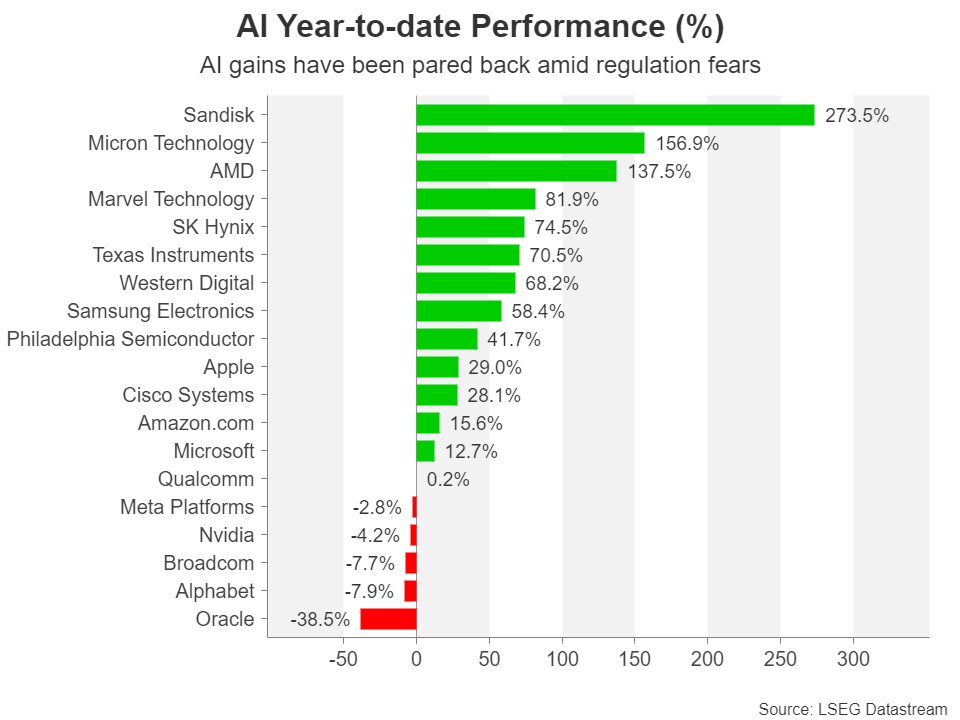
This reaction can already be observed, with most Big Tech stocks benefiting from the more favourable interest-rate path as well as potentially smaller AI bills, while chipmakers continue to bleed on the expectation that demand for semiconductors would be hit by the pushback on AI datacentres.
Hopes for Iran ceasefire
There is also a third dimension to the inflation outlook from Democrats’ midterm triumph: the Iran war. Trump’s escapades in the Middle East have been deeply unpopular with American voters, as it’s driven up the cost of gasoline and diesel. Although much of what happens next lies with the President, Democrats may threaten to cut defence spending if Trump orders fresh military strikes against Iran. With Republicans also now acknowledging that the war cost them the election, they may side with the Democrats if Trump does not pull out soon.
The only danger is if Iran were to escalate first and Washington had to respond in defence. But otherwise, investors think a quick resolution to the conflict is more likely now, as reflected by the sharp drop in oil prices following the election results. More importantly, the Fed is not seen hiking rates more than twice over the course of the next 12 months, and this could put a floor beneath the deepening selloff in AI-related stocks, while lifting small-cap and value stocks.
The healthcare and financials sectors also stand to benefit from a Democratic majority, while defence and energy stocks are likely to become laggards.
Dollar risks
For the dollar, however, a shallower rate path can only be negative, although there may be some potential upside from reduced trade tensions. As things stand, Congress has little power to repeal existing tariffs, as overriding the President’s veto would require a two-thirds majority in both the House and Senate. But lawmakers may attempt to exempt some products from tariffs or limit the President’s powers over trade policy.
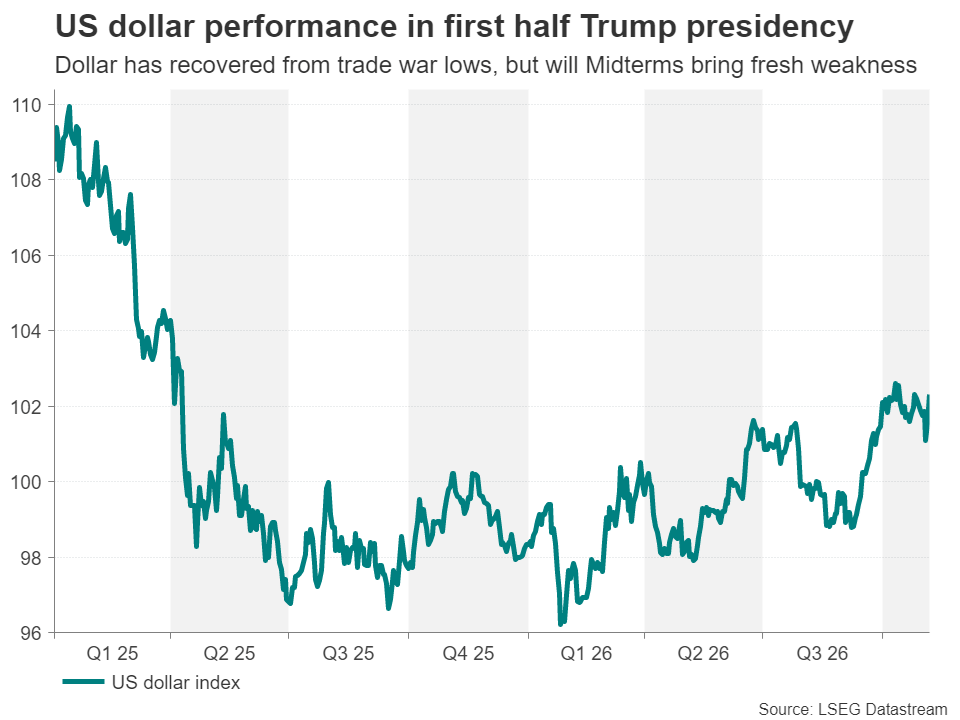
On the whole, having lost control of Congress, Trump is less likely to re-escalate his trade war and even before the bruising defeat, there was surprise progress in negotiations with Canada to reach a new trade agreement.
Changing fortunes for Gold?
Yet, the combination of lower yields, a weaker dollar and cheaper oil are the perfect cocktail for a more bullish gold. The best scenario for gold is if Trump wraps up the Middle East conflict and oil prices trend lower. But at the very least, the changing political landscape in the US establishes strong support for the precious metal.
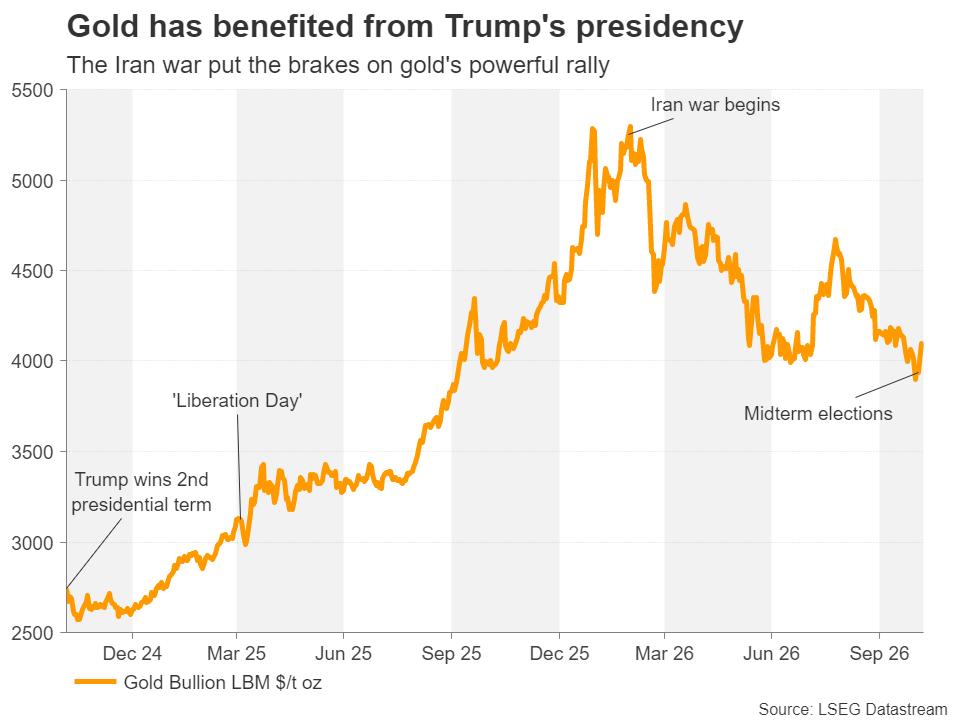
Whilst this may not exactly be win-win situation, the reduced fiscal risks should put a lid on Treasury yields even if energy prices stay elevated. The same is true with economic growth, as some kind of a slowdown in the rollout of AI is anticipated, reining in Fed rate hikes to some extent. However, a prolonged rout in AI stocks may have a dampening effect on gold rather than boost safe-haven flows towards it if investors continue to sell bullion to cover their equity losses or margin calls.
CLARITY Act may not be dead
One the legislative front, the one thing that’s certain is that Democrats intend to use their newfound authority to launch investigations into Trump’s family business dealings. Although such investigations would not have much significance for the markets, where Democrats may push hard is amending the CLARITY Act to include tougher restrictions on crypto transactions by the president and his family. Democrats also want to improve safeguards for consumers and strengthen the bill’s enforcement and anti-money laundering provisions.
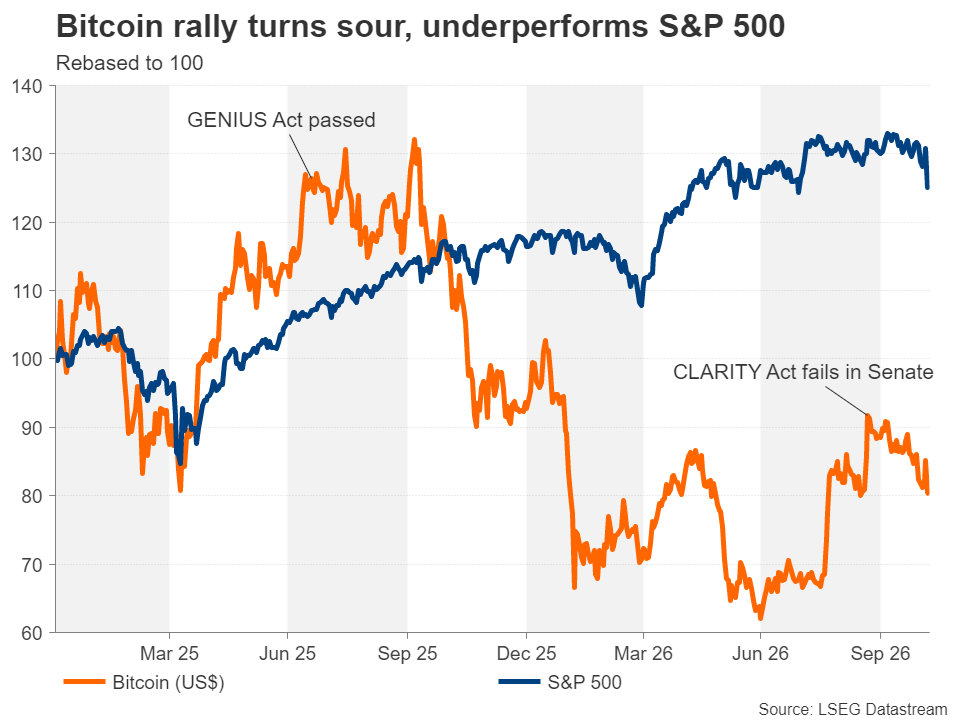
For major cryptos such as Bitcoin and Ether, the bill’s passage would still be broadly positive, as it would do what it’s set out to do, which is to provide regulatory clarity. But the gains would be far less than what they would have been if the legislation had already passed, while any decision by Congress to delay it indefinitely would risk putting cryptocurrencies on the backfoot at least until 2028.
A storm before the calm?
The overall impact of a Democrat-led Congress on the markets will likely only become clearer a few months into the new term when party leaders set out their agenda. There’s a risk that Democrats may not get the strong start they were hoping for, for example, if Republicans force a government shutdown right before the holidays or if Trump decides to order a major military attack on Iran for a final time before agreeing to any new ceasefire deal.
But it should be reassuring for investors that there’s not much support within the Trump administration for fresh strikes on Iran, which may make it more difficult for Trump to go it alone. Moreover, it remains to be seen whether Democrats will maintain such a hostile stance against AI datacentres if the panic on Wall Street worsens and job cuts start to mount in the states most opposed to the AI buildout.
Author

Mr Boyadjian graduated from the London School of Economics in 1999 with a BSc in Business Mathematics and Statistics.











