Can the New Zealand Dollar hold 0.5600 this time?
NZD/USD trades lower on Tuesday, struggling to maintain its position above the psychological 0.5600 level as the New Zealand Dollar (NZD) remains under pressure following the Reserve Bank of New Zealand's (RBNZ) unexpected monetary policy decision last week.
The currency pair has repeatedly tested the 0.5600-0.5565 support area over the past few months, with buyers consistently stepping in to prevent a sustained breakdown. However, the latest decline raises questions about whether this important price floor can withstand another wave of selling pressure.
The Kiwi faces conflicting forces. While expectations of further RBNZ interest rate increases could provide support, weak domestic demand, uncertainty surrounding the US Dollar (USD) and upcoming economic data leave the currency vulnerable.
RBNZ's unexpected pause leaves the Kiwi on shaky ground
The RBNZ surprised financial markets last week by keeping its Official Cash Rate (OCR) unchanged at 2.75% despite widespread expectations of a 25-basis-point increase.
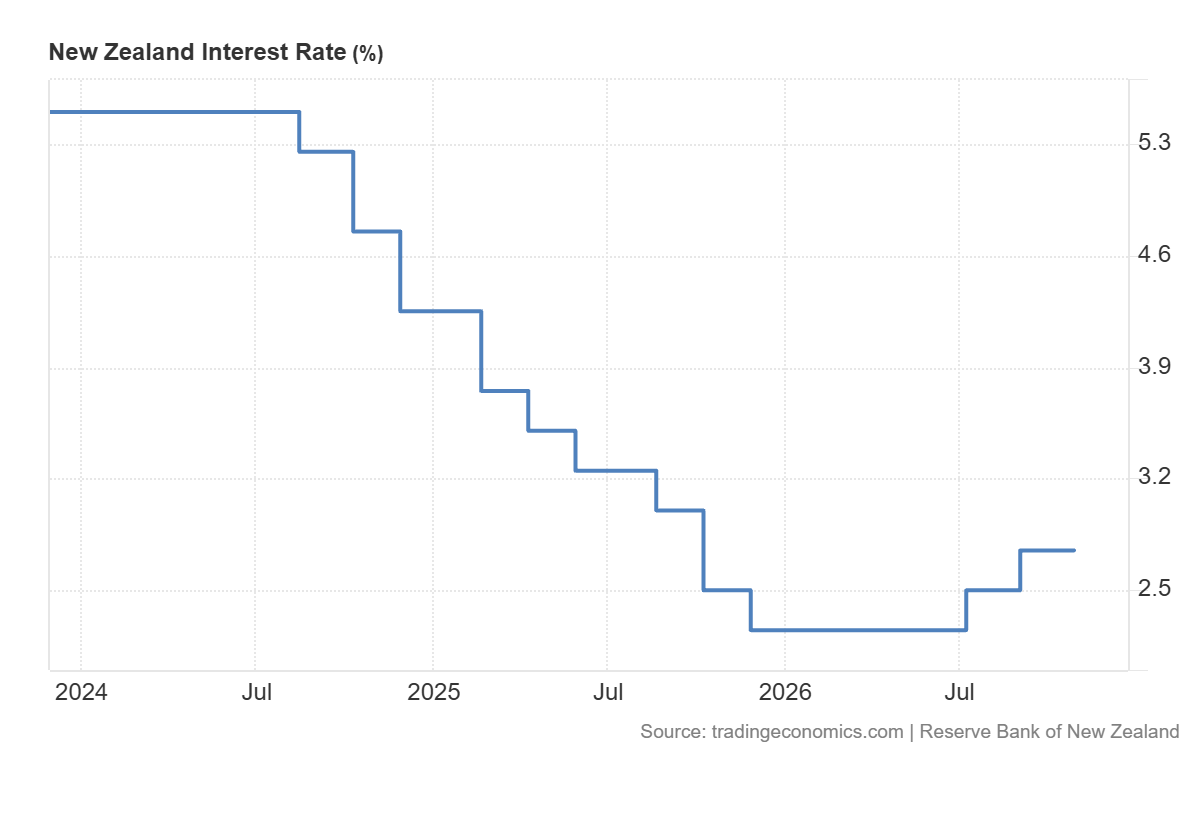
The decision was particularly close, with four policymakers voting to maintain rates and three supporting an increase. Although the central bank acknowledged that further monetary tightening would likely be necessary, its decision immediately weighed on the New Zealand Dollar, triggering a sustained decline against the US Dollar.
The central bank faces a difficult balancing act. Annual inflation slowed to 3.7% in the third quarter from 4.1%, but policymakers expect it to accelerate to 4.4% in the fourth quarter, partly reflecting higher fuel prices and currency depreciation. At the same time, New Zealand's economic recovery remains fragile, limiting the central bank's ability to aggressively raise borrowing costs without damaging domestic activity.
Rabobank Senior FX Strategist Jane Foley highlighted this dilemma, noting that "The RBNZ commented at its policy meeting, that while annual inflation is expected to increase to 4.4% in the December quarter (largely on the back of fuel), that domestic demand remains subdued."
This combination of persistent inflation and weak economic activity complicates the outlook for the Kiwi as higher interest rates could support the currency while simultaneously weighing on growth.
December rate hike expectations offer support, but analysts remain cautious
Despite the October surprise, several major financial institutions continue to anticipate further monetary tightening. Standard Chartered interpreted the RBNZ's decision as a postponement rather than a fundamental change in policy direction: "Overall, we believe that the RBNZ chose to defer policy hikes rather than call an end to the cycle." The bank forecasts two 25-basis-point increases, in December and February, which would bring the OCR to 3.25%. UOB similarly expects the RBNZ to raise rates to 3% at its December meeting.
However, expectations of higher interest rates do not necessarily guarantee a sustained recovery in the New Zealand Dollar. Commerzbank warned that financial markets may already be anticipating too much monetary tightening, with approximately four quarter-point increases priced in by September 2027: "While we continue to expect a rate hike in December, we are more sceptical than the market about the medium-term outlook. As rate-hike expectations are pared back, the Kiwi is therefore likely to weaken."
This creates a potential vulnerability for NZD/USD. Even if the RBNZ raises interest rates in December, the Kiwi could struggle if investors begin reducing expectations for subsequent increases.
US Dollar dynamics and upcoming data could decide the next move
The New Zealand Dollar's outlook also depends heavily on developments in the United States (US). The Federal Reserve (Fed) maintained its benchmark interest rate range at 3.75%-4.00%, leaving US interest rates significantly above New Zealand's 2.75% policy rate. This interest rate differential continues to favor the US Dollar, particularly as investors anticipate the possibility of another Fed rate increase in December.
Nevertheless, Commerzbank also considers current expectations for US monetary tightening excessive, suggesting that a reassessment of the Fed's outlook could limit further Kiwi depreciation.
Political developments add another layer of uncertainty, with Tuesday's US midterm elections potentially influencing market sentiment and demand for the Greenback.
Meanwhile, New Zealand's third-quarter employment report, scheduled for later Tuesday, represents an important test for RBNZ rate hike expectations. The Unemployment Rate is expected to decline slightly to 5.5% from 5.6%, while Employment Change is forecast to slow to 0.4% from 0.5%.
Stronger-than-expected labor market figures could reinforce expectations of a December rate increase and help stabilize the Kiwi. Conversely, disappointing data could strengthen concerns about domestic economic weakness and intensify pressure on NZD/USD.
NZD/USD technical outlook: Can the 0.5600-0.5565 support zone survive?
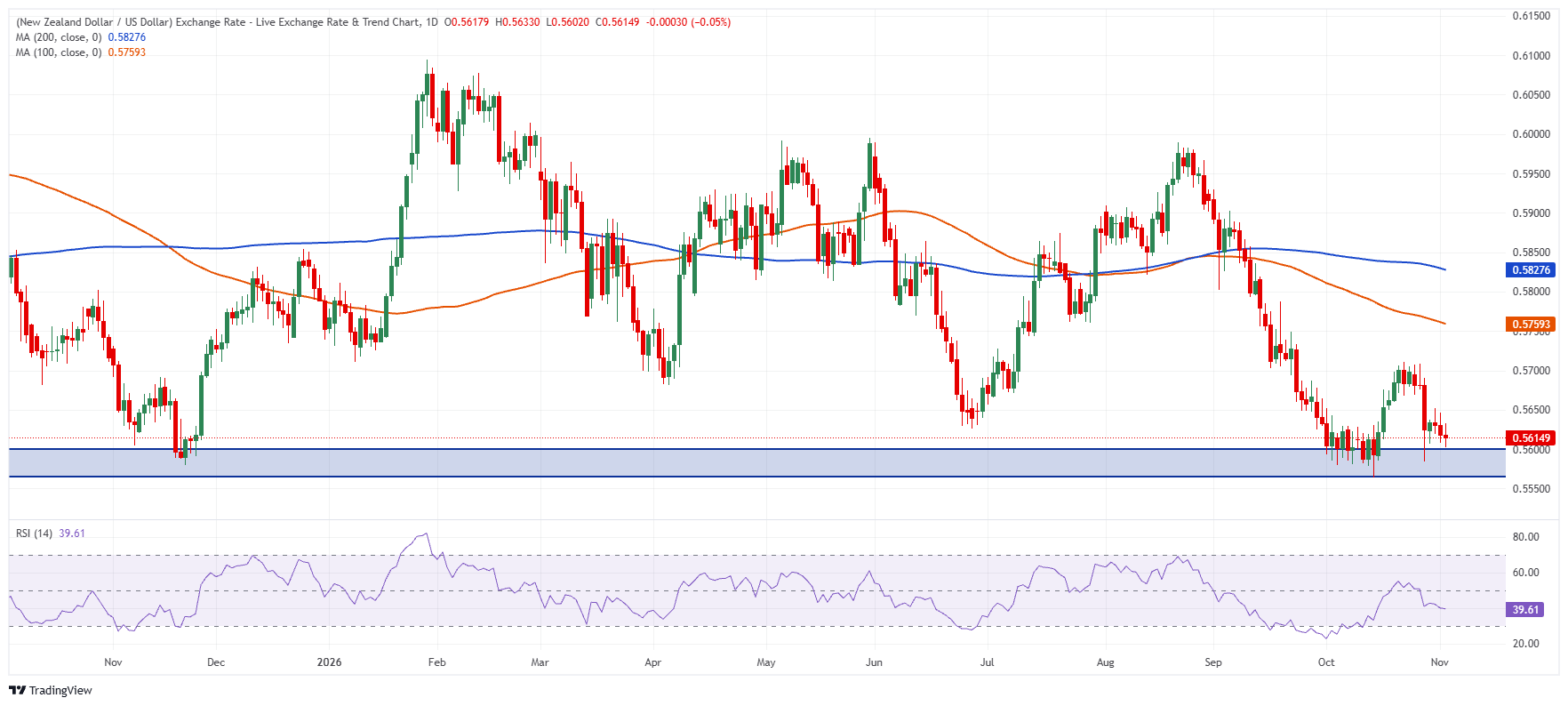
The daily chart highlights the importance of the 0.5600-0.5565 support zone, which has repeatedly attracted buying interest since late 2025. The pair trades below its 100-day and 200-day Simple Moving Averages (SMAs), currently around 0.5759 and 0.5828, respectively. Meanwhile, the Relative Strength Index (RSI) stands near 39.6, suggesting persistent bearish momentum without yet reaching oversold territory.
A sustained break below 0.5565 would represent a significant deterioration in the technical outlook and expose the April 2025 low around 0.5480. Conversely, another successful defense of the support area could encourage a recovery toward 0.5700 and the recent rebound high near 0.5710. However, a more convincing bullish reversal would require the pair to reclaim the 100-day SMA.
For now, the balance remains fragile. The prospect of further RBNZ rate increases offers the New Zealand Dollar a potential lifeline, but weak economic fundamentals and a persistent bearish technical structure suggest that the battle for 0.5600 is far from over.
Author

Ghiles Guezout
FXStreet
Ghiles Guezout is a Market Analyst with a strong background in stock market investments, trading, and cryptocurrencies. He combines fundamental and technical analysis skills to identify market opportunities.