|

Brent Oil outlook: Overheated geopolitical situation continues to underpin Oil prices

Brent Oil

Brent keeps firm tone and trading near new three-week high on Wednesday, as the latest attack on the Saudi Aramco headquarters further fueled already overheated situation in Yemen, while Iran announced launch of new tactics to control all traffic through Strait of Hormuz.

Oil prices remain supported by strong supply worries, with most large economies having their oil reserves at the minimums, while significantly reduced supplies cannot cover demand.

Also, the world faces shortage in refined products, particularly in diesel fuel, which reached a record high in the US and hit the highest levels since 2022 in Europe, with the latest US-Russia deal for importing significant quantity of Russian diesel, so far showing no significant positive impact, as oil prices continue to rise.

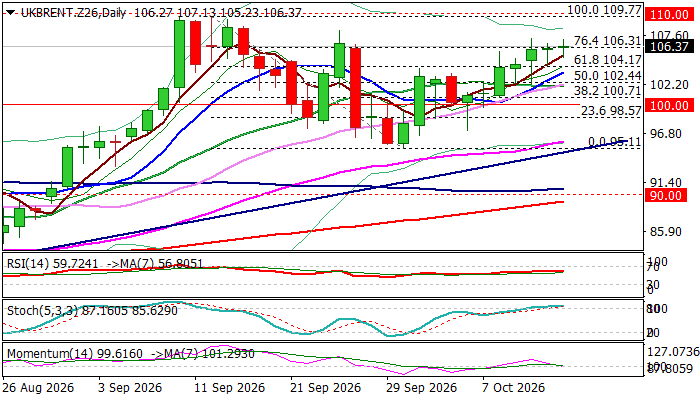
On the other hand, negative signals are developing on daily chart, as descending 14-d momentum cracks the centreline, Wednesday’s Doji (although with long tail and suggesting that bids are still strong) signaling indecision and Stochastic entered overbought territory.

Initial negative signals still require more work at the downside to be validated, which so far keeps hopes of possible pullback fragile.

Near-term action remains bullish overall but struggles at Fibo barrier at $106.31 (76.4% of $109.77/$95.11) following repeated failure on Mon / Tue, with firm break here to strengthen bullish structure for attack at $108.22 (Sep 24 lower top) guarding key $110 zone.

Rising hourly cloud (currently spanned between $105.35 and $104.81) which tracks the ascend in past four days, offer initial support, followed by broken Fibo 61.8% ($104.17) and ascending 10DMA ($103.52) which should contain potential dips.

Res: 107.27; 108.22; 109.40; 109.77.
Sup: 104.81; 104.17; 103.52; 102.44.
Chart

Author

Slobodan Drvenica

Slobodan Drvenica

Windsor Brokers

Industry veteran with over 22 years’ experience, Slobodan Drvenica joined Windsor Brokers in 1995 when he was an active trader for more than 10 years, managing the trading desk and own account departments.


More from Slobodan Drvenica
Share:

Editor's Picks

AUD/USD holds firm near 0.7000 after Chinese inflation, trade data

AUD/USD stays firm near 0.7000 in Wednesday’s Asian session, picking up some bids after China's mixed inflation and upbeat trade data. CPI rose less than expected in September, while PPI inflation picked up. Meanwhile, the Chinese trade surplus unexpectedly widened in September. The pair remains underpinned by a broadly subdued US Dollar, despite the Middle East escalation, as focus remains on US CPI data.

USD/JPY consolidates near 158.50; looks to US CPI for fresh impetus

USD/JPY stays range-bound near 158.50 in the Asian session on Wednesday, with looming intervention risks supporting the Japanese Yen and capping upside amid a softer US Dollar. However, geopolitical uncertainties act as a tailwind for the safe-haven USD and the pair. Traders also seem hesitant ahead of the release of the latest US inflation figures.

Gold remains offered below $4,100

Gold adds to the weekly bearish tone and slips back below the $4,100 mark per troy ounce on Wednesday. Indeed, the precious metal continues to suffer the stronger US Dollar and rising US Treasury yields as bets for extra tightening by the Fed remain on the rise following US inflation figures.

XRP recovery faces headwinds despite Ripple and Meritz Securities' tokenization push in Korea

XRP trades above $1.36 as bulls gather momentum to face a critical supply range toward $1.40. Ripple and Meritz Securities partner to explore institutional custody and tokenization services for South Korea’s capital markets.

China's rare earth leverage has an expiration date: November 10. Here's what Beijing is deciding
China is approaching a major strategic deadline in its trade confrontation with the United States (US). On November 10, the suspension of additional rare earth export restrictions Beijing announced in October 2025 is set to expire.
Has Bitcoin really escaped the macro forces it was built to fight?
Over 17 years ago, Satoshi Nakamoto designed Bitcoin (BTC) on the back of a global financial crisis as an alternative to the global monetary system outside the control of central banks, governments and traditional intermediaries. This raises a key question: has Bitcoin really become independent of the macroeconomic forces it was built to challenge?















