Australian GDP Preview: Economy to avert a second recession
- Australian economy is seen growing by 0.5% in the second quarter of 2021.
- Q2 GDP to prove meaningless as the economy is set to see Delta lockdown-led contraction n Q3.
- The daily technical setup shows more room for the upside for AUD/USD.


AUD/USD is breaking higher heading into the second quarter Australian GDP release on Wednesday, which is likely to reveal that the economy may have just averted a second recession.
The second quarter (Q2) GDP data will drop in at 0130 GMT on Wednesday and is seen arriving at 0.5% vs. a 1.8% growth booked in the three months to March. Meanwhile, on an annualized basis, the economy is expected to rebound sharply by 9.2% in the reported period vs. 1.1% seen in the first quarter. The yearly figures are likely to show either record annual growth or at least the best economic performance in the last 50 years.
Australia to see marginal growth, but risks loom
The June quarter Australian GDP is likely to show a marginal expansion, suggesting a slow down in the country’s economic recovery. The faltering upturn could be attributed to a massive pullback in the exports, retail sales and construction output data, which are key inputs for the national accounts.
For the second quarter, Australia’s net exports slid 1%, construction work done disappointed with 0.8% while the nation’s retail sales fell for the second straight month in July, arriving at -2.7%. Amidst a bunch of discouraging economic indicators, a 4.4% rise in the Australian Q2 private capital expenditure is likely to do little to offer a tailwind to the growth figures.
Even though we see an upside surprise to the Q2 GDP release, it is likely to prove meaningless. Investors have already priced in a massive contraction for the September quarter due to the extended lockdowns in New South Wales (NSW) and Victoria, Australia’s two most populous states.
The rapid spread of the Delta covid variant in August forced the Australian authorities to impose strict lockdown measures to curb the contagion.
The only silver lining from the Q2 GDP figures is that it may help the economy to just avoiding a recession. Usually, two consecutive quarters of economic contraction is defined as a technical recession.
Australian Treasurer Josh Frydenberg told parliament on Tuesday, "No matter what the result is tomorrow, the exact number, it doesn't change the fact that today, our economy faces some significant challenges.”
Meanwhile, the nation’s Shadow treasurer Jim Chalmers said, "We already know that the economy is bleeding hundreds of millions of dollars a day and billions of dollars a week as a consequence of Scott Morrison's failures on vaccines and quarantine.”
Second recession: A 'line ball' ahead of RBA next week
The Reserve Bank of Australia (RBA) board members left the official cash rate (OCR) at a record low of 0.10% at their August monetary policy meeting, The central bank said that it will continue with tapering of the bond-buying programme after early September.
The central bank Governor Phillip Lowe argued that the economy will recover quickly once coronavirus lockdowns ease. However, with the September month monetary policy review due next week, the RBA is likely to acknowledge the potential economic damage and could maintain a more cautious tone while offering fresh insights on its tapering guidance.
AUD/USD Technical outlook
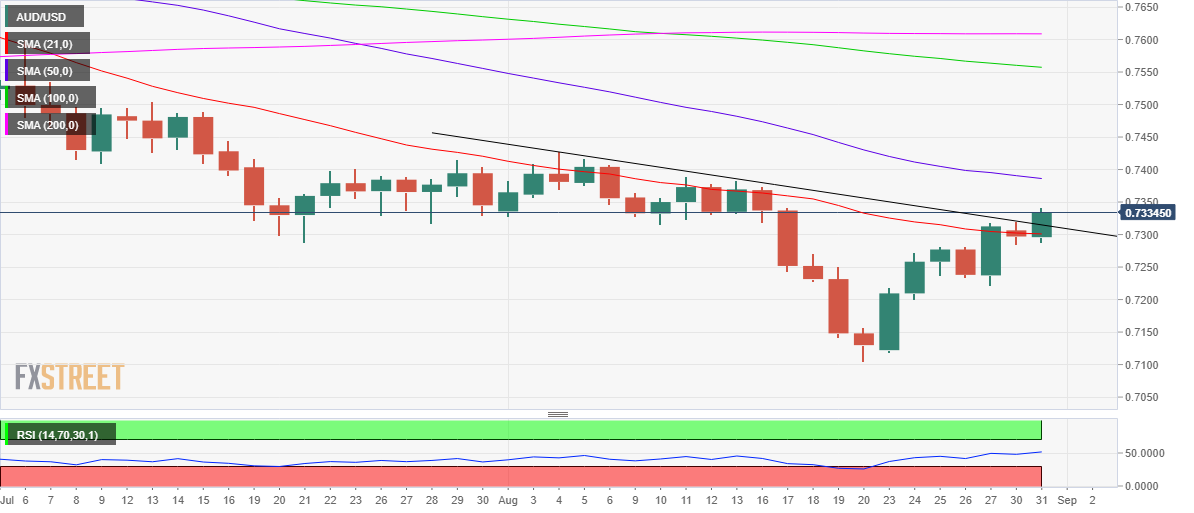
As investors brace for the Australian Q2 GDP release, AUD/USD is sitting at two-week highs of 0.7342 amid a persistent downbeat tone seen around the US dollar. The greenback continues to feel the heat of Fed Chair Jerome Powell’s dovish take. Markets await the US CB Consumer Sentiment data, which could save the day for the USD bulls. However, the aussie pair will continue to watch out for the US dollar’s price action and the prevalent market mood, which could, in turn, impact the aussie dollar’s reaction to the GDP data.
AUD/USD: Daily chart
From a technical perspective, the daily chart shows that AUD/USD has taken out the three-week-old falling trendline resistance at 0.7314 on Tuesday. The aussie now awaits a daily close above the latter for bullish confirmation.
On a GDP big beat and extension of the greenback’s weakness, the aussie could extend the upside break towards the bearish 50-Daily Moving Average (DMA) at 0.7386, above which a test of the 0.7400 mark would be inevitable. The Relative Strength Index (RSI) has pierced through the 50.00 level to trend into the bullish zone, allowing room for more upside. If the Australian economy contracts in Q2, then it could recall the AUD sellers, knocking off the currency pair towards 0.7250.
Premium
You have reached your limit of 3 free articles for this month.
Start your subscription and get access to all our original articles.
Author
Dhwani Mehta
FXStreet
Residing in Mumbai (India), Dhwani is a Senior Analyst and Manager of the Asian session at FXStreet. She has over 10 years of experience in analyzing and covering the global financial markets, with specialization in Forex and commodities markets.