Asia week ahead: RBA rate decision and key data on China, Japan, Korea, Taiwan, and Philippines

The Reserve Bank of Australia is expected to hold rates steady. Other highlights of the week include key data on China, Japan, South Korea, Taiwan and the Philippines.
Australia: RBA expected to maintain the current rate
We expect the Reserve Bank of Australia to hold rates steady on Tuesday after third-quarter CPI inflation came in above expectations -- and the 2.5% midpoint of its target range. That's likely to outweigh a surprise uptick in September's unemployment rate, even as other labour market indicators still point to underlying strength.
South Korea: Inflation expected to rise, while export momentum remains strong
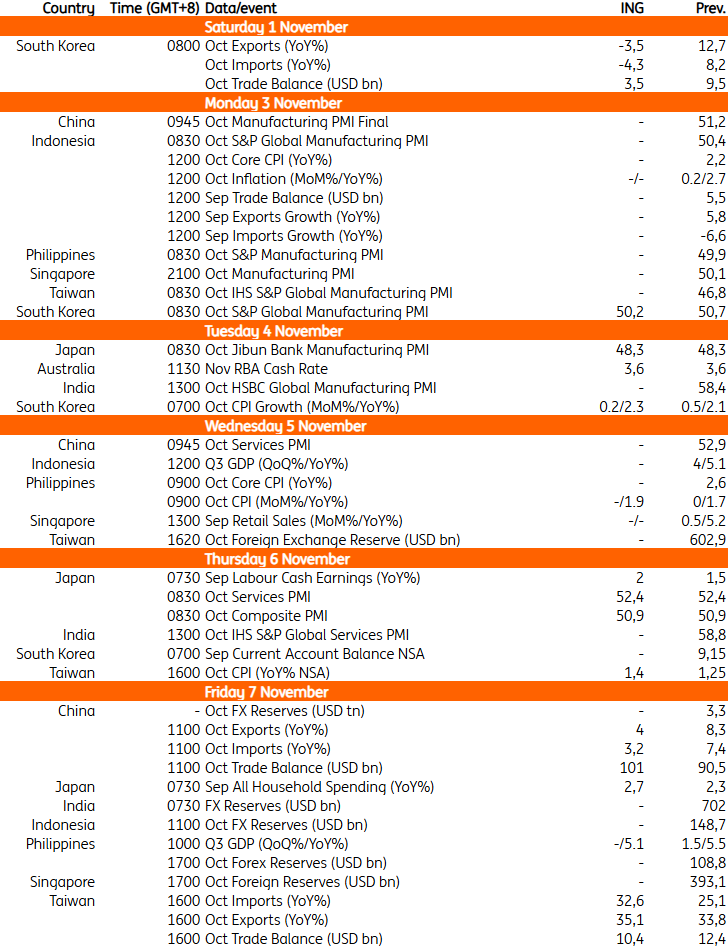
South Korean exports are expected to decline by 3.5% year-on-year in October, primarily due to an unfavourable calendar effect. Underlying momentum should appear robust, with a 6% increase in daily average exports. Semiconductors and ship exports are expected to remain strong, while auto exports are likely to decline. Although we expect the purchasing managers’ index to decline slightly, as it was surveyed before the recent trade agreement, we believe the recovery in manufacturing is likely to continue. Consumer price inflation is expected to rise to 2.3% YoY in October as gasoline and manufactured food prices increase.
China: Trade growth expected to slow down
Last week’s much-hyped Xi-Trump meeting led to a de-escalation of bilateral tensions. Next week should be a calmer one in China. The main data point will be the trade data on Friday. We expect export growth to slow to 4.0% YoY, and imports to edge down to 3.2% YoY, leading to a rebound of the trade surplus to $101bn.
Taiwan: Inflation expected to remain below target while robust trade growth continues
Taiwan releases inflation and trade data. CPI inflation has been below target for the past 5 months. This should continue in October with only a moderate uptick to 1.4% YoY expected. Trade is expected to continue to post strong growth, with exports up 35.1% YoY and imports up 32.6% YoY for a trade surplus of $10.4bn.
Japan: Labor earnings and household spending expected to grow despite inflation
Japanese labour earnings and household spending figures are projected to increase, suggesting that consumption remains stable despite elevated inflation levels. Strong wage negotiation outcomes may continue to contribute to higher wages, and the asset market rally could influence household spending.
Philippines: GDP growth expected to slow down sharply
We expect third-quarter Philippine GDP growth to slow sharply to 5.1%, primarily due to a significant decline in government spending. This follows corruption scandals associated with flood control projects. Business sentiment also took a hit in the third quarter, with tariff uncertainties adding to the drag on growth.
Key events in Asia next week
Read the original analysis: Asia week ahead: RBA rate decision and key data on China, Japan, Korea, Taiwan, and Philippines
Author

ING Global Economics Team
ING Economic and Financial Analysis
From Trump to trade, FX to Brexit, ING’s global economists have it covered. Go to ING.com/THINK to stay a step ahead.

















