Why Lowe’s is up and home depot down
-
Lowe’s moves higher while Home Depot moves lower on similar results.
-
Lowe’s position with DIY has it set up for a better 2023.
-
Lowe’s dividend is more attractive because the growth is more reliable.


Lowe’s (NYSE: LOW) is up strong following a solid report that was foreshadowed by Home Depot (NYSE:HD). Home Depot gave a better-than-expected report driven in large part by strength in the DIY channels and Lowe’s has more exposure to those channels.
With the coming (current) quarter expected to be weak, inflation still on the rise, and interest rates as well it is logical to think there will be a slowdown in professional demand. The latest report from D.R. Horton, the nation’s largest home builder, is more evidence of the same.
Negative sales growth and declining backlog point not just to slower professional demand but a potentially deep contraction in it; that’s why Lowe’s is up and Home Depot is down. That, and it offers value while paying a healthier-looking dividend as well.
Lowe’s outshines home depot in Q3
Lowe’s Q3 results matched Home Depot’s in that it beat the top and bottom line consensus estimates but it outshines its competitor in the arena of guidance. The company was able to raise its guidance for revenue and earnings while Home Depot only reaffirmed the prior outlook.
At the same time, Lowe’s also increased its share repurchased plans for the year by $1 billion or about 0.75% of the pre-release market cap.
Regarding the Q3 results, Lowe’s revenue came in at $23.48 billion, up 2.4% from last year, and beat the Marketbeat.com consensus figure by 140 basis points as well.
The gains were driven by a 2.2% increase in system-wide comps and a 3.0% increase in the US which is surprisingly driven by a 19% increase in the Pro channel. The DIY channel is down on a YOY basis compared to last year’s stimulated quarter but the company reports “trends are improving”.
Lowe’s earnings were strong as well. The company reported a large decline in GAAP margin but this is due to a non-cash asset charge related to the Canadian business and had little impact on actual operations.
The adjusted margin improved “substantially” on a sequential basis and helped to drive outperformance on the bottom line and improved guidance as well.
On the bottom line, Lowe’s reported $3.27 in adjusted EPS which is up nearly 20% YOY, aided by share repurchases, and $0.18 or 860 bps better than expected. As for the guidance, the company raised its outlook for FY2022 earnings to a range with the low end a nickel above the previous high end and more than a dime above the consensus estimate.
Lowe’s, a more reliable dividend grower
Home Depot pays a higher yield at roughly 2.45% but there are factors that make Lowe’s payment far more attractive. Not only does Lowe’s 2.0% come at a lower valuation, 15X compared to 18X, but it is a more reliable dividend grower.
Home Depot has been increasing its payout for only 12 years because it did not issue any increases during the great recession. Lowe’s, on the other hand, has increased its payout every year without fail for the last 59 years and the metrics suggest a few more decades are coming at least.
The company’s payout ratio is low at 27% and the balance sheet is healthy so there is no reason to think distribution increases will end any time soon.
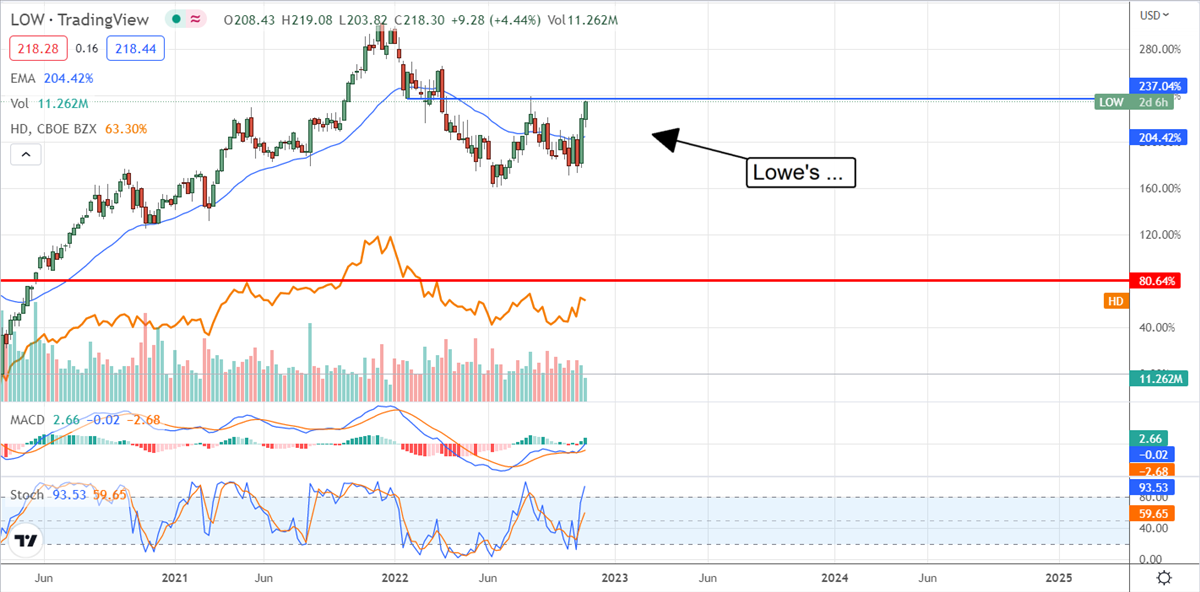
Lowe’s shares rose nearly 5.0% in the wake of the Q3 report and they may move higher. Home Depot shares, on the other hand, are capped at the post-release high and seem to be having a hard time holding the level.
If the market follows through on this disparity, Lowe’s shares should move up and outside the recent trading range while Home Depot will continue to lag as it has done since the pandemic bottom.
Author
Jacob Wolinsky
ValueWalk
Jacob Wolinsky is the founder of ValueWalk, a popular investment site. Prior to founding ValueWalk, Jacob worked as an equity analyst for value research firm and as a freelance writer. He lives in Passaic New Jersey with his wife and four children.