Walmart finishes last among Dow Jones members on Friday as tariffs frustrate global supply chain
- Walmart ends Friday session down 3.1%.
- Executives are getting pushback from Chinese suppliers when asking for discounts.
- Trump paused most tariffs on Canada and Mexico this week but left in place those on China.
- NFP miss shows that labor market might be at outset of downturn.


The US stock market seesawed on Friday, pulling back in the morning session before advancing in the afternoon. The market continued its downward spiral at the release of US Nonfarm Payrolls (NFP) for February that came in below forecast but later recovered after a Federal Reserve (Fed) Governor seemed to be at ease with the labor market data.
All three major US indices closed higher on Friday but were down for the week. In the case of the S&P 500 and the NASDAQ Composite, it was the third week of losses.
While most names in the Dow Jones Industrial Average (DJIA) gained in the session, Walmart (WMT) was a notable outlier as it performed the worst among all index members. WMT stock shed 3.1% on Friday, ending the session at $91.67.
Walmart stock news
Walmart stock lost more than 7% this week and has been shifting lower since delivering tepid guidance three weeks ago.
A major uncertainty at the moment is President Donald Trump’s tariffs. After commencing with 25% tariffs on imports from Canada and Mexico on Tuesday, Trump then paused them for one month on the auto industry on Wednesday and then on Thursday passed that one-month pause onto all goods covered by his first-term trade agreement: The United States-Mexico-Canada Agreement (USMCA).
To put it simply, Trump’s tariff policy changes so frequently that it’s possibly causing more anxiety than if he had just left it in place. One nation where he did not alter his policy this week was China, where a new 10% tariff added onto the 10% levy issued in February.
Walmart sources a large segment of its products from China and has operations in both Canada and Mexico. This means that Trump’s fluctuating tariff policy could upend Walmart’s full-year results more than most companies.
Bloomberg reported on Thursday that Walmart executives were having trouble shifting Trump’s 20% tariff onto Chinese manufacturers. The suppliers were said to be pushing back strongly against any notion of cutting prices by 10% in order to share the burden of Trump’s tariffs.
Walmart claims to source two-thirds of its goods from within the US, so most of its offerings should be immune. However, US suppliers that source inputs from abroad might need to raise prices as well.
Despite Canadian tariffs being largely paused until April 2, Walmart could face a backlash as headlines claim that Canadian customers are already informally boycotting US goods and firms.
Nonfarm Payrolls miss forecast, unemployment rises
The February NFP came in at 151K new jobs in the US economy, which missed the 160K forecast but was above January’s figure. However, January’s figure was revised down from 143K to 125K. The Unemployment Rate also rose by a tenth of a percent to 4.1%.
Many investors actually liked the lower jobs number with the reasoning that it might allow the Fed to cut interest rates sooner. In a speech on Friday, Fed Governor Adriana Kugler called it a “solid number” in light of the Trump administration’s largescale federal employment layoffs.
Kugler argued, however, that the tariffs could slow economic growth and said she would be paying special attention to inflation expectations and the labor market.
In his own remarks, Fed Chair Jerome Powell said Trump’s tariffs were heightening uncertainty but said the bank wouldn’t be quick to trim interest rates.
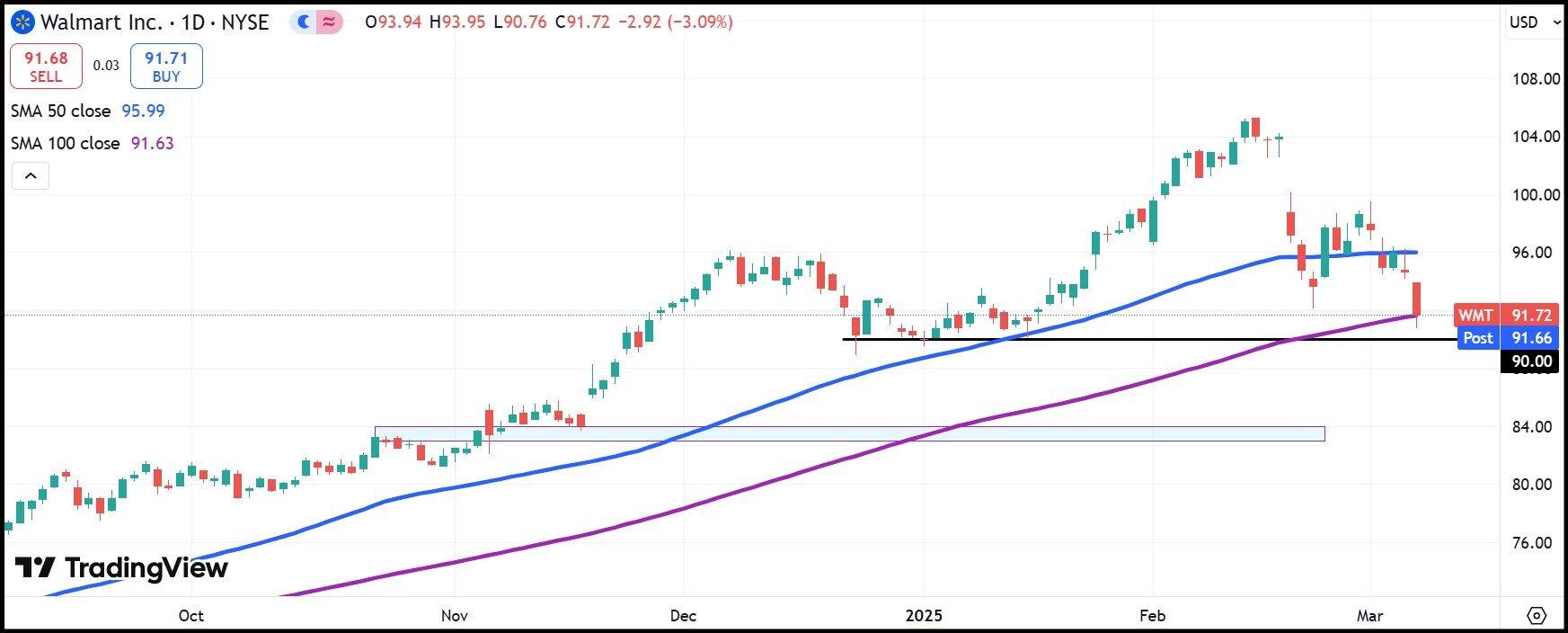
WMT daily stock chart
Premium
You have reached your limit of 3 free articles for this month.
Start your subscription and get access to all our original articles.
Author
Clay Webster
FXStreet
Clay Webster grew up in the US outside Buffalo, New York and Lancaster, Pennsylvania. He began investing after college following the 2008 financial crisis.

















