|

USD/MXN: Mexican Peso eyes biggest monthly decline since May 2008

  • The Mexican Peso is eyeing the biggest monthly loss since May 2008. 
  • Mexico has declared health emergency as the number of virus cases has crossed above 1,000.
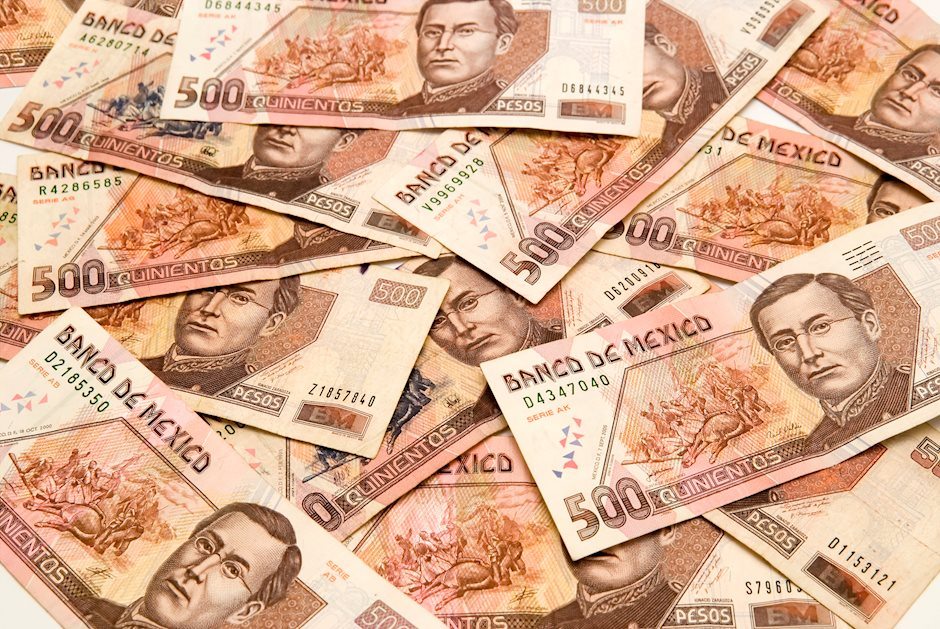
Mexico's Peso (MXN) is on track to register its biggest monthly loss in over a decade.

The MXN is currently trading at 23.8141 per US dollar, representing a 21% decline from the opening rate of 15.5995 per dollar observed on March 3. The currency last witnessed over a 21 percent decline in May 2008.

The latest double-digit decline could be associated with the coronavirus outbreak across the globe and in Mexico and the resulting fears of a global recession. Further, the oil price decline added to MXN's woes. The black gold is currently reporting over 50 percent losses on a month-to-date basis.

Mexico declares emergency

Mexico's Peso could continue to lose ground in the near-term as the government has announced a health emergency in response to the number of coronavirus cases passing 1,000.

Health officials reported a total of 1,094 cases of coronavirus on Monday, up from 993 a day earlier and 28 deaths from the virus, up from 20, according to Reuters News.

Mexico has also extended a suspension of non-essential activities to April 30. That could cause a substantial decline in the activity across various sectors of the economy.

Technical levels

USD/MXN

Overview
Today last price23.8141
Today Daily Change0.0401
Today Daily Change %0.17
Today daily open23.7905
 
Trends
Daily SMA2022.4003
Daily SMA5020.2614
Daily SMA10019.6849
Daily SMA20019.5329
 
Levels
Previous Daily High24.5599
Previous Daily Low23.5003
Previous Weekly High25.459
Previous Weekly Low22.8617
Previous Monthly High19.895
Previous Monthly Low18.5151
Daily Fibonacci 38.2%24.1551
Daily Fibonacci 61.8%23.9051
Daily Pivot Point S123.3406
Daily Pivot Point S222.8907
Daily Pivot Point S322.2811
Daily Pivot Point R124.4001
Daily Pivot Point R225.0098
Daily Pivot Point R325.4597

Author

Omkar Godbole

Omkar Godbole

FXStreet Contributor

Omkar Godbole, editor and analyst, joined FXStreet after four years as a research analyst at several Indian brokerage companies.


More from Omkar Godbole
Share:

Editor's Picks

EUR/USD keeps the bid bias just over 1.1800

EUR/USD has started the week on a positive foot, hovering around the 1.1800 region in the latter part of Monday’s session. The pair’s recovery comes on the back of a decent decline in the US Dollar, as investors keep their attention on the evolving US–EU trade relationship after President Trump’s announcement of sweeping global tariff hikes.

GBP/USD looks stuck around 1.3500 amid firm gains

GBP/USD is pushing further north on Monday, revisiting the 1.3500 hurdle and beyond. Cable’s uptick is largely being fuelled by the broader softness in the Greenback, amid lingering uncertainty around tariffs.

Gold pops above $5,200, four-week highs

Gold is holding onto its bullish tone on Monday, reaching new multi-week highs just past the $5,200 mark per troy ounce. Fresh trade-war concerns, coupled with rising geopolitical tensions in the Middle East, are keeping demand for the yellow metal well on the rise.

Crypto Today: Bitcoin, Ethereum, XRP intensify sell-off as tariff uncertainty weighs

Bitcoin, Ethereum and Ripple are trading amid increasing selling pressure at the time of writing on Monday, as investors react to fresh trade uncertainty over US President Donald Trump’s push for more tariffs.

Supreme Court nixes tariffs, Trump teases 15% global tariff

On February 20th, the Supreme Court ruled that Trump’s global tariffs under IEEPA authority were unconstitutional, effectively nullifying the framework. However, the relief was short-lived. Within hours, Trump floated a 15% blanket tariff under an alternative legal authority.

XRP recovers slightly as bearish sentiment dominates crypto market

Ripple is rising above $1.40 at the time of writing on Monday amid fresh tariff-triggered headwinds in the broader cryptocurrency market. The sell-off to $1.33, the token’s intraday low, can be attributed to macroeconomic uncertainty, geopolitical tensions and risk-averse sentiment among other factors.