|

USD/JPY slips toward 140.50 as Fed pressure builds

  • USD/JPY dives to the 140.50 region amid renewed political threats to Fed independence
  • Trump’s remarks intensify fears of institutional instability, weighing further on the US Dollar
  • Momentum signals remain bearish, with next key support eyed near 139.60

The USD/JPY pair slumped on Monday during North American trading, falling sharply toward the 140.50 mark as the broader market reacted to escalating concerns surrounding the Federal Reserve’s independence. The Greenback extended its downtrend after US President Donald Trump reiterated his displeasure with Fed Chair Jerome Powell, accusing him of politically motivated rate adjustments in late 2024. The situation has sparked intense speculation over Powell’s future and raised doubts about the Fed's autonomy.

Meanwhile, the US Dollar Index (DXY) trades deep in the red, testing the 98.50 zone for the first time in three years. Amid this backdrop, demand for the Japanese Yen has strengthened. Investors are seeking safer assets as global uncertainty grows and confidence in US monetary leadership deteriorates. Despite Trump’s 90-day pause on new reciprocal tariffs, the absence of a clear trade policy path continues to unsettle markets.

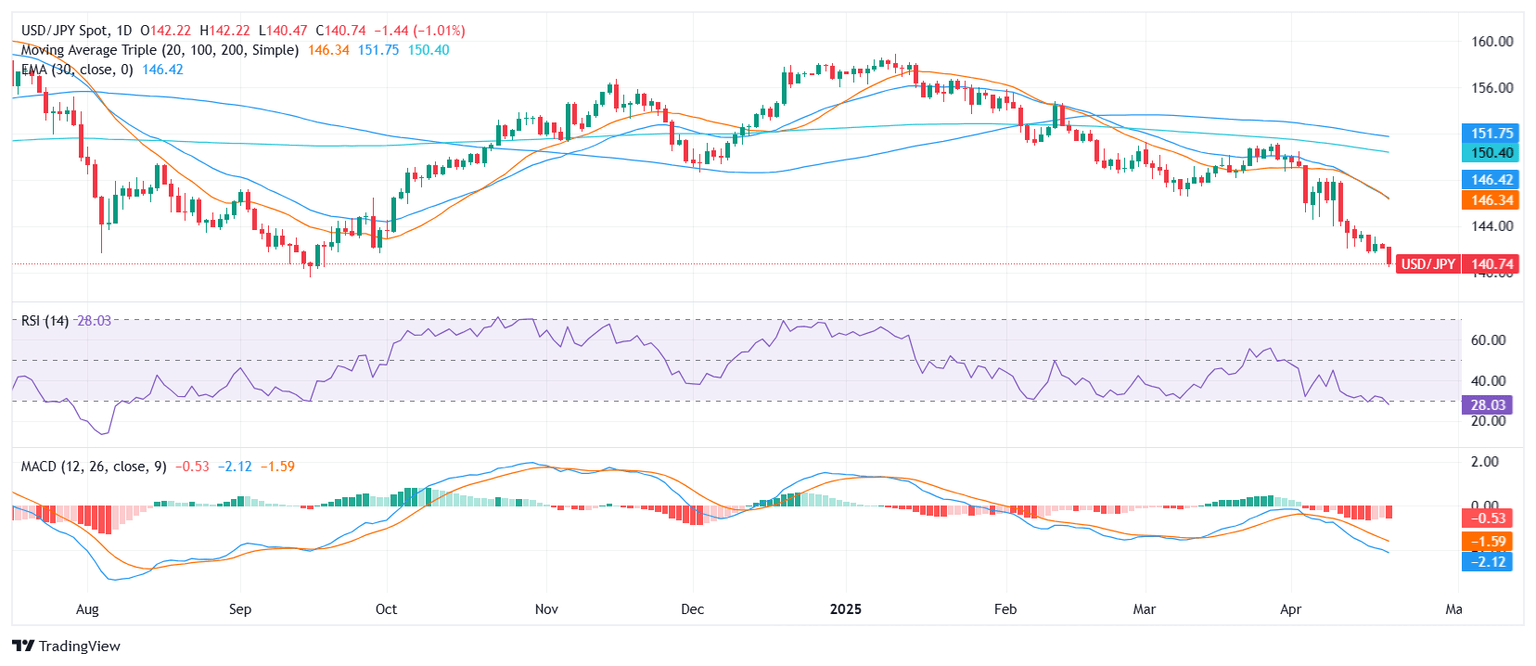
On the technical front, USD/JPY is flashing a bearish signal. Price action collapsed through the prior week’s low at 141.64 and now targets the June 2023 trough near 139.60. The 140.00 level remains a pivotal psychological support zone. A clean break below this threshold could expose downside risk toward the mid-130s in the medium term. Indicators support this outlook, with MACD printing bearish divergence and the RSI slipping into oversold territory. Key resistance levels are seen near 142.20, followed by 143.40 and 144.60.

Daily chart
Author

Patricio Martín

Patricio is an economist from Argentina passionate about global finance and understanding the daily movements of the markets.


More from Patricio Martín
Share:

Markets move fast. We move first.

Orange Juice Newsletter brings you expert driven insights - not headlines. Every day on your inbox.

By subscribing you agree to our Terms and conditions.

Editor's Picks

EUR/USD trades with negative bias around 1.1730 amid recovering USD; downside seems limited

The EUR/USD pair kicks off the new week on a softer note, though it remains within striking distance of the highest level since early October, touched last Thursday. Spot prices currently trade around the 1.1730 region, down less than 0.10% for the day.

GBP/USD holds steady above mid-1.3300s as traders await key data and BoE this week

The GBP/USD pair remains on the defensive during the Asian session on Monday, though it lacks bearish conviction and holds above the 200-day Simple Moving Average pivotal support. Spot prices currently trade around the 1.3360 region, nearly unchanged for the day.

Gold regains traction toward $4,350 in the final full week of 2025

Gold price picks up bids once again toward $4,350 in Asian trading on Monday. The precious metal extends its upside to the highest since October 21 amid the prospect of interest rate cuts by the US Federal Reserve next year. The delayed US Nonfarm Payrolls report for October will be in the spotlight later on Tuesday. 

Top Crypto Losers: DASH, SPX, PENGU – Privacy and meme coins lose ground

Altcoins, including Dash, SPX6900, and Pudgy Penguins, are leading losses as the broader cryptocurrency market remains cautious ahead of the macroeconomic data releases, such as the US Nonfarm payroll report, CPI data, and the Bank of Japan’s rate-hike decision.

Big week ends with big doubts

The S&P 500 continued to push higher yesterday as the US 2-year yield wavered around the 3.50% mark following a Federal Reserve (Fed) rate cut earlier this week that was ultimately perceived as not that hawkish after all. The cut is especially boosting the non-tech pockets of the market.

Aave Price Forecast: AAVE primed for breakout as bullish signals strengthen

Aave (AAVE) price is trading above $204 at the time of writing on Friday and approaching the upper boundary of its descending parallel channel; a breakout from this structure would favor the bulls.