USD/JPY loses ground on Monday after intervention talk
- USD/JPY drops slightly after intervention talk from Japan’s chief of FX, Masato Kanda.
- Recent weakness in the Yen should be attributed to speculation not fundamentals, Kanda said.
- The authorities may intervene to correct the situation, propping up the Yen.


USD/JPY is trading down almost a tenth of a percent in the 151.300s at the start of the new week. It has lost ground after intervention talk from Japan’s currency chief, Masato Kanda heightens speculation the Japanese authorities are about to use market operations to prop up their currency.
Kanda, the vice-finance minister for international affairs was responding to the weakness experienced by the Yen, which remains at historic lows, after the Bank of Japan’s (BoJ) historic decision to raise interest rates for the first time since 2007 at their policy meeting last Tuesday. The move seemed highly unexpected since higher interest rates are usually a factor that strengthens not weakens currencies.
"The current weakening of the Yen is not in line with fundamentals and is clearly driven by speculation,” Kanda told reporters Monday. "We will take appropriate action against excessive fluctuations, without ruling out any options,” he said, according to a report in the Japan Times.
When questioned about the possibility of the authorities engaging in direct intervention, or Yen-buying in the open market Kanda said, “We are always prepared.”
USD/JPY has reached a level, above 150.000, where historically the BoJ has been known to intervene to prop it up, as was the case in 2022 when the currency hit 151.950 against the US Dollar.
Data from the currency futures market seems to support Kanda’s view. During the week of the BoJ’s March meeting, speculators, such as hedge funds, actually increased their bearish (short) bets on the Yen, according to data from the Commodity Futures Trading Commision (CFTC), despite widespread rumors the BoJ was going to hike rates.
From a technical perspective the USD/JPY has formed a bearish Hanging Man Japanese candlestick pattern (circled) on Thursday, suggesting a heightened risk of a short-term reversal and pullback.
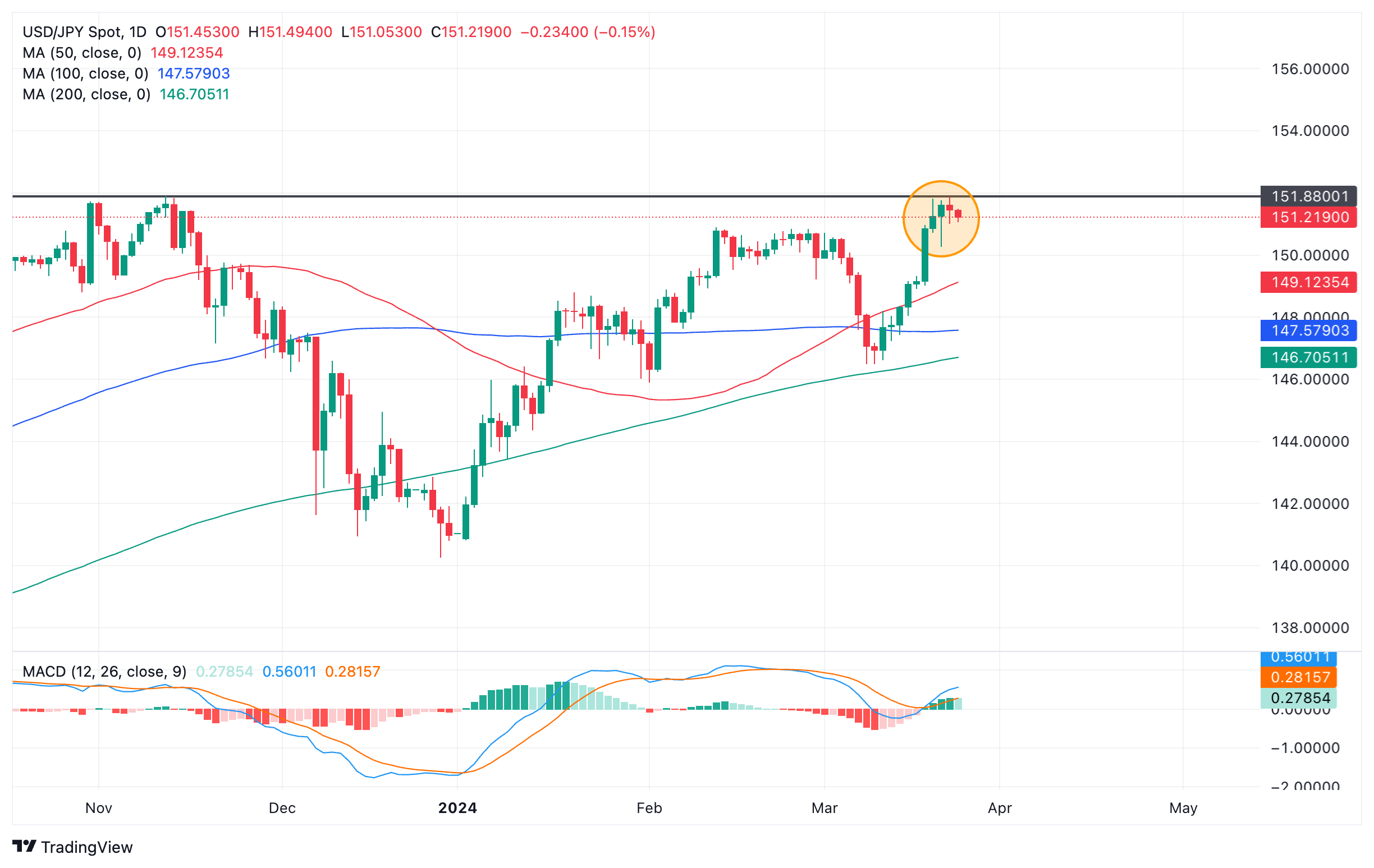
US Dollar versus Japanese Yen: Daily chart
The combination of the fact that the pair has tested the level of the 2023 and 2022 intervention highs, and at the same time formed the bearish pattern increases the possibility of a decline following on.
Friday’s red candlestick adds confirmation to the Hanging Man from Thursday, and further increases the odds of more downside.
Japanese candlesticks are only short-term reversal patterns, however, so the move lower may be short-lived.
A continuation of the pullback might be expected to go as low as support at the 50-day Simple Moving Average (SMA) situated at 149.123.
Alternatively, a recovery and clear break above 152.000 would suggest bulls continue to have the upper hand and the BoJ is reluctant or unable to intervene sufficiently to move the exchange rate.
Such a move, however, would be unlikely to rise much higher given the forces pitched against it, with a possible target at the next whole number of 153.000.
Author
Joaquin Monfort
FXStreet
Joaquin Monfort is a financial writer and analyst with over 10 years experience writing about financial markets and alt data. He holds a degree in Anthropology from London University and a Diploma in Technical analysis.