USD/JPY drops as weak US data fuels rate cut bets, Yen strengthens
- US Consumer Confidence plunges to an 8-month low, inflation fears rise.
- Markets now price in 58 bps of Fed rate cuts, up from 40 bps last week.
- BoJ watching services inflation as Ueda signals possible rate hikes.


The Japanese Yen (JPY) extended its gains versus the US Dollar (USD) on Tuesday, which was helped by the fall of US Treasury bond yields as consumer confidence deteriorated further, according to the Conference Board. At the time of writing, the USD/JPY trades at 149.02, down 0.46 at the brisk of clearing the 149.00 handle.
USD/JPY nears 149.00 as falling yields, Fed expectations pressure the dollar
Data revealed earlier showed that Consumer Confidence in February plunged to an eight-month low from 104.1 to 98.3. Digging more into the data, inflation expectations rose to 6% from 5.2% over a 12-month period.
Of note is that tariffs were mentioned in the survey at levels not seen in six years. Today’s data and the University of Michigan survey show that Americans are becoming pessimistic about the economic outlook.
As the US economy weakened, expectations that the Fed would cut rates jumped. Money markets had priced in that the Federal Reserve (Fed) would ease policy by 58 basis points (bps), up from 40 bps last week, revealed data from Prime Market Terminal.
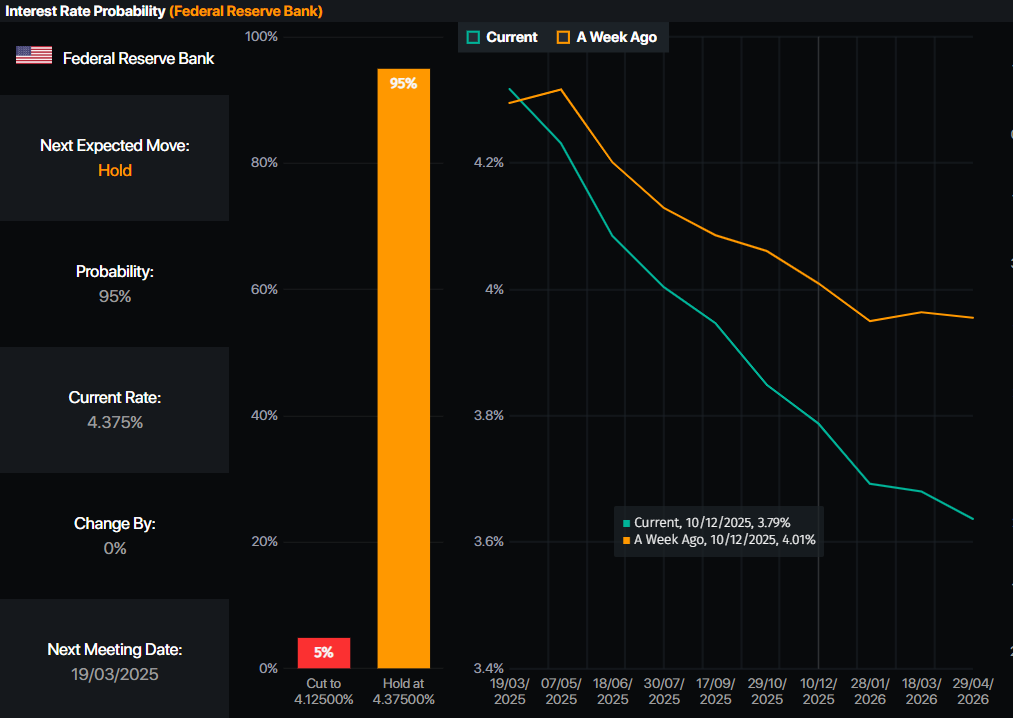
Source: Prime Market Terminal
Consequently, the yield of the US 10-year Treasury note is plummeting ten basis points (bps) to 4.294%.
Richmond Fed President Thomas Barkin stated that he is adopting a wait-and-see approach on interest rate adjustments, emphasizing the need for clear evidence that inflation is steadily moving toward the Fed’s 2% target before considering any policy changes.
In Japan, prices paid by producers accelerated to 3.1% YoY as prices for services continued to rise. The Bank of Japan (BoJ) is watching services inflation to gauge prospects of sustained wage gains. BoJ Governor Kazuo Ueda signaled his willingness to continue raising rates if wage growth accelerates and supports consumer spending, reinforcing the central bank’s data-dependent approach to monetary policy.
Ahead, the Japanese economic docket would feature the Coincident Index Final reading for December, alongside the Leading Economic Index.
USD/JPY Price Forecast: Technical outlook
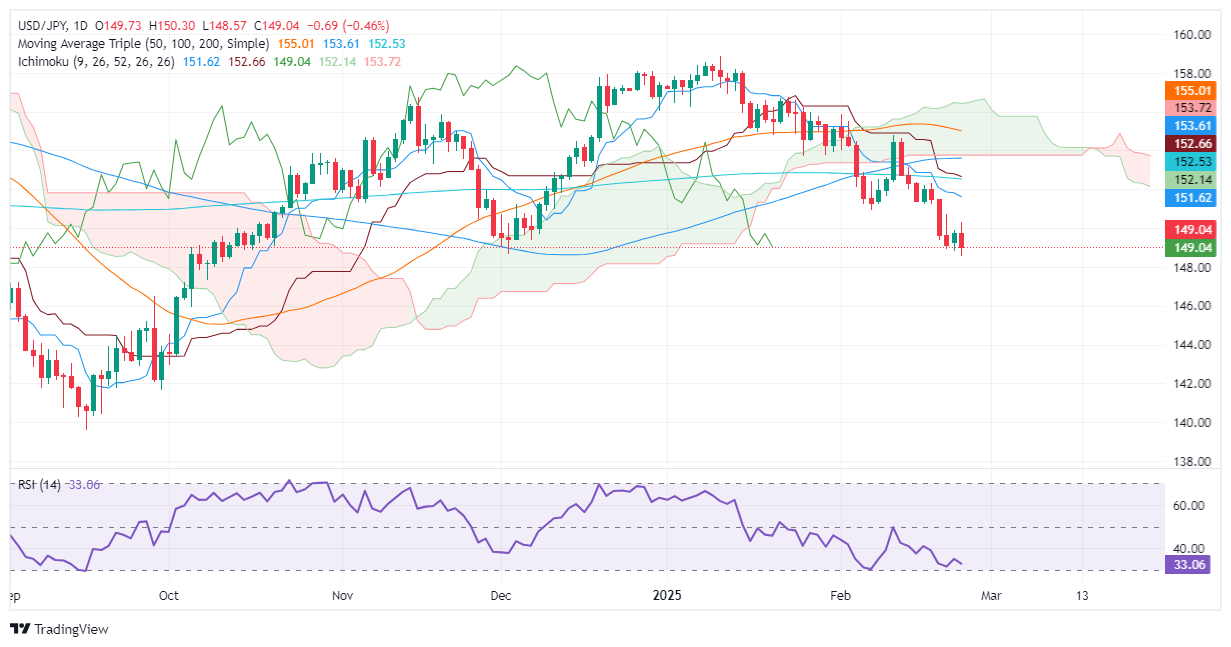
The USD/JPY daily chart depicts the pair as downward biased, though it seems that sellers cannot drive prices on a closing basis below the December 3 low of 148.64. In that outcome, the next support would be the October 4 daily low of 145.92 ahead of the September 30 swing low of 141.64.
Conversely, if USD/JPY climbs past 150.00, look for further upside as buyers could be poised to challenge the Tenkan-sen at 151.62.
Japanese Yen FAQs
The Japanese Yen (JPY) is one of the world’s most traded currencies. Its value is broadly determined by the performance of the Japanese economy, but more specifically by the Bank of Japan’s policy, the differential between Japanese and US bond yields, or risk sentiment among traders, among other factors.
One of the Bank of Japan’s mandates is currency control, so its moves are key for the Yen. The BoJ has directly intervened in currency markets sometimes, generally to lower the value of the Yen, although it refrains from doing it often due to political concerns of its main trading partners. The BoJ ultra-loose monetary policy between 2013 and 2024 caused the Yen to depreciate against its main currency peers due to an increasing policy divergence between the Bank of Japan and other main central banks. More recently, the gradually unwinding of this ultra-loose policy has given some support to the Yen.
Over the last decade, the BoJ’s stance of sticking to ultra-loose monetary policy has led to a widening policy divergence with other central banks, particularly with the US Federal Reserve. This supported a widening of the differential between the 10-year US and Japanese bonds, which favored the US Dollar against the Japanese Yen. The BoJ decision in 2024 to gradually abandon the ultra-loose policy, coupled with interest-rate cuts in other major central banks, is narrowing this differential.
The Japanese Yen is often seen as a safe-haven investment. This means that in times of market stress, investors are more likely to put their money in the Japanese currency due to its supposed reliability and stability. Turbulent times are likely to strengthen the Yen’s value against other currencies seen as more risky to invest in.
Author
Christian Borjon Valencia
FXStreet
Christian Borjon began his career as a retail trader in 2010, mainly focused on technical analysis and strategies around it. He started as a swing trader, as he used to work in another industry unrelated to the financial markets.