USD/INR tumbles after RBI cuts repo rate by 25 bps to 6.25%
- The Indian Rupee recovers in Friday’s early European session.
- RBI’s MPC cut the repo rate by 25 bps to 6.25% in the February meeting on Friday.
- Rising RBI rate cut bets, weakness of Asian peers and uncertainties could undermine the INR.
- The US labour market data for January will be closely watched later on Friday.


The Indian Rupee (INR) rebounds after falling to a fresh all-time low in the previous session. The Reserve Bank of India’s (RBI) Monetary Policy Committee (MPC) decided to cut the policy repo rate by 25 basis points (bps) to 6.25% for the first time in nearly five years.
The local currency remains vulnerable amid a broader decline among Asian currencies, the uncertainties surrounding US trade tariffs and continued portfolio outflows. Nonetheless, the routine intervention by the RBI to sell US Dollar via state-run banks might help limit the INR’s losses. Later on Friday, investors await the US labour market data for January, including Nonfarm Payrolls (NFP), Unemployment Rate and Average Hourly Earnings.
Indian Rupee drifts higher after RBI rate decision
- RBI Governor Sanjay Malhotra said "Inflation has declined supported by favourable outlook on food. It is expected to moderate further gradually aligning with the target.”
- The RBI projected headline inflation for FY25 at 4.8%, while the projection for FY26 remains unchanged at 4.2%.
- The Indian central bank estimates real GDP growth for the next year to be at about 6.7% for the first quarter, 6.7% for the second quarter, 7% for the third quarter, and 6.5% for the fourth quarter.
- The stock market tumbled after the RBI's rate cut announcement. The Sensex declined 192.14 points, or 0.25%, to 77,866.02, while the Nifty fell 73.05 points, or 0.31%, to 23,530.30.
- Chicago Fed President Austan Goolsbee noted on Thursday that the uncertainty makes the environment for the Fed foggier, a reason to slow the pace of cuts.
- Dallas Fed President Lorie Logan said that while inflation progress has been significant, the US labor market remains far too firm to push the Fed into rate cuts any time soon.
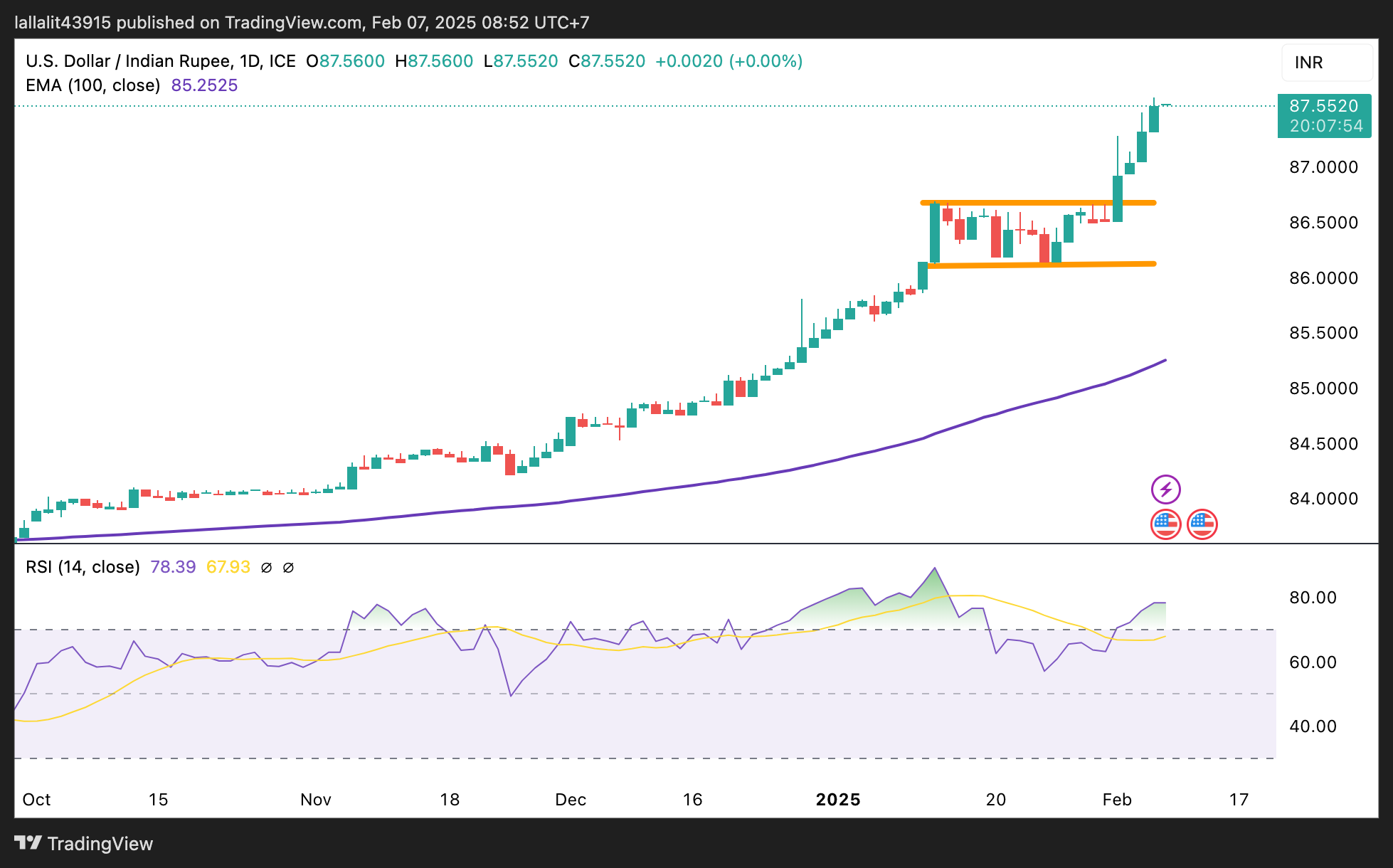
USD/INR paints a positive picture, overbought RSI warrants caution for bulls in the short term
The Indian Rupee trades on a positive note on the day. The constructive outlook of the USD/INR pair remains intact as the price holds above the key 100-day Exponential Moving Average (EMA) on the daily chart. However, the 14-day Relative Strength Index (RSI) reaches overbought territory beyond the 70.00 mark, potentially signaling a temporary weakness or further consolidation in the near term.
The immediate resistance level for USD/INR emerges at 87.62, an all-time high. Sustained trading above this level could pave the way to the 88.00 psychological level.
On the downside, the initial support level for the pair is located in the 87.05-87.00 zone, representing the low of February 5 and the round mark. A breach of the mentioned level could drag USD/INR down to 86.51, the low of February 3.
Interest rates FAQs
Interest rates are charged by financial institutions on loans to borrowers and are paid as interest to savers and depositors. They are influenced by base lending rates, which are set by central banks in response to changes in the economy. Central banks normally have a mandate to ensure price stability, which in most cases means targeting a core inflation rate of around 2%. If inflation falls below target the central bank may cut base lending rates, with a view to stimulating lending and boosting the economy. If inflation rises substantially above 2% it normally results in the central bank raising base lending rates in an attempt to lower inflation.
Higher interest rates generally help strengthen a country’s currency as they make it a more attractive place for global investors to park their money.
Higher interest rates overall weigh on the price of Gold because they increase the opportunity cost of holding Gold instead of investing in an interest-bearing asset or placing cash in the bank. If interest rates are high that usually pushes up the price of the US Dollar (USD), and since Gold is priced in Dollars, this has the effect of lowering the price of Gold.
The Fed funds rate is the overnight rate at which US banks lend to each other. It is the oft-quoted headline rate set by the Federal Reserve at its FOMC meetings. It is set as a range, for example 4.75%-5.00%, though the upper limit (in that case 5.00%) is the quoted figure. Market expectations for future Fed funds rate are tracked by the CME FedWatch tool, which shapes how many financial markets behave in anticipation of future Federal Reserve monetary policy decisions.
Author
Lallalit Srijandorn
FXStreet
Lallalit Srijandorn is a Parisian at heart. She has lived in France since 2019 and now becomes a digital entrepreneur based in Paris and Bangkok.