|

USD/CNH Price Analysis: Retreats inside bull flag, 6.9150 is the trigger

  • USD/CNH fades the previous day’s corrective bounce from the weekly bottom but stay inside a bullish chart pattern.
  • Steady RSI, sustained trading beyond fortnight-old support line, 50-SMA also favor buyers.
  • Sellers need validation from 6.8820, May’s high to retake control.
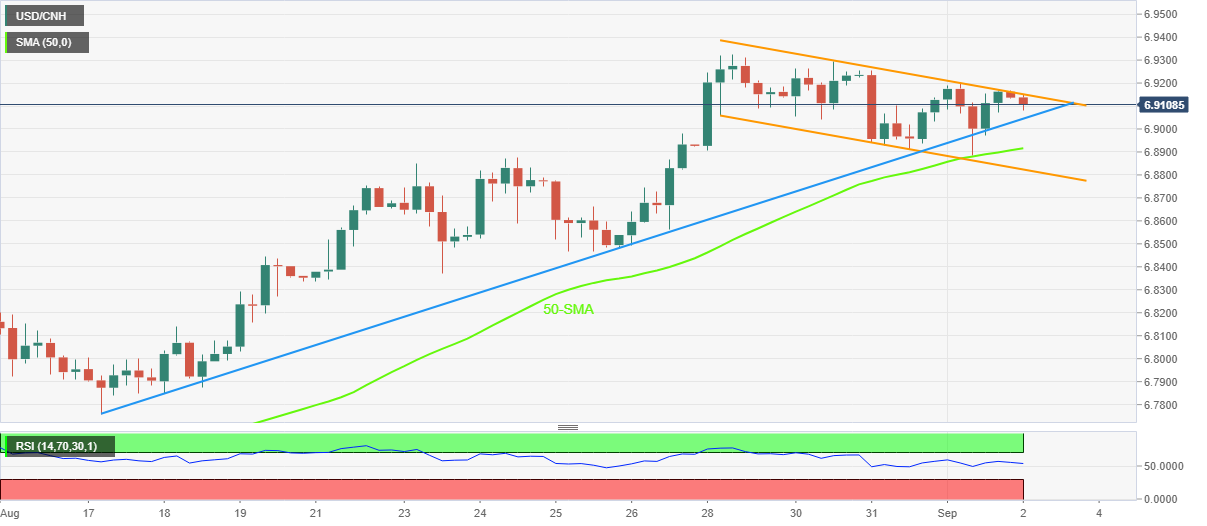
USD/CNH portrays a bullish chart pattern around the two-year high as it drops back to 6.9100 during Friday’s Asian session. In doing so, the offshore Chinese yuan (CNH) pair reverses the previous day’s rebound from the weekly low.

However, steady RSI and the quote’s ability to stay firmer past a two-week-old support line and the 50-SMA keep the USD/CNH buyers hopeful.

In addition to the aforementioned support line and the 50-SMA, close to 6.9050 and 6.8910 in that order, the lower line of the stated channel could also test the bearish bias around 6.8820.

Even if the USD/CNH bears conquer the 6.8820 support, the May 2022 peak surrounding 6.8385 could challenge the pair’s further downside.

Meanwhile, the pair’s upside moves need a sustained break of the 6.9150 hurdle to justify the bullish flag.

Following that, the recent multi-month high near 6.9325-30 could entertain the USD/CNH bulls before the theoretical target surrounding 7.0550. During the run-up, the 7.000 psychological magnet will be crucial to watch.

USD/CNH: Four-hour chart
Trend: Further upside expected

Additional important levels

Overview
Today last price6.9106
Today Daily Change-0.0046
Today Daily Change %-0.07%
Today daily open6.9152
 
Trends
Daily SMA206.8262
Daily SMA506.771
Daily SMA1006.7196
Daily SMA2006.5406
 
Levels
Previous Daily High6.9204
Previous Daily Low6.8882
Previous Weekly High6.8982
Previous Weekly Low6.8338
Previous Monthly High6.9326
Previous Monthly Low6.7164
Daily Fibonacci 38.2%6.9081
Daily Fibonacci 61.8%6.9006
Daily Pivot Point S16.8955
Daily Pivot Point S26.8758
Daily Pivot Point S36.8633
Daily Pivot Point R16.9277
Daily Pivot Point R26.9402
Daily Pivot Point R36.9599

Author

Anil Panchal

Anil Panchal

FXStreet

Anil Panchal has nearly 15 years of experience in tracking financial markets. With a keen interest in macroeconomics, Anil aptly tracks global news/updates and stays well-informed about the global financial moves and their implications.


More from Anil Panchal
Share:

Editor's Picks

EUR/USD clings to gains around 1.1800

EUR/USD manages to regain composure and retests the 1.1800 region in quite a positive start to the week. The pair’s bounce follows the US Dollar’s offered stance post-SCOTUS ruling ahead of important US data and Fedspeak on Tuesday.

GBP/USD looks stuck around 1.3500 amid firm gains

GBP/USD is pushing further north on Monday, revisiting the 1.3500 hurdle and beyond. Cable’s uptick is largely being fuelled by the broader softness in the Greenback, amid lingering uncertainty around tariffs.

Gold pops above $5,200, four-week highs

Gold is holding onto its bullish tone on Monday, reaching new multi-week highs just past the $5,200 mark per troy ounce. Fresh trade-war concerns, coupled with rising geopolitical tensions in the Middle East, are keeping demand for the yellow metal well on the rise.

Ethereum Price Forecast: BitMine's holdings reach 4.42 million ETH as Fundstrat predicts 87% win-ratio

Ethereum (ETH) treasury firm BitMine Immersion Technologies (BMNR) scooped up 51,162 ETH last week, marking its largest purchase since December.

Supreme Court nixes tariffs, Trump teases 15% global tariff

On February 20th, the Supreme Court ruled that Trump’s global tariffs under IEEPA authority were unconstitutional, effectively nullifying the framework. However, the relief was short-lived. Within hours, Trump floated a 15% blanket tariff under an alternative legal authority.

XRP recovers slightly as bearish sentiment dominates crypto market

Ripple is rising above $1.40 at the time of writing on Monday amid fresh tariff-triggered headwinds in the broader cryptocurrency market. The sell-off to $1.33, the token’s intraday low, can be attributed to macroeconomic uncertainty, geopolitical tensions and risk-averse sentiment among other factors.