USD/CAD Price Forecast: Extends winning streak amid caution ahead of Liberation Day
- USD/CAD climbs to near 1.4360 as the Canadian Dollar (CAD) declines amid caution ahead of US President Trump’s reciprocal tariff announcement on Wednesday.
- Trump’s tariffs are expected to weigh on the global economic outlook, including the US.
- This week, investors will keenly focus on the US/Canada employment data for March.


The USD/CAD pair extends its winning streak for the third day on Monday. The Loonie pair jumps to near 1.4360 as investors expect the imposition of reciprocal tariffs by United States (US) President Donald Trump on so-called Liberation Day, which is Wednesday, will have a native impact on the Canadian economic outlook.
Market participants expect that those nations will be potentially targeted through fresh tariffs who have higher trade deficit with the US or have significant trade or non-trade barriers on US products. Canada is one of the leading nations that has a large trade surplus over the US.
Meanwhile, the US Dollar Index (DXY) recovers some intraday losses and ticks higher to near 104.10. However, the outlook of the US Dollar (USD) is uncertain as investors expect Trump's tariffs will also weigh on US economic growth.
This week, investors will also focus on the US ISM Manufacturing and Services Purchasing Managers’ Index (PMI), and a slew of labor market related economic indicators, including the Nonfarm Payrolls (NFP) data for March. Investors will pay close attention to the Canadian employment data for March, which will be released on Friday.
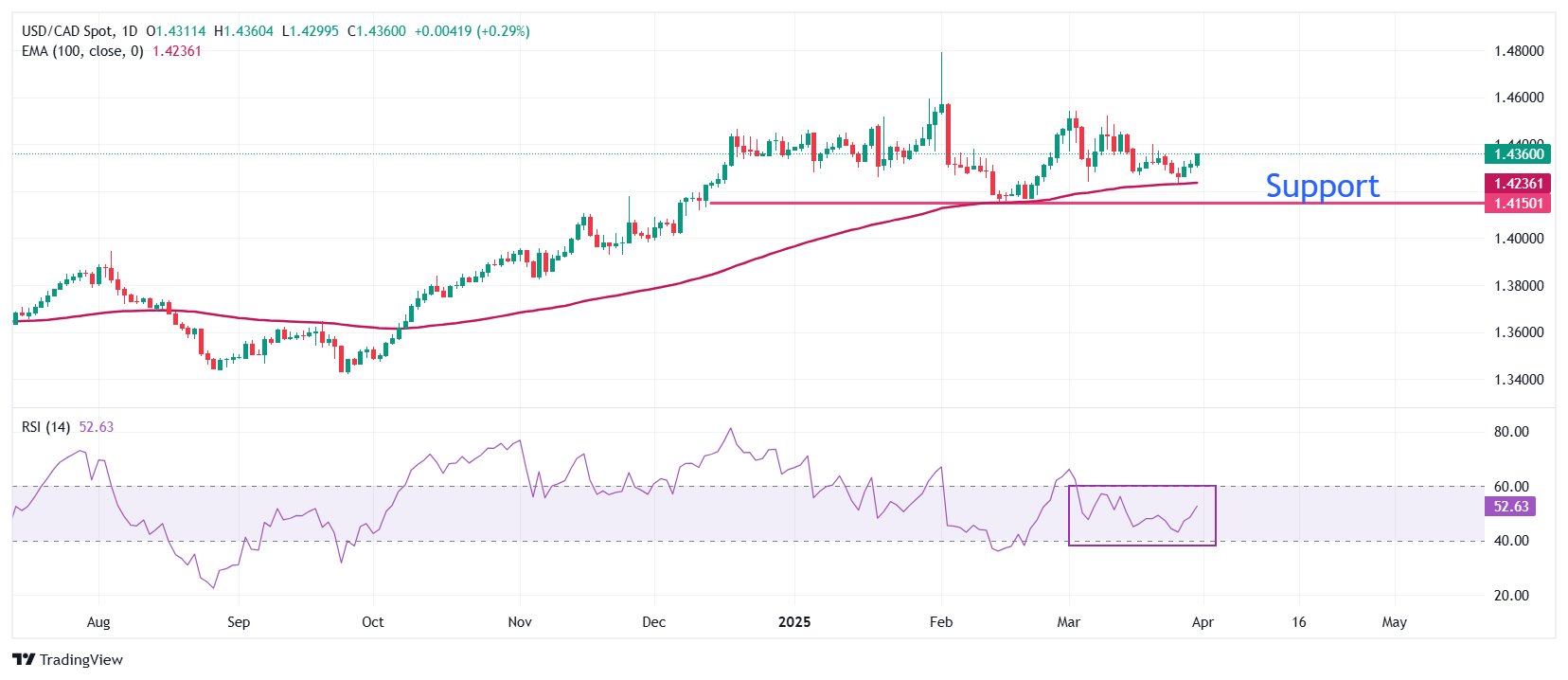
USD/CAD holds above the 100-period Exponential Moving Average (EMA), which is around 1.4233, suggesting that the overall trend is bullish.
The 14-period Relative Strength Index (RSI) oscillates in the 40.00-60.00 range, indicating a sideways trend.
Going forward, an upside move would emerge above the March 10 high of 1.4470, which will open the door toward the psychological resistance of 1.4500 and the January 30 high of 1.4595.
On the contrary, a breakdown below the February 14 low of 1.4151 by the pair would expose it to the December 9 low of 1.4094, followed by the December 6 low of 1.4020.
USD/CAD daily chart
Tariffs FAQs
Tariffs are customs duties levied on certain merchandise imports or a category of products. Tariffs are designed to help local producers and manufacturers be more competitive in the market by providing a price advantage over similar goods that can be imported. Tariffs are widely used as tools of protectionism, along with trade barriers and import quotas.
Although tariffs and taxes both generate government revenue to fund public goods and services, they have several distinctions. Tariffs are prepaid at the port of entry, while taxes are paid at the time of purchase. Taxes are imposed on individual taxpayers and businesses, while tariffs are paid by importers.
There are two schools of thought among economists regarding the usage of tariffs. While some argue that tariffs are necessary to protect domestic industries and address trade imbalances, others see them as a harmful tool that could potentially drive prices higher over the long term and lead to a damaging trade war by encouraging tit-for-tat tariffs.
During the run-up to the presidential election in November 2024, Donald Trump made it clear that he intends to use tariffs to support the US economy and American producers. In 2024, Mexico, China and Canada accounted for 42% of total US imports. In this period, Mexico stood out as the top exporter with $466.6 billion, according to the US Census Bureau. Hence, Trump wants to focus on these three nations when imposing tariffs. He also plans to use the revenue generated through tariffs to lower personal income taxes.
Author
Sagar Dua
FXStreet
Sagar Dua is associated with the financial markets from his college days. Along with pursuing post-graduation in Commerce in 2014, he started his markets training with chart analysis.

















