US Treasury yields hit five-week high amid adjusted Fed rate cut expectations
- 10-year Treasury note yields climb to 4.129%, and 30-year bonds reach 4.344%, reflecting investors' alignment with the Fed's cautious policy outlook.
- Positive US Retail Sales and Industrial Production data contribute to rising bond yields and slight gains in the USD, currently at 103.38.
- Fed Governor Waller's emphasis on a methodical approach to easing monetary policy prompts market recalibration, reducing bets on aggressive rate cuts.

US Treasury yields across the yield curve climbed to five-week highs as the 10-year note rose to 4.129%, while the 30-year bond jumped as high as 4.344%, on investors adhering to the US Federal Reserve (Fed) “higher for longer” mantra. Consequently, that sponsored a leg-up in the Greenback (USD) though pared some of its gain, clings to minuscule gains of 0.05%, at 103.38.
Investors adopt the “higher-for-longer” mantra as US 2-year yields skyrocketed
Traders during the US session witnessed the release of US Retail Sales for December, which saw an increase of 0.6%, surpassing both the forecasted rise of 0.4% and the figures from November. Later, the US Federal Reserve reported a modest improvement in Industrial Production, which grew by 0.1%. This marks a positive shift after a period of contraction and stagnation in October and November of the previous year.
In addition to that, earlier data revealed during the European session revealed that the UK’s inflation exceeded forecasts, sparking a jump in global bond yields.
At the beginning of the week, investors were expecting 175 basis points of rate cuts by the Fed in 2024. But throughout the session, they adjusted their bets, and now expect 145 basis points of monetary easing, which means they trimmed one rate cut.
On Tuesday, Federal Reserve Governor Christopher Waller said the Fed is not in a hurry to ease its monetary policy, as inflation is "within striking distance" of their target. While he is open to the idea of reducing interest rates, Waller cautioned that any such policy changes need to be "carefully calibrated and not rushed," emphasizing the importance of waiting until the risks of inflation reigniting have significantly diminished.
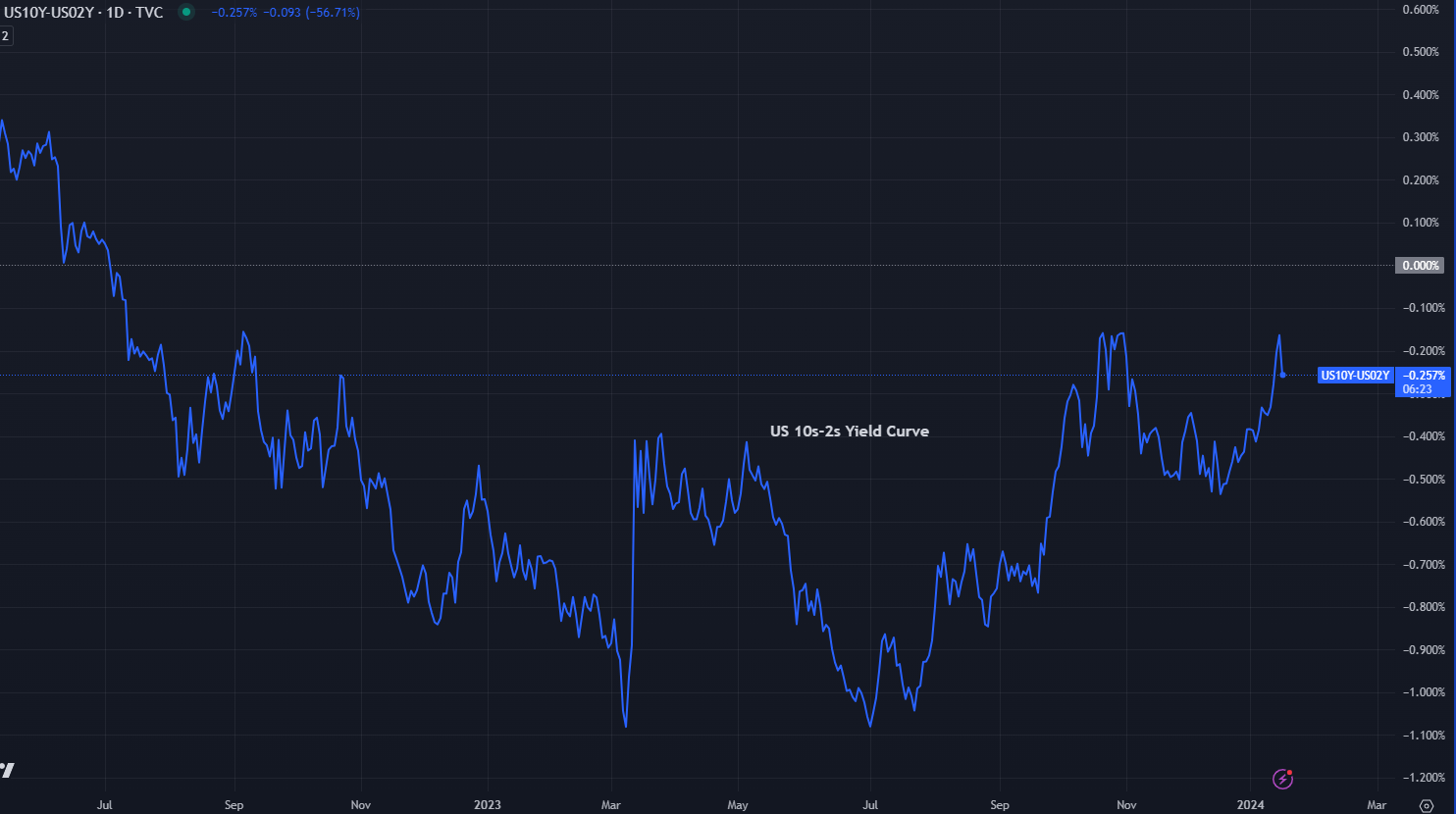
The US 10-year Treasury note climbed four basis points, up to 4.106%, while the 30-year bond rose five basis points toward 4.344%, before retreating to 4.323%. Meanwhile, the diversion of the US 10s-2s yield curve, halted, as the 2-year Treasury note climbed 13 basis points of expectations that the Fed would remain reluctant to easy policy as the markets expected.
Ahead of the week, the US economic docket will feature US Initial Jobless Claims, and further Fed speakers will cross the wires on Thursday, followed by Friday’s University of Michigan (UoM) Consumer Sentiment.
US 10s-2s Spread Chart
Interest rates FAQs
What are interest rates?
Interest rates are charged by financial institutions on loans to borrowers and are paid as interest to savers and depositors. They are influenced by base lending rates, which are set by central banks in response to changes in the economy. Central banks normally have a mandate to ensure price stability, which in most cases means targeting a core inflation rate of around 2%.
If inflation falls below target the central bank may cut base lending rates, with a view to stimulating lending and boosting the economy. If inflation rises substantially above 2% it normally results in the central bank raising base lending rates in an attempt to lower inflation.
How do interest rates impact currencies?
Higher interest rates generally help strengthen a country’s currency as they make it a more attractive place for global investors to park their money.
How do interest rates influence the price of Gold?
Higher interest rates overall weigh on the price of Gold because they increase the opportunity cost of holding Gold instead of investing in an interest-bearing asset or placing cash in the bank.
If interest rates are high that usually pushes up the price of the US Dollar (USD), and since Gold is priced in Dollars, this has the effect of lowering the price of Gold.
What is the Fed Funds rate?
The Fed funds rate is the overnight rate at which US banks lend to each other. It is the oft-quoted headline rate set by the Federal Reserve at its FOMC meetings. It is set as a range, for example 4.75%-5.00%, though the upper limit (in that case 5.00%) is the quoted figure.
Market expectations for future Fed funds rate are tracked by the CME FedWatch tool, which shapes how many financial markets behave in anticipation of future Federal Reserve monetary policy decisions.
Author
Christian Borjon Valencia
FXStreet
Markets analyst, news editor, and trading instructor with over 14 years of experience across FX, commodities, US equity indices, and global macro markets.