US Dollar picks up gains ahead of Nonfarm Payrolls
- The US Dollar Index holds below 108.00 as mixed economic indicators raise concerns ahead of Friday's employment report.
- ADP reports a stronger-than-expected increase in private sector employment for January, while Initial Jobless Claims also rise.
- Investors anticipate the upcoming Nonfarm Payrolls data to gauge the Federal Reserve's future monetary policy decisions.


The US Dollar Index (DXY), which measures the value of the US Dollar (USD) against a basket of currencies, struggles to hold its recent gains, trading below 108.00 on Thursday. Mixed United States (US) economic data fuels uncertainty ahead of the January employment report due on Friday. Investors remain cautious as labor market signals provide conflicting outlooks, with ADP data showing strength while jobless claims rise.
Daily digest market movers: US Dollar index remains soft after mixed data
- ADP reports a stronger-than-expected private sector job increase of 183,000 in January, exceeding the 150,000 consensus.
- On Thursday, Initial jobless claims rise to 219,000, surpassing expectations of 213,000 and up from last week's 208,000, signaling potential labor market softening.
- Continuing jobless claims increase to 1.886 million, above the forecast of 1.87 million and last week's 1.858 million.
- Investors now focus on Friday's Nonfarm Payrolls report, projected to show 170,000 new jobs in January, down from December's 256,000.
- The CME FedWatch tool shows a nearly 90% probability of the Fed keeping rates steady in March, reinforcing expectations of a prolonged hold. NFP data will dictate the pace of the markets bets.
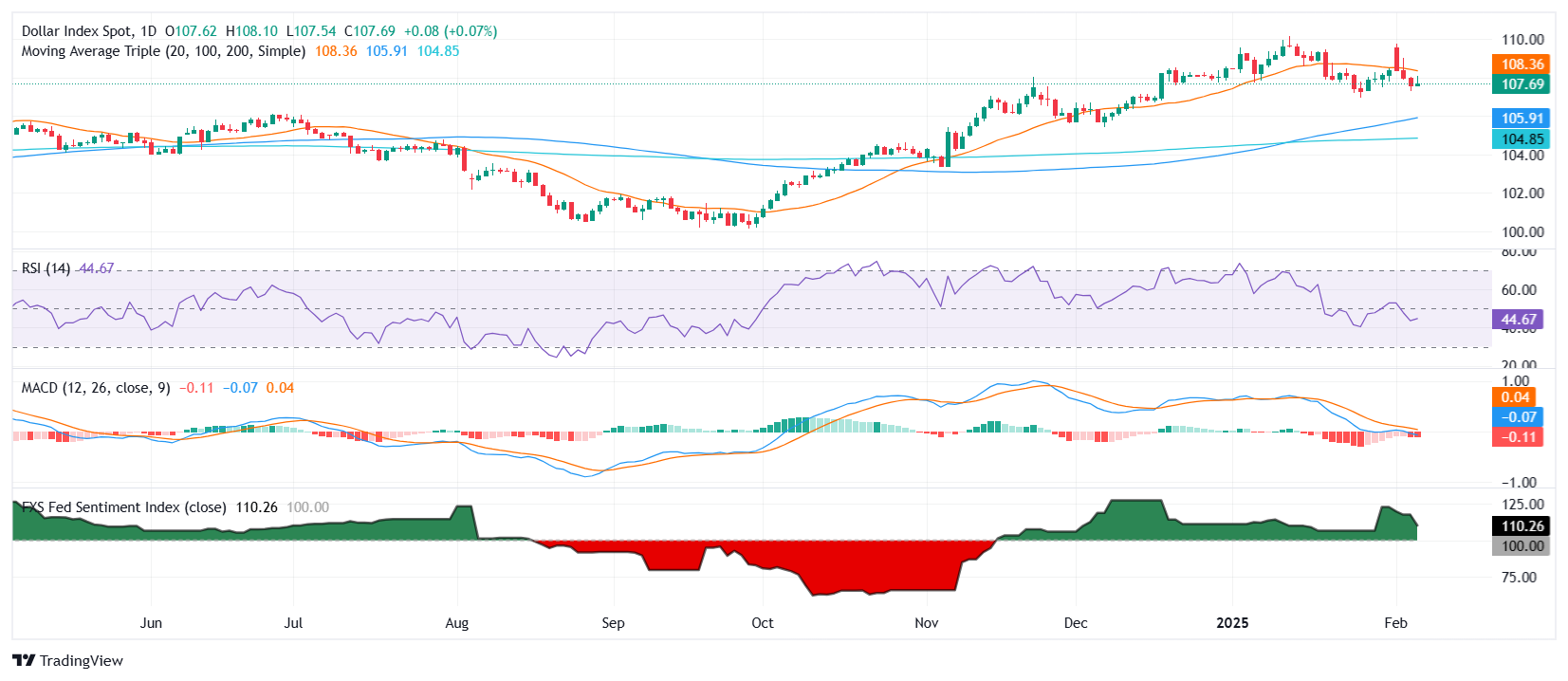
- Fed's Austan Gooble was on the wires during Thursday's session but didn't provide any relevant insights but noted that the pace of the cuts will be slower. In the meantime, the Fed's sentiment index remains in hawkish territory above 100 but downwards sloping.
DXY technical outlook: Indicators show growing bearish momentum
The US Dollar Index struggles to maintain recent gains, slipping below the 20-day Simple Moving Average (SMA) at 108.50. The Relative Strength Index (RSI) remains below 50, signaling increasing bearish traction. The DXY now looks poised to test the psychological support level at 107.00, with downside risks growing as mixed economic data clouds the Fed’s hawkish policy outlook.
Nonfarm Payrolls FAQs
Nonfarm Payrolls (NFP) are part of the US Bureau of Labor Statistics monthly jobs report. The Nonfarm Payrolls component specifically measures the change in the number of people employed in the US during the previous month, excluding the farming industry.
The Nonfarm Payrolls figure can influence the decisions of the Federal Reserve by providing a measure of how successfully the Fed is meeting its mandate of fostering full employment and 2% inflation. A relatively high NFP figure means more people are in employment, earning more money and therefore probably spending more. A relatively low Nonfarm Payrolls’ result, on the either hand, could mean people are struggling to find work. The Fed will typically raise interest rates to combat high inflation triggered by low unemployment, and lower them to stimulate a stagnant labor market.
Nonfarm Payrolls generally have a positive correlation with the US Dollar. This means when payrolls’ figures come out higher-than-expected the USD tends to rally and vice versa when they are lower. NFPs influence the US Dollar by virtue of their impact on inflation, monetary policy expectations and interest rates. A higher NFP usually means the Federal Reserve will be more tight in its monetary policy, supporting the USD.
Nonfarm Payrolls are generally negatively-correlated with the price of Gold. This means a higher-than-expected payrolls’ figure will have a depressing effect on the Gold price and vice versa. Higher NFP generally has a positive effect on the value of the USD, and like most major commodities Gold is priced in US Dollars. If the USD gains in value, therefore, it requires less Dollars to buy an ounce of Gold. Also, higher interest rates (typically helped higher NFPs) also lessen the attractiveness of Gold as an investment compared to staying in cash, where the money will at least earn interest.
Nonfarm Payrolls is only one component within a bigger jobs report and it can be overshadowed by the other components. At times, when NFP come out higher-than-forecast, but the Average Weekly Earnings is lower than expected, the market has ignored the potentially inflationary effect of the headline result and interpreted the fall in earnings as deflationary. The Participation Rate and the Average Weekly Hours components can also influence the market reaction, but only in seldom events like the “Great Resignation” or the Global Financial Crisis.
Author
Patricio Martín
FXStreet
Patricio is an economist from Argentina passionate about global finance and understanding the daily movements of the markets.