US Dollar down on fresh tariffs clues
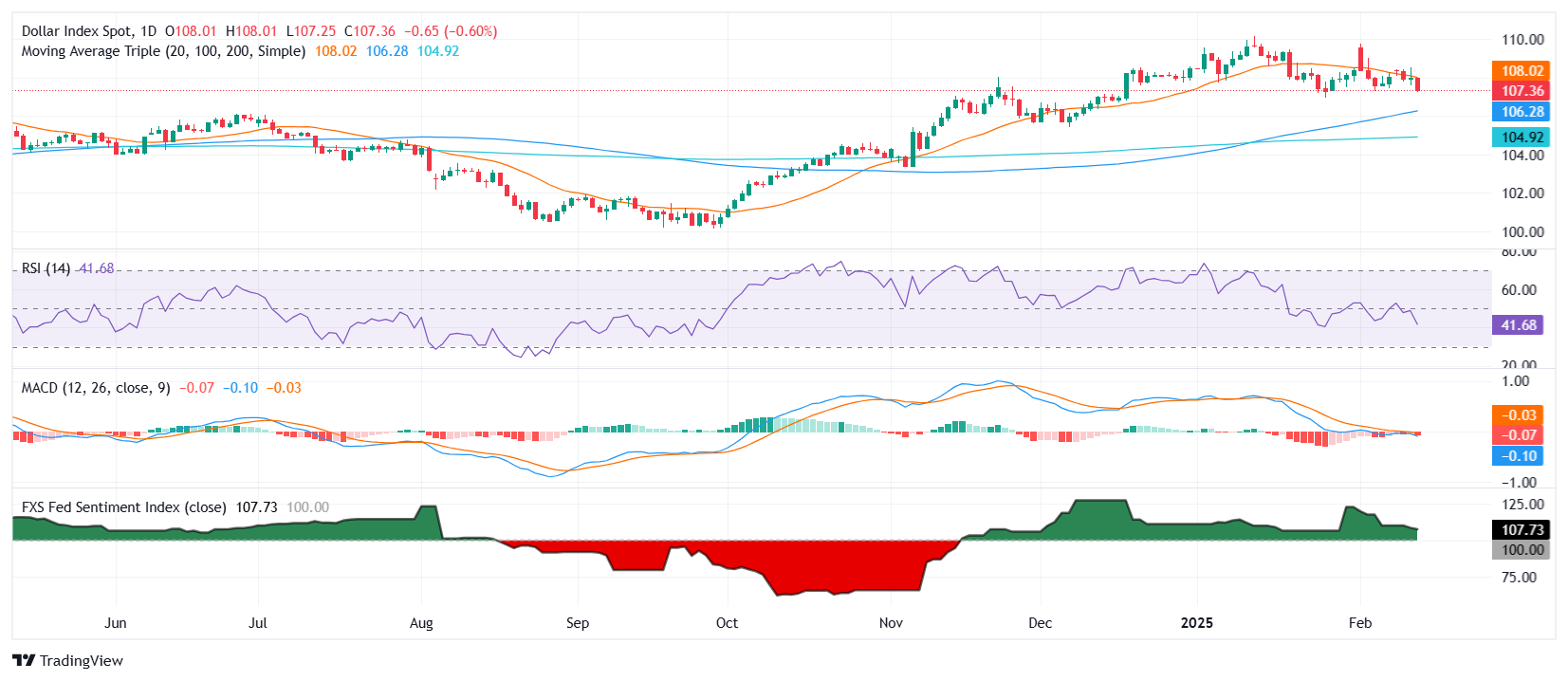
- The US Dollar Index plummeted on Thursday, failing to hold gains after Wednesday's inflation-driven rally.
- Stronger-than-expected Producer Price Index data initially supported the Greenback but was offset by geopolitical headlines.
- President Trump and Russian President Putin agreed to begin peace talks with Ukraine, reducing market risk aversion.
- Jobless claims data came in slightly better than expected, reinforcing resilience in the US labor market.


The US Dollar Index (DXY), which measures the value of the US Dollar against a basket of currencies, struggles to hold onto gains following Wednesday’s inflation data. Traders are quick to dismiss the latest Producer Price Index (PPI) figures, shifting their focus to geopolitical developments.
A potential peace agreement between Russia and Ukraine and the latest US jobless claims data add to the market’s uncertainty, leaving the DXY below 107.30.
Daily digest market movers: US Dollar fails to capitalize on strong PPI data
- The PPI for January increased by 0.4%, exceeding the expected 0.3%, but came down from a revised 0.5% prior.
- Core PPI matched expectations at 0.3%, but December’s figure was revised higher to 0.4%, signaling persistent price pressure.
- Initial Jobless Claims fell to 213,000 for the week ending February 7, slightly below the forecast of 215,000.
- Continuing Jobless Claims dropped to 1.850 million, below the projected 1.880 million, highlighting labor market resilience.
- A surprise geopolitical development saw President Trump and President Putin agreeing to begin peace negotiations with Ukraine, which sparked a wave of optimism.
- On the Federal Reserve’s side, its stance remains cautious with officials set to provide further guidance on the monetary policy outlook.
- The Federal Sentiment Index remains unchanged but is still in hawkish territory, signaling policymakers’ reluctance to ease prematurely.
- President Trump proposed reciprocal tariffs on nations imposing barriers on U.S. goods, including VAT. The President cited “non-monetary tariffs,” a concept that does not exist in conventional economics.
- Although details of this plan remain scarce, Commerce Secretary Howard Lutnick has been tasked with refining it.
DXY technical outlook: Index loses grip of 20-day moving average as bearish pressure mounts
The US Dollar Index struggles to hold above the 20-day Simple Moving Average (SMA), signaling weakness after failing to sustain Wednesday’s gains. The Relative Strength Index (RSI) remains below 50, pointing to persistent bearish momentum, while the Moving Average Convergence Divergence (MACD) continues to show a negative trend.
Immediate resistance stands at 108.50 with support near 107.80. A break below this level could accelerate declines toward the psychological 107.00 mark.
Tariffs FAQs
Tariffs are customs duties levied on certain merchandise imports or a category of products. Tariffs are designed to help local producers and manufacturers be more competitive in the market by providing a price advantage over similar goods that can be imported. Tariffs are widely used as tools of protectionism, along with trade barriers and import quotas.
Although tariffs and taxes both generate government revenue to fund public goods and services, they have several distinctions. Tariffs are prepaid at the port of entry, while taxes are paid at the time of purchase. Taxes are imposed on individual taxpayers and businesses, while tariffs are paid by importers.
There are two schools of thought among economists regarding the usage of tariffs. While some argue that tariffs are necessary to protect domestic industries and address trade imbalances, others see them as a harmful tool that could potentially drive prices higher over the long term and lead to a damaging trade war by encouraging tit-for-tat tariffs.
During the run-up to the presidential election in November 2024, Donald Trump made it clear that he intends to use tariffs to support the US economy and American producers. In 2024, Mexico, China and Canada accounted for 42% of total US imports. In this period, Mexico stood out as the top exporter with $466.6 billion, according to the US Census Bureau. Hence, Trump wants to focus on these three nations when imposing tariffs. He also plans to use the revenue generated through tariffs to lower personal income taxes.
Author
Patricio Martín
FXStreet
Patricio is an economist from Argentina passionate about global finance and understanding the daily movements of the markets.