US Dollar for now able to avoid another daily loss with geopolitics roaming markets
- The US Dollar steadies after an earlier wild ride as a flood of geopolitical news erupts this Monday.
- In Germany, the far-right AfD party is outpaced by the CDU.
- The US Dollar Index (DXY) has recovered a near 0.50% loss andd trades marginally higher at the time of writing.


The US Dollar Index (DXY), which tracks the performance of the US Dollar (USD) against six major currencies, has completely recovered Asian losses in the US trading session this Monday. The initial move down in the US Dollar came in, due to euphoria for the Euro (EUR) after the first German election results showed a firm lead for the Christian Democratic Union of Germany (CDU), which will take the lead in forming a coalition. As the dust settles, this means that fundamentally, no big changes will take place in Germany regarding leadership and political agenda, which triggers the Euro to pare back gains and the DXY to turn flat to positive.
Meanwhile US headlines have been added where several US departments such as the Pentagon have asked employees not to go ahead with the request from Elon Musk and DOGE (Department of Government Efficiency) to disclose their duties. Elon Musk meanwhile issued warnings on Twitter that those who fail to comply coming into the office or reporting back to DOGE, will be put on leave.
In an ongoing G7 meeting, the group is unable to agree on a joint statement to mark the three year since Russia invaded Ukraine, due to disagreements between the US and its European allies. The US opposed language condemning Moscow and a call for more energy sanctions, and has threatened to pull support for a statement altogether, although discussions are ongoing.
The US economic calendar starts off the week slowly, with all eyes on the US Gross Domestic Product (GDP) release for the fourth quarter of 2024 on Thursday and Personal Consumption Expenditures (PCE) for January on Friday. However, the Chicago Fed National Activity Index for January is due this Monday. Later in the day, United States (US) President Donald Trump is also due to deliver a speech.
Daily digest market movers: Not impressed
- The Euro (EUR) has given up all its gains against the US Dollar (USD) as traders are not impressed with the possible lack of major reforms or changes in the German political landscape for the new government formation.
- The Chicago Fed National Activity Index for January came in at -0.03, a small loss compared to the previous 0.15 reading.
- The US Treasury will auction a 3-month, 6-month Bills, and a 2-year Note auction this Monday.
- US President Donald Trump is set to hold a press conference with President of France Macron near 19:00 GMT.
- Equities are having a sigh of relief after the German election outcome, though the German Dax is fading its intraday gains at the start of the US trading session. The broader pan-European Stoxx 50 index is even turning negative after the US opening bell.
- The CME FedWatch tool shows a 41.2% chance that interest rates will remain unchanged at current levels in June against a bigger 46.2% for a 25 basis points (bps) rate cut.
- The US 10-year yield trades around 4.43%, down over 3% from last week’s high at 4.574%.
US Dollar Index Technical Analysis: It is bound to move
The US Dollar Index (DXY) portrays a textbook element here, with the German election outcome as a catalyst. During the Asian session, a sigh of relief and support for the Euro was outpacing the Greenback in the idea that a crisis was averted with the Far-Right not having enough seats to secure the lead in Germany. However, now that the dust settles, markets start to realise that the current coalition probability is dull and the same politics markets saw in the past few decades is due, which is seen as not enough to trigger substantial additional upside in Euro.
On the upside, the 100-day Simple Moving Average (SMA) could limit bulls buying the Greenback near 106.61. From there, the next leg could go up to 107.35, a pivotal support from December 2024 and January 2025. In case US President Trump has some surprise comments on Monday, even 107.96 (55-day SMA) could be tested.
On the downside, the 106.52 (April 16, 2024, high) level has seen a false break for now. However, that does mean quite a few stops might have been triggered in the markets, with a few bulls having been washed out of their long US Dollar positions. Another leg lower might be needed to entice those Dollar bulls to reenter at lower levels, near 105.89 or even 105.33.
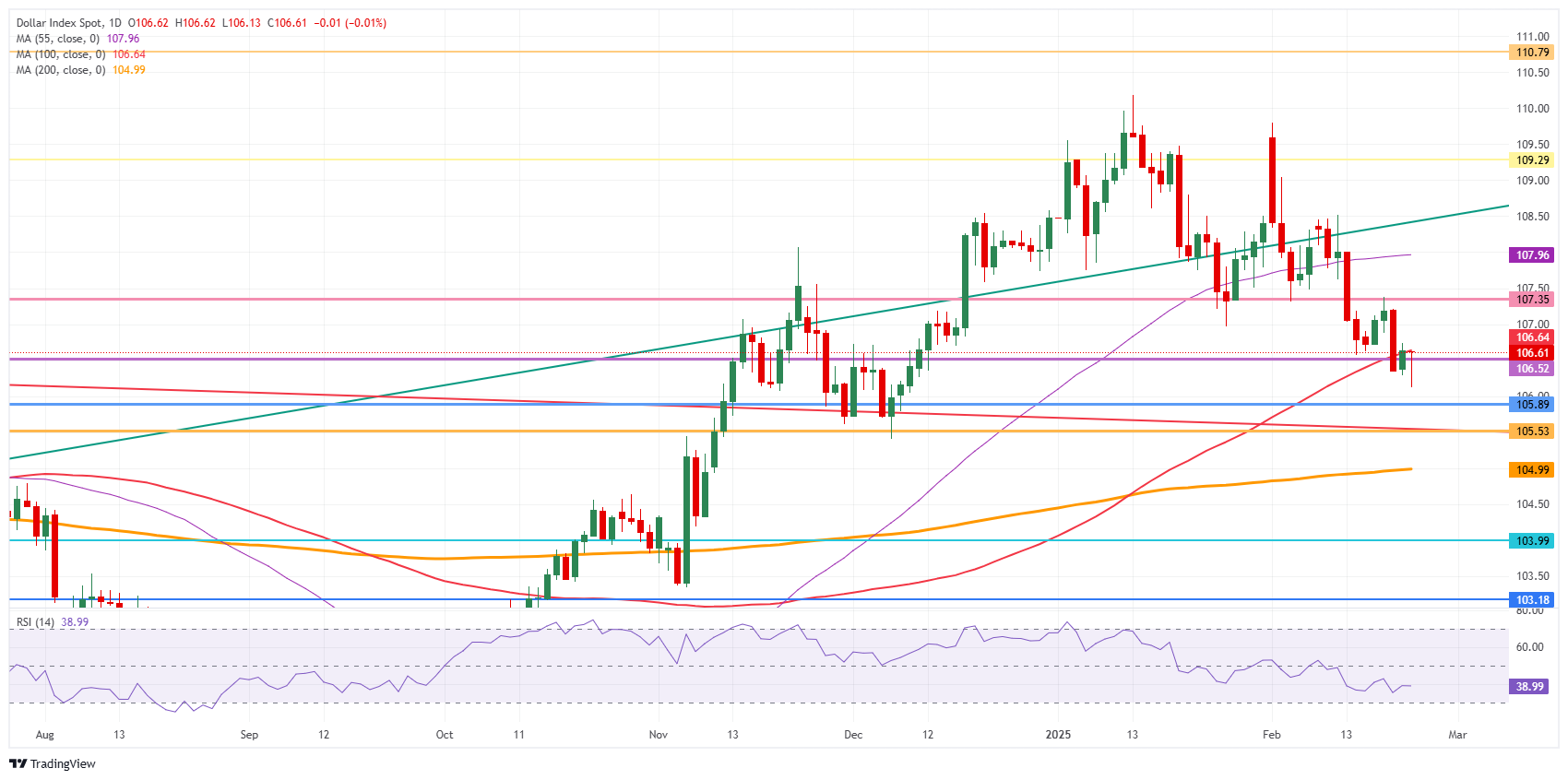
US Dollar Index: Daily Chart
Fed FAQs
Monetary policy in the US is shaped by the Federal Reserve (Fed). The Fed has two mandates: to achieve price stability and foster full employment. Its primary tool to achieve these goals is by adjusting interest rates. When prices are rising too quickly and inflation is above the Fed’s 2% target, it raises interest rates, increasing borrowing costs throughout the economy. This results in a stronger US Dollar (USD) as it makes the US a more attractive place for international investors to park their money. When inflation falls below 2% or the Unemployment Rate is too high, the Fed may lower interest rates to encourage borrowing, which weighs on the Greenback.
The Federal Reserve (Fed) holds eight policy meetings a year, where the Federal Open Market Committee (FOMC) assesses economic conditions and makes monetary policy decisions. The FOMC is attended by twelve Fed officials – the seven members of the Board of Governors, the president of the Federal Reserve Bank of New York, and four of the remaining eleven regional Reserve Bank presidents, who serve one-year terms on a rotating basis.
In extreme situations, the Federal Reserve may resort to a policy named Quantitative Easing (QE). QE is the process by which the Fed substantially increases the flow of credit in a stuck financial system. It is a non-standard policy measure used during crises or when inflation is extremely low. It was the Fed’s weapon of choice during the Great Financial Crisis in 2008. It involves the Fed printing more Dollars and using them to buy high grade bonds from financial institutions. QE usually weakens the US Dollar.
Quantitative tightening (QT) is the reverse process of QE, whereby the Federal Reserve stops buying bonds from financial institutions and does not reinvest the principal from the bonds it holds maturing, to purchase new bonds. It is usually positive for the value of the US Dollar.
Author
Filip Lagaart
FXStreet
Filip Lagaart is a former sales/trader with over 15 years of financial markets expertise under its belt.