US Dollar remains under pressure NFPs, Trump and Powell comments
- DXY plunges further, losing over 3.5% this week.
- February's Nonfarm Payrolls miss expectations and the unemployment rate rises.
- Fed officials signal multiple rate cuts in 2025, fueling more USD weakness.
- Tariff uncertainty continues as President Trump hints at new Canada levies.


The US Dollar Index (DXY) extends its brutal slide on Friday, heading for its worst weekly performance in over a year as traders accelerate the selloff ahead of the February employment report. The Greenback is now in freefall, with expectations of multiple Fed rate cuts and growing economic uncertainty driving capital outflows.
Meanwhile, tariff-related volatility continues, with United States (US) President Donald Trump keeping markets on edge by hinting at fresh trade measures against Canada but refusing to commit to a timeline. DXY is now struggling to hold the 104.00 handle, having lost over 3.5% since Monday, marking a historic devaluation.
Daily digest market movers: USD spirals lower amid Fed and tariff risks, February’s NFP reading
- On the data front, US Nonfarm Payrolls (NFP) for February came in at 151,000, missing the 160,000 forecast but above January’s 125,000 print.
- Average Hourly Earnings growth slowed to 0.3% month-over-month, a drop from January’s 0.4%.
- The US unemployment rate climbed to 4.1%, marking an uptick from the previous 4.0%.
- Fed Governor Christopher Waller suggested the potential for up to three rate cuts this year, reinforcing the market’s dovish expectations.
- Federal Reserve Chair Jerome Powell warned that ongoing policy uncertainty complicates the central bank’s ability to adjust monetary policy.
- Markets continue digesting shifting Fed policy expectations, with the interest rate differential between the US and other economies narrowing.
- President Trump hinted at fresh tariffs on Canada but refrained from confirming a specific timeline, leaving uncertainty hanging over markets.
- CME FedWatch Tool now shows a rising probability of a June rate cut, as traders further price in easing.
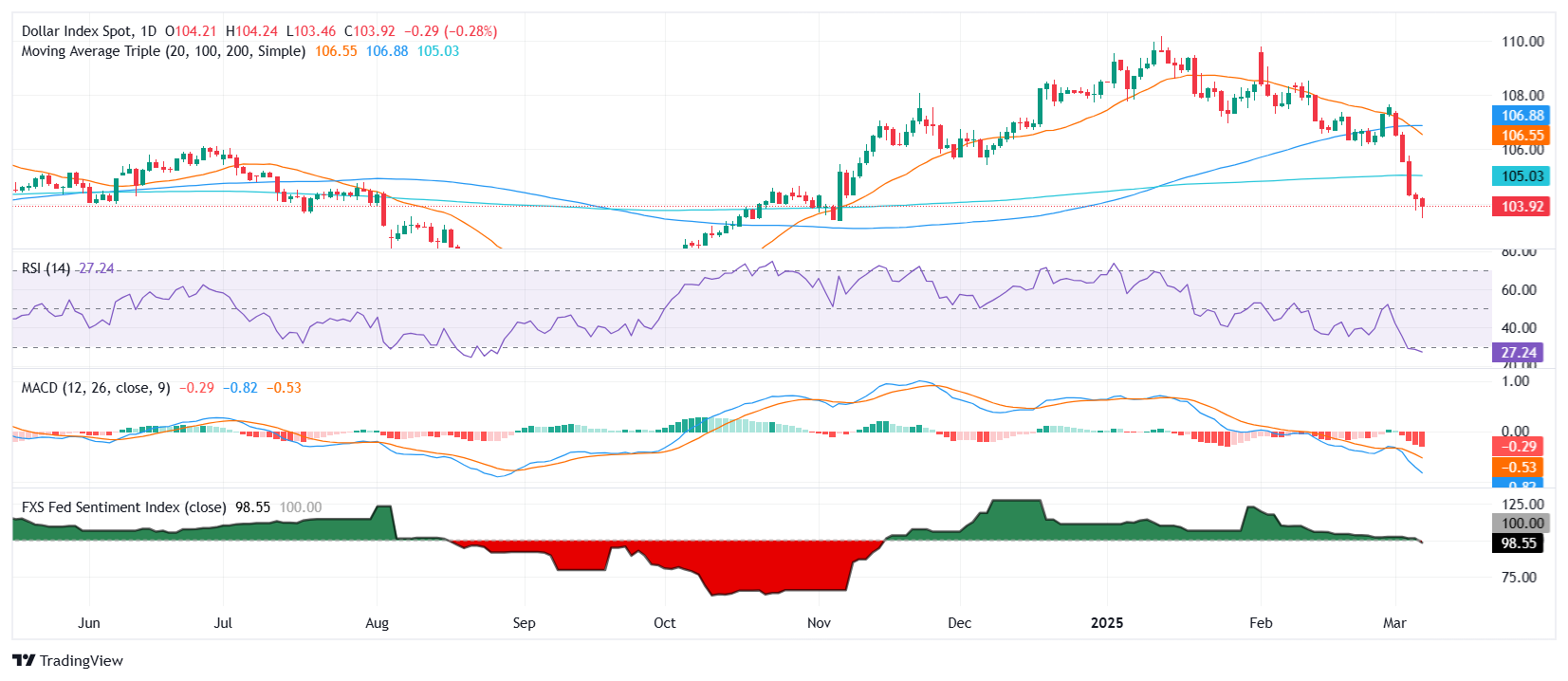
- On the daily chart, the Fed sentiment index fell towards 100, which reflects a slow lean of the Fed towards a more dovish stance.
DXY technical outlook: Bearish pressure dominates
The US Dollar Index (DXY) is entrenched in a deep selloff, having broken below 104.00 and revisiting its lowest levels since November 2024. The 20-day and 100-day Simple Moving Averages (SMA) have now confirmed a bearish crossover, reinforcing negative momentum. The Relative Strength Index (RSI) signals oversold conditions, suggesting a potential short-term rebound, but the MACD remains firmly in bearish territory, pointing to continued downside risk. Should DXY fail to reclaim 104.50, the next key support level lies at 103.50, which could determine whether the selloff extends further.
Employment FAQs
Labor market conditions are a key element in assessing the health of an economy and thus a key driver for currency valuation. High employment, or low unemployment, has positive implications for consumer spending and economic growth, boosting the value of the local currency. Moreover, a very tight labor market – a situation in which there is a shortage of workers to fill open positions – can also have implications on inflation levels because low labor supply and high demand leads to higher wages.
The pace at which salaries are growing in an economy is key for policymakers. High wage growth means that households have more money to spend, usually leading to price increases in consumer goods. In contrast to more volatile sources of inflation such as energy prices, wage growth is seen as a key component of underlying and persisting inflation as salary increases are unlikely to be undone. Central banks around the world pay close attention to wage growth data when deciding on monetary policy.
The weight that each central bank assigns to labor market conditions depends on its objectives. Some central banks explicitly have mandates related to the labor market beyond controlling inflation levels. The US Federal Reserve (Fed), for example, has the dual mandate of promoting maximum employment and stable prices. Meanwhile, the European Central Bank’s (ECB) sole mandate is to keep inflation under control. Still, and despite whatever mandates they have, labor market conditions are an important factor for policymakers given their significance as a gauge of the health of the economy and their direct relationship to inflation.
Author
Patricio Martín
FXStreet
Patricio is an economist from Argentina passionate about global finance and understanding the daily movements of the markets.