US Dollar steady with US markets closed despite geopolitical headlines
- The US Dollar flatlines on Monday with more headlines on Ukraine.
- Traders are mulling possible outcomes from Riyadh's Ukraine talks this week.
- The US Dollar Index (DXY) stuck in the mid 106-range and is looking for direction.


The US Dollar Index (DXY), which tracks the performance of the US Dollar (USD) against six major currencies, is trading around 106.80 for the bigger part of this Monday while traders mull any possible outcomes from this week's meeting in Saudi Arabia on Ukraine. The United States (US) economy is no longer an outlier, with several data points and the blood-red January Retail Sales data released last week pointing to slower economic growth. All eyes this week will be on Riyadh, in Saudi Arabia, where US and Russian officials are set to meet ahead of a meeting between US President Donald Trump and Russian President Vladimir Putin.
The economic calendar is very calm this week in the run-up to the S&P Purchasing Managers Index (PMI) data on Friday. Although the US bond market is closed due to the President’s Day bank holiday, the Federal Reserve (Fed) has three policymakers lined up to speak on Monday.
Daily digest market movers: US officials headlines
- US bond markets are closed on Monday due to the President’s Day bank holidays.
- Traders will need to be vigilant for any headlines coming out of Riyadh, where US and Russian officials are meeting in the runup to the meeting between US President Donald Trump and Russian President Vladimir Putin to agree on a deal for Ukraine.
- At 14:30 GMT, Federal Reserve Bank of Philadelphia Patrick Harker delivers a speech on the economic outlook at the Central Banking Series Conference at the University of the Bahamas in Nassau.
- At 15:20 GMT, Fed Governor Michelle W. Bowman delivers brief remarks on the economy and bank regulation at the American Bankers Association (ABA) Conference for Community Bankers in Phoenix, Arizona.
- Closing off this Monday, at 23:00 GMT, Fed Governor Christopher J. Waller speaks on the economic outlook at the UNSW Macroeconomic Workshop in Sydney, Australia.
- Equities start off this week with some small and cautious gains. US futures are trading and are in the green as well.
- The CME FedWatch tool shows a 46.7% chance that interest rates will remain unchanged at current levels in June.
- The US 10-year yield is trading around 4.48%, and will remain closed for trading this Monday
US Dollar Index Technical Analysis: Watch out for the 'in principal'
The US Dollar Index (DXY) is not expected to go anywhere this Monday with most US markets closed due to President’s Day. The main focus will be on headlines around Ukraine, where the question will be what kind of deal will be put on the table. Be on the lookout thus for false breaks on a peace deal being reached, with the aftermath resulting in a knee jerk reaction and seeing the DXY possibly rally from there on out.
On the upside, the previous support at 107.35 has now turned into a firm resistance. Further up, the 55-day SMA at 107.91 must be regained before reclaiming 108.00.
On the downside, look for 106.52 (April 16, 2024, high), 106.40 (100-day SMA), or even 105.89 (resistance in June 2024) as support levels. As the Relative Strength Index (RSI) momentum indicator in the daily chart shows room for more downside, the 200-day SMA at 104.93 could be a possible outcome.
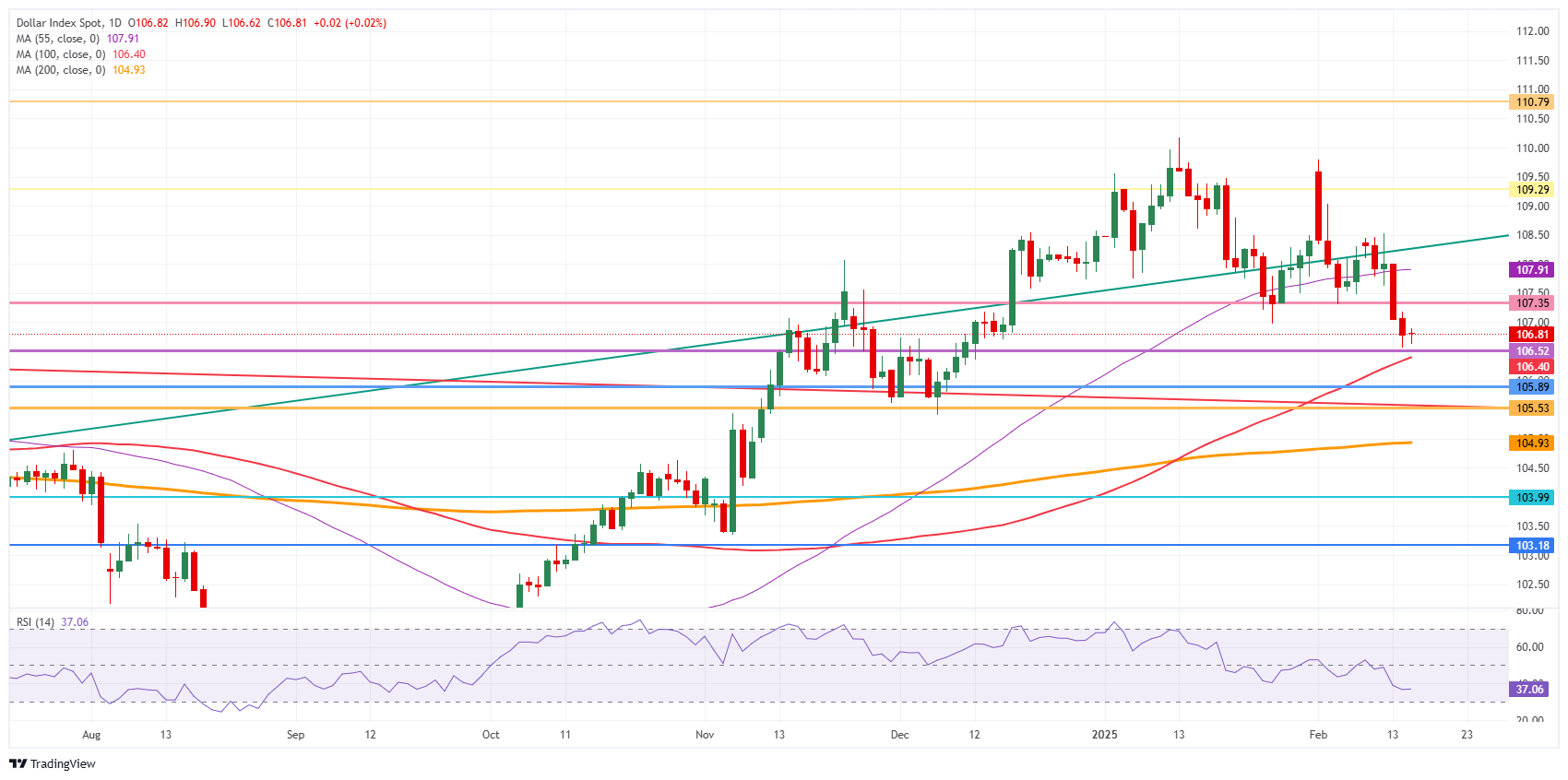
US Dollar Index: Daily Chart
Central banks FAQs
Central Banks have a key mandate which is making sure that there is price stability in a country or region. Economies are constantly facing inflation or deflation when prices for certain goods and services are fluctuating. Constant rising prices for the same goods means inflation, constant lowered prices for the same goods means deflation. It is the task of the central bank to keep the demand in line by tweaking its policy rate. For the biggest central banks like the US Federal Reserve (Fed), the European Central Bank (ECB) or the Bank of England (BoE), the mandate is to keep inflation close to 2%.
A central bank has one important tool at its disposal to get inflation higher or lower, and that is by tweaking its benchmark policy rate, commonly known as interest rate. On pre-communicated moments, the central bank will issue a statement with its policy rate and provide additional reasoning on why it is either remaining or changing (cutting or hiking) it. Local banks will adjust their savings and lending rates accordingly, which in turn will make it either harder or easier for people to earn on their savings or for companies to take out loans and make investments in their businesses. When the central bank hikes interest rates substantially, this is called monetary tightening. When it is cutting its benchmark rate, it is called monetary easing.
A central bank is often politically independent. Members of the central bank policy board are passing through a series of panels and hearings before being appointed to a policy board seat. Each member in that board often has a certain conviction on how the central bank should control inflation and the subsequent monetary policy. Members that want a very loose monetary policy, with low rates and cheap lending, to boost the economy substantially while being content to see inflation slightly above 2%, are called ‘doves’. Members that rather want to see higher rates to reward savings and want to keep a lit on inflation at all time are called ‘hawks’ and will not rest until inflation is at or just below 2%.
Normally, there is a chairman or president who leads each meeting, needs to create a consensus between the hawks or doves and has his or her final say when it would come down to a vote split to avoid a 50-50 tie on whether the current policy should be adjusted. The chairman will deliver speeches which often can be followed live, where the current monetary stance and outlook is being communicated. A central bank will try to push forward its monetary policy without triggering violent swings in rates, equities, or its currency. All members of the central bank will channel their stance toward the markets in advance of a policy meeting event. A few days before a policy meeting takes place until the new policy has been communicated, members are forbidden to talk publicly. This is called the blackout period.
Author
Filip Lagaart
FXStreet
Filip Lagaart is a former sales/trader with over 15 years of financial markets expertise under its belt.

















