|

US Dollar bulls could start to emerge in the opening sessions

  • US Dollar is meeting a key support area for the open. 
  • Bulls are lurking on the backside of the hourly trendline. 

The US Dollar DXY index broke out of the week's channel between 111.25 and 109.40 in the final two days of the week on the back of the US Consumer Price Index. DXY dropped to a fresh low of 106.28 on Friday, extending the post-CPI dump into a fresh layer of potential support. 

O(n Friday, the US Treasury market was closed for the Veterans Day Holiday, but investors cheered a slight softening of China’s COVID restrictions which helped risk assets to run higher, weighing on the greenback as investors favored riskier currencies. DXY was down about 3.8% over two sessions, on pace for its largest two-day percentage loss since March 2009.

For the week ahead, Federal Reserve speakers are likely to push back on the overly dovish market reaction after the October CPI report. This could see the greenback correct as the following analysis will illustrate. ''Officials will make clear that following the positive news on the inflation front, there must be further evidence of sustained monthly core inflation that is more in line with their 2% target,'' analysts at TD Securities argued. ''And given the persistent strength of the labor market, this may take a while.''

US Dollar technical analysis
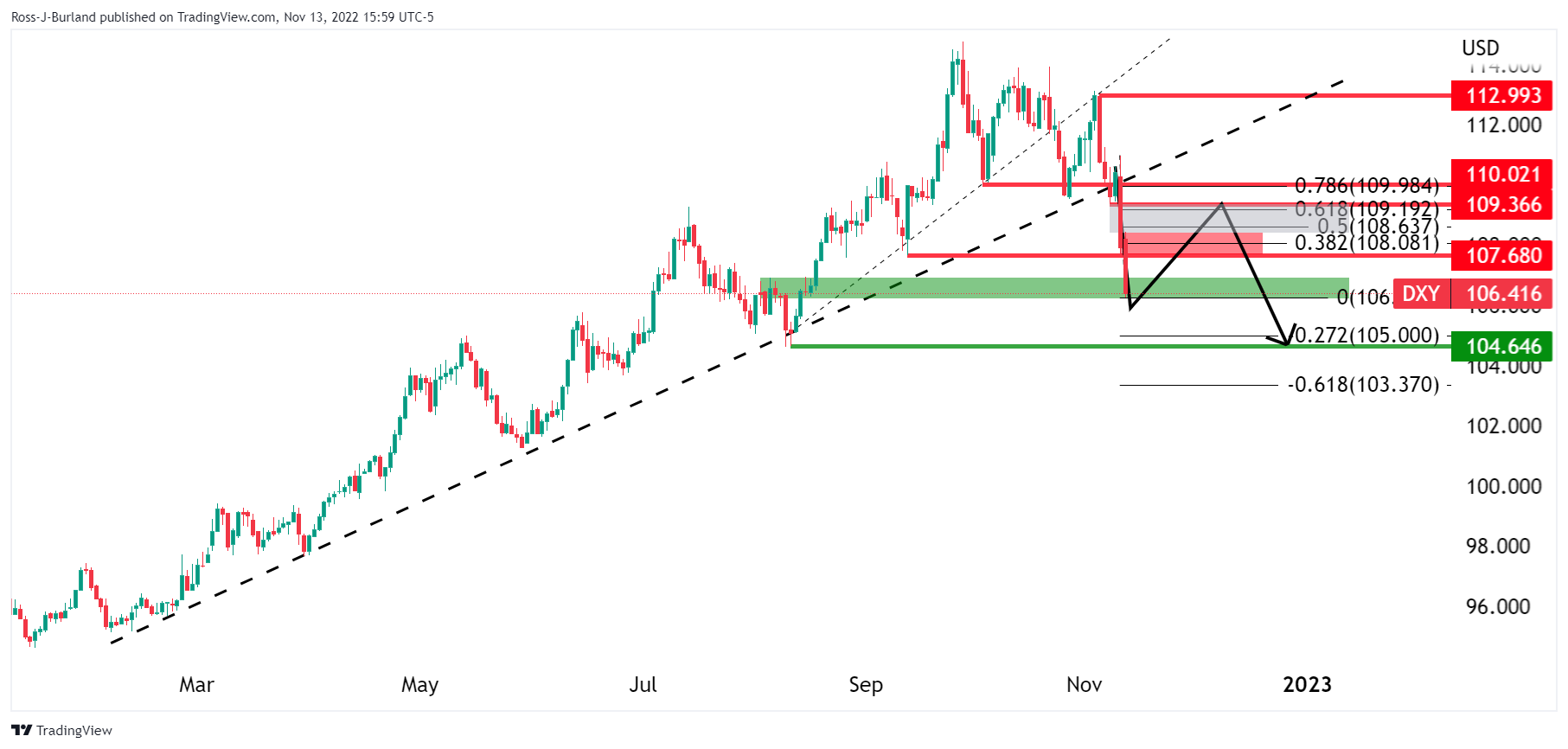
The bears are now meeting support at the lower quarter of the 106 area which could serve as a foundation for a significant correction.  A break of 108.00 opens the risk of a prolonged reversion up the Fibonacci scale towards 109.50. 

Meanwhile, eyes will be on the lower time frames for confirmation of a deceleration of the downside:

The index remains on the front side of the micro trendline on the hourly trend, so until it breaks through, the downside remains intact. 

Author

Ross J Burland

Ross J Burland, born in England, UK, is a sportsman at heart. He played Rugby and Judo for his county, Kent and the South East of England Rugby team.


More from Ross J Burland
Share:

Editor's Picks

EUR/USD retreats below 1.1800 as EU-US trade relations sour

EUR/USD loses its traction and retreats below 1.1800 following the earlier climb. The data from Germany highlighted a modest improvement in business sentiment in February but failed to help the Euro as investors assess the US-EU trade relations following Trump's global tariff hike announcement.

GBP/USD rises toward 1.3550 as tariff confusion slams USD

GBP/USD extends the advance toward 1.3550 on Monday. The US Dollar faces intense selling pressure as tariff uncertainty lingers following US President Trump's latest announcement. Traders will take more cues from the broader market sentiment and central bank talks. 

Gold climbs above $5,100 on broad USD weakness

Gold sticks to its bullish bias near the monthly above $5,100 on Monday. Renewed trade-war fears, along with rising geopolitical tensions in the Middle East, turn out to be key factors that underpin the safe-haven precious metal and validate the constructive outlook.

Cardano braces for impact as US tariff storm brews

Cardano is down 4% at press time on Monday, entering its third consecutive day of decline. Bearish bias in Cardano’s derivatives market positional buildup aligns with rising pressure on the broader cryptocurrencymarket amid US President Donald Trump's reassessment of global tariffs and domestic conflict with the US Supreme Court. 

Supreme Court nixes tariffs, Trump teases 15% global tariff

On February 20th, the Supreme Court ruled that Trump’s global tariffs under IEEPA authority were unconstitutional, effectively nullifying the framework. However, the relief was short-lived. Within hours, Trump floated a 15% blanket tariff under an alternative legal authority.

Top Crypto Losers: Zcash, Pump.fun, and LayerZero extended losses as Bitcoin loses $65,000

The cryptocurrency market starts the week in panic mode, with altcoins Zcash, Pump.fun, and LayerZero. Bitcoin falls below $65,000 as the US President Donald Trump regroups amid renewed trade policy risks.