|

Tesla stock ($TSLA) buying the dips at the blue box area

In this technical article we’re going to take a quick look at the Elliott Wave charts of Tesla Stock ( $TSLA ) . As our members know, the stock is trading within the cycle from the April 27th low. We have been calling for the rally in the stock after 3 waves pull back. Our team recommended members to avoid selling Tesla, while keep favoring the long side. In the further text we are going to explain the Elliott Wave Forecast and the trading setup.

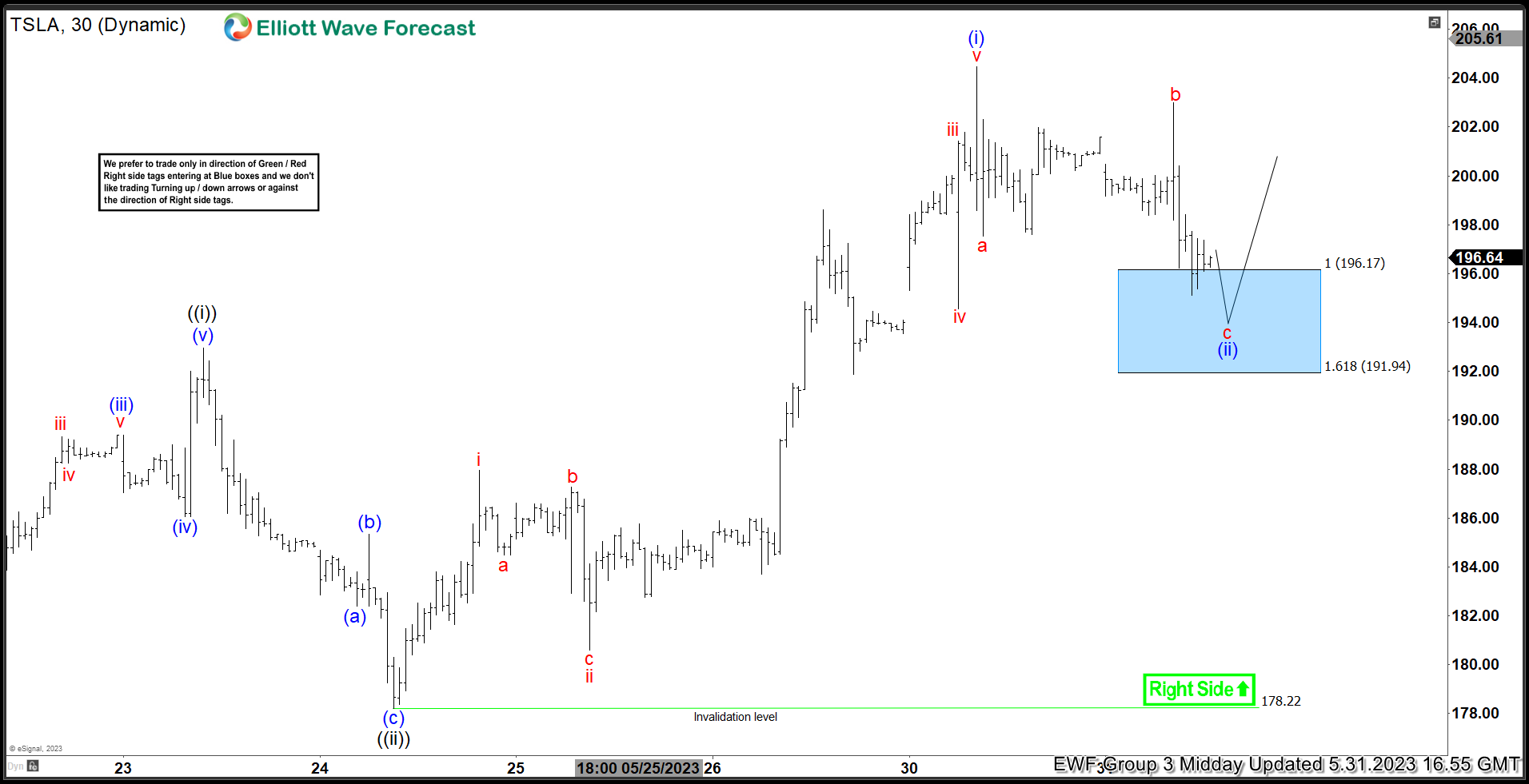
Tesla stock ($TSLA) Elliott Wave 1-hour chart 05.31.2023

Current view suggests the stock is doing correction of the cycle from the 178.22 low.  We got 5 waves up from the mentioned low wave  and now about to complete (ii) blue short term pull back.  We can already count 3 waves down from the peak. The price has reached extreme zone at 196.17-191.94 ( blue box- buying zone) . We don’t recommend selling it and prefer the long side.  Tesla stock should ideally make a rally toward new highs.
Chart

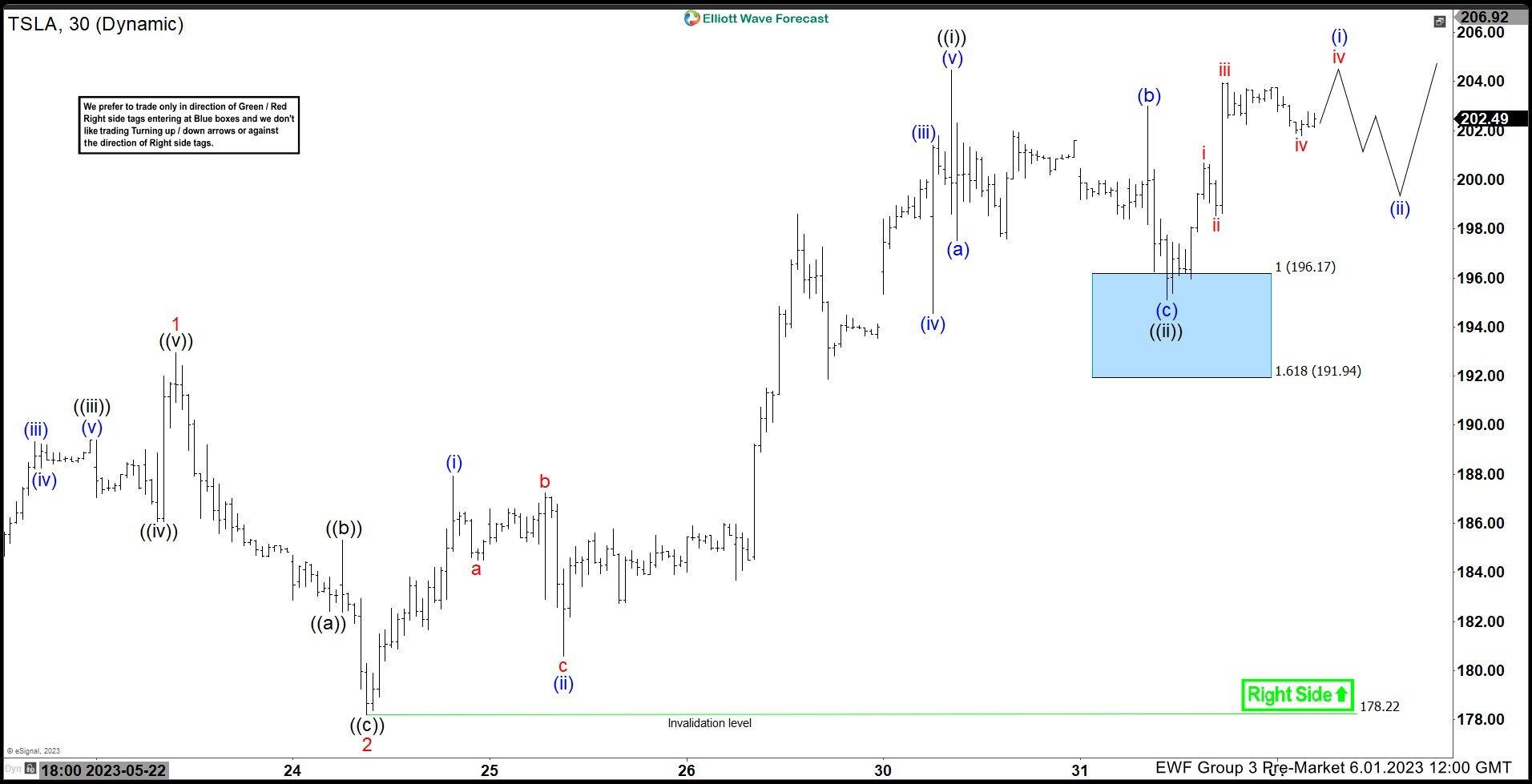
Tesla stock ($TSLA) Elliott Wave 1-hour chart 06.01.2023

$TSLA found buyers right at the Blue Box area and we are getting good reaction from there. Rally made enough separation from the lows.  As a result, members who took long positions are enjoying profits in a risk free trades. Wave ((ii)) looks completed at 195.17 low . As far as the price holds above that low, the stock can be trading higher in ((iii)) toward new highs. We would like to see break above previous peak ((i)) black which will confirm next leg up is in progress.  That would also make 5 waves up in (i) blue. Then we expect to get 3 waves pull back before further rally continues again.
Chart

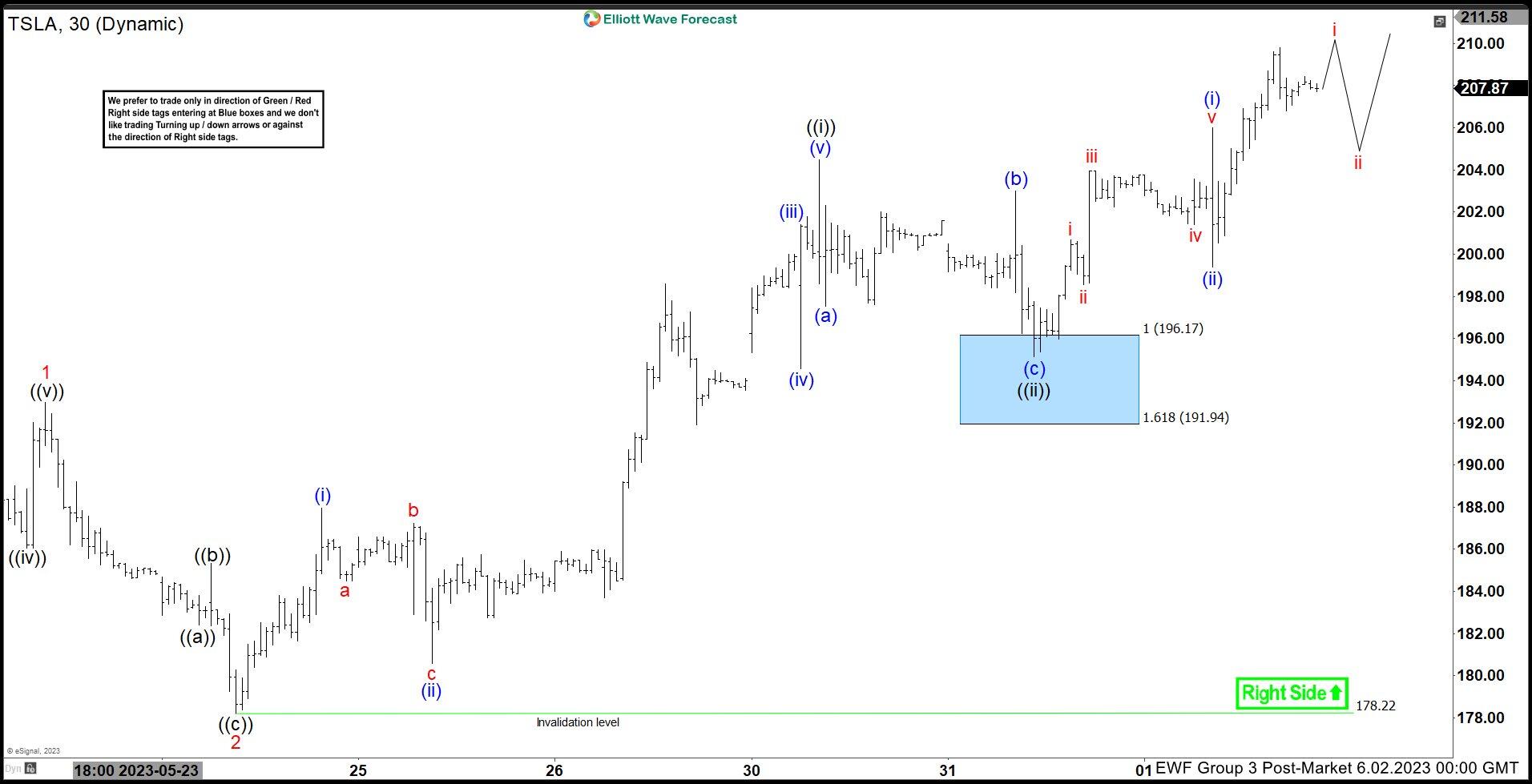
Tesla stock ($TSLA) Elliott Wave 1-hour chart 06.02.2023

Eventually the stock made break up as expected. It completed 5 waves up in (i) blue, made pull back in (ii) blue and continued higher again.
Chart

Author

Elliott Wave Forecast Team

Elliott Wave Forecast Team

ElliottWave-Forecast.com

More from Elliott Wave Forecast Team
Share:

Editor's Picks

EUR/USD gains traction to near 1.1800 as tariff uncertainty weighs on US Dollar

The EUR/USD pair holds positive ground around 1.1795 during the early Asian session on Tuesday. The US Dollar weakens against the Euro amid US tariff uncertainty. The release of the US January Producer Price Index report will be in the spotlight later on Friday. 

GBP/USD treads water near 1.3500 as BoE-Fed divergence debate stalls

GBP/USD spent Monday spinning in place as market participants await a fresh catalyst to break the pair out of its recent range. The BoE's February hold came with a surprisingly dovish 5-4 split, and UK Consumer Price Index data last week showed inflation easing to 3.0%, reinforcing the case for earlier rate cuts, with most economists now looking to April or March for the next move. 

Gold down but not out as key $5,140 support holds

Gold consolidates the advance to monthly top of $5,250 in Tuesday’s Asian trades. The US Dollar finds demand as liquidity returns and risk sentiment recovers, despite US tariffs uncertainty. Gold defends 61.8% Fibo resistance at $5,142 amid the pullback, daily RSI remains bullish.

Top Crypto Losers: BCH, HYPE, PUMP extend losses as Bitcoin drops below $64,000

Altcoins, including Bitcoin Cash, Hyperliquid, and Pump.fun, are leading losses over the last 24 hours as Bitcoin falls below $64,000 on Tuesday. The technical outlook for BCH, HYPE, and PUMP flags downside risk amid broader market selling.

Supreme Court nixes tariffs, Trump teases 15% global tariff

On February 20th, the Supreme Court ruled that Trump’s global tariffs under IEEPA authority were unconstitutional, effectively nullifying the framework. However, the relief was short-lived. Within hours, Trump floated a 15% blanket tariff under an alternative legal authority.

XRP recovers slightly as bearish sentiment dominates crypto market

Ripple is rising above $1.40 at the time of writing on Monday amid fresh tariff-triggered headwinds in the broader cryptocurrency market. The sell-off to $1.33, the token’s intraday low, can be attributed to macroeconomic uncertainty, geopolitical tensions and risk-averse sentiment among other factors.