|

S&P 500 and market breadth

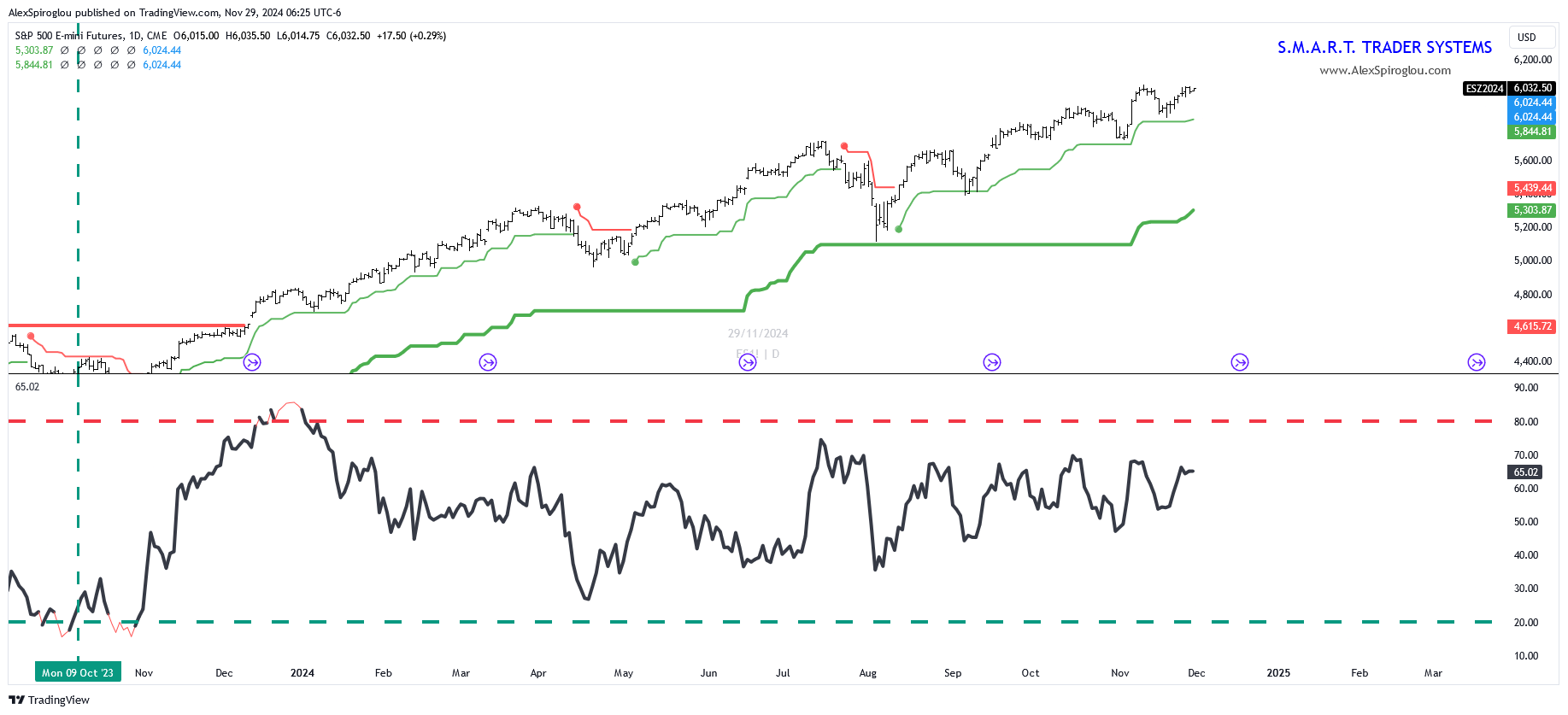
The chart of the S&P 500 alongside the percentage of NYSE stocks trading above their 50-day Exponential Moving Average (EMA) provides a snapshot of market breadth —a measure of participation across individual stocks.

Currently, 65% of NYSE stocks are above their 50 EMA, a healthy sign indicating broad market participation in the upward trend.

Market breadth is an important indicator for understanding overall market momentum. The percentage above the 50 EMA highlights how many stocks are in a short-term bullish phase. When a large proportion of stocks exceed this threshold, it often suggests robust underlying strength in the market. Conversely, a decline below key levels may signal weakening participation and potential trend reversals.

At 65%, the breadth suggests the market is in a favorable position, yet it has not reached extreme levels that typically warn of overbought conditions or momentum exhaustion.

Historically, readings closer to 80% or higher often coincide with temporary peaks, as buying pressure becomes overstretched. This middle-ground level reflects sustained bullish momentum without the risks associated with euphoria.

Monitoring market breadth helps traders gauge whether the broader market supports price action in major indices like the S&P 500. A divergence, where the index rises but breadth declines, can be an early warning of weakening momentum. For now, the positive breadth supports the current rally, reinforcing confidence in the market’s short-term trend.
Chart

Author

Alex Spiroglou, CFTe, DipTA (ATAA)

Alex Spiroglou is a quasi-systematic, cross-asset proprietary futures trader. His involvement with capital markets began in 1998, having worked for various proprietary trading and investment management firms in the UK and Greece.


More from Alex Spiroglou, CFTe, DipTA (ATAA)
Share:

Editor's Picks

EUR/USD: US Dollar to remain pressured until uncertainty fog dissipates

Unimpressive European Central Bank left monetary policy unchanged for the fifth consecutive meeting. The United States first-tier employment and inflation data is scheduled for the second week of February. EUR/USD battles to remain afloat above 1.1800, sellers moving to the sidelines.

GBP/USD softens to near 1.3600 as BoE hints further rate cuts

The GBP/USD pair loses ground to near 1.3610 during the early Asian session on Monday. The Pound Sterling softens against the Greenback amid growing expectations of the Bank of England’s interest-rate cut. Traders will take more cues from the Fedspeak later on Monday.

Gold holds gains near $5,000 as China's gold buying drives demand

Gold price clings to the latest uptick near $5,000 in Asian trading on Monday. The precious metal holds its recovery amid a weaker US Dollar and rising demand from the Chinese central bank. The delayed release of the US employment report for January will be in the spotlight later this week.

Bitcoin Weekly Forecast: The worst may be behind us

Bitcoin price recovers slightly, trading at $65,000 at the time of writing on Friday, after reaching a low of $60,000 during the early Asian trading session. The Crypto King remained under pressure so far this week, posting three consecutive weeks of losses exceeding 30%.

Weekly column: Saturn-Neptune and the end of the Dollar’s 15-year bull cycle

Tariffs are not only inflationary for a nation but also risk undermining the trust and credibility that go hand in hand with the responsibility of being the leading nation in the free world and controlling the world’s reserve currency.

XRP rally extends as modest ETF inflows support recovery

Ripple is accelerating its recovery, trading above $1.36 at the time of writing on Friday, as investors adjust their positions following a turbulent week in the broader crypto market. The remittance token is up over 21% from its intraday low of $1.12.