Shopify Stock Forecast: Deliverr acquisition may give SHOP a boost after Netflix-driven loss
- Netflix plunging 35% on poor growth outlook trickled over to other growth stocks on Wednesday.
- SHOP stock lost 13.3% on Wednesday trading.
- Shopify shares gained 1.8% afterhours after announcing Deliverr acquisition.

Shopify (SHOP) stock may have a plan to recover ground lost on Wednesday with the possible acquisition of Deliverr, a Silicon Valley-based fulfillment company that provides merchants with the ability to deliver goods within two days. This would be another step in Shopify's campaign to convert from a software-only service for mom-and-pop e-commerce outfits to a full-service solution that also aids in shipping and fulfillment. SHOP stock dropped 13.3% to $525 in Wednesday's session on the heels of Netflix's breathtaking plunge.
Read more stock market research
Shopify Stock News: King of growth falters
Netflix, long the very face of growth stocks in the US, shed more than 35% of its value on Wednesday after the streaming giant announced its first net subscriber loss in more than a decade. The fact that it also guided for 2 million additional losses in Q2 signaled to growth investors that the party might be over for other growth stars. Shopify meets that criteria perfectly. Between its IPO in May 2015 and its all-time high just last autumn, SHOP stock gained nearly 62 fold. The pandemic alone saw the share price triple. With growth stocks on the decline in popularity due to inflation and interest rate hikes, SHOP had already lost all of its pandemic gains before Wednesday's drop.
The beleaguered e-commerce sales platform has gained 2.4% in Thursday's premarket, however, as the market takes stock of whether SHOP's sell-off was overdone and how Deliverr might augment its current client offerings. Bloomberg announced that Shopify was in talks to buy Deliverr, with hearsay putting the figure at $2 billion. Neither company is responding to the reports on Thursday. Deliverr analyses where users are located for various specific goods they might order. Sellers can then use Deliverr's systems of warehouses to position goods geographically in order to ship them more quickly. Faster shipping may then lead to repeat customers. Deliverr was valued at $2 billion last November when it raised $250 million in a round sponsored by Tiger Global
Until now Shopify, which sets up online stores for smaller retailers and processes their payments, has used third-party logistics companies for delivery and fulfillment. By performing fulfillment in-house, Shopify would become more like its primary competitor, Amazon (AMZN).
Shopify will provide Q1 earnings on May 5.
SHOP key statistics
| Market Cap | $76 billion |
| Price/Earnings | 82 |
| Price/Sales | 14 |
| Price/Book | 6 |
| Enterprise Value | $70 billion |
| Operating Margin | 21% |
| Profit Margin |
17% |
| 52-week high | $1,762.92 |
| 52-week low | $510.02 |
| Short Interest | 6% |
| Average Wall Street Rating and Price Target | Buy, $1,532 |
Shopify Stock Forecast: $594 is the first upside target
SHOP stock bottomed out at $510 in mid-March. Since then it has made attempts at recovery, even ranging as high as $780. $703 has proved to be strong resistance, however. Every break above $700 in recent months has dwindled quickly. If SHOP breaks $510, then it might not find support until $305.30, the covid nadir from two years back. This price level also has support from autumn 2019.
With today's Deliverr announcement, SHOP should see some pick-up in share price. At the moment it seems slight, but if market sentiment turns around then SHOP could make a run for $594. This price level served as resistance in early 2020 at least twice as well as several instances in the past two months. Above here, $703 is the next logical bullish target.
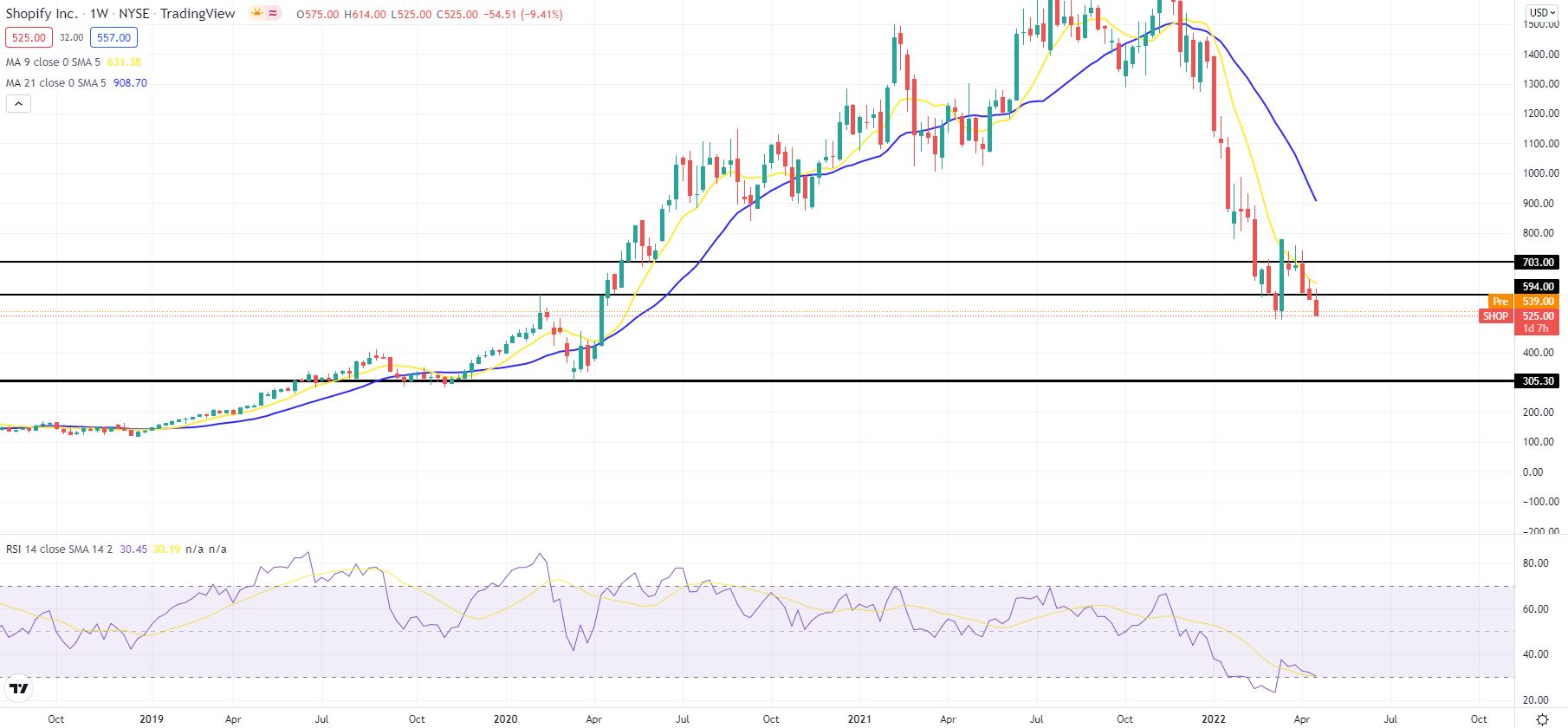
SHOP 1-week chart
Premium
You have reached your limit of 3 free articles for this month.
Start your subscription and get access to all our original articles.
Author
Clay Webster
FXStreet
Clay Webster grew up in the US outside Buffalo, New York and Lancaster, Pennsylvania. He began investing after college following the 2008 financial crisis.