Salesforce Stock Earnings: CRM rallies above $250 as Dow leaves other indices in the dust
- Salesforce beats Wall Street earnings forecast for Q3.
- CRM stock jumps 9% at the open on Thursday.
- Dow Jones continues to lead NASDAQ, S&P 500 as Salesforce is a component.
- PCE inflation for October was reported largely in line with expectations.


Salesforce (CRM) stock has gained 8.6% late in Thursday's session, rising to $250 per share. The enterprise software company utilized artificial-intelligence-based (AI) integrations in its product suite to grow profits and revenue for the third quarter.
Salesforce’s stock price jumped more than 9% at Thursday’s open. This helped the Dow Jones (DJIA) climb to its highest gain of the week, up 1% late in the session. Salesforce comprises about 4.3% of the Dow index.
Both the S&P 500 and NASDAQ Composite are losing ground in contrast. The S&P 500 is down by just a few basis points, while the NASDAQ has lost about 0.7%. Inflation data from the Personal Consumption Expenditures (PCE) report for October largely printed in line with consensus and showed inflation waning.
Salesforce stock earnings: AI saves the day
Salesforce reported adjusted earnings per share (EPS) of $2.11, five cents better than the average Wall Street forecast, which amounted to a more than 50% increase from the same quarter a year ago. Revenue printed in-line at $8.72 billion, up 11% YoY.
Salesforce's AI-geared product Data Cloud is being run by more than 1,000 customers in a trial period. Another AI-infused platform, Einstein GPT CoPilot, is now being utilized by 17% of the Fortune 500 and conducts 1 trillion queries per week. Analysts were excited by the speed of AI adoption and view the figures as a catalyst for large-scale growth ahead.
“We are the number one AI [Customer Relationship Management],” said CEO Marc Benioff on the earnings call. “If that isn't clear already, we're leading the industry through the unprecedented AI innovation cycle.”
Analysts were also impressed by Salesforce repurchasing $1.9 billion worth of shares over the length of the quarter. Based on the share price during Q3, this likely amounted to slightly more than 1% of outstanding shares.
For the fourth quarter, Benioff’s company provided guidance between $9.18 billion to $9.23 billion, a projected gain of 10% from a year earlier, and adjusted EPS of $2.25 to $2.26, growth of 34% YoY.
JPMorgan raised its price target on CRM stock from $240 to $260, while Bank of America raised its price target from $280 to $300.
AI stocks FAQs
What is artificial intelligence?
First and foremost, artificial intelligence is an academic discipline that seeks to recreate the cognitive functions, logical understanding, perceptions and pattern recognition of humans in machines. Often abbreviated as AI, artificial intelligence has a number of sub-fields including artificial neural networks, machine learning or predictive analytics, symbolic reasoning, deep learning, natural language processing, speech recognition, image recognition and expert systems. The end goal of the entire field is the creation of artificial general intelligence or AGI. This means producing a machine that can solve arbitrary problems that it has not been trained to solve.
What are AI applications?
There are a number of different use cases for artificial intelligence. The most well-known of them are generative AI platforms that use training on large language models (LLMs) to answer text-based queries. These include ChatGPT and Google’s Bard platform. Midjourney is a program that generates original images based on user-created text. Other forms of AI utilize probabilistic techniques to determine a quality or perception of an entity, like Upstart’s lending platform, which uses an AI-enhanced credit rating system to determine credit worthiness of applicants by scouring the internet for data related to their career, wealth profile and relationships. Other types of AI use large databases from scientific studies to generate new ideas for possible pharmaceuticals to be tested in laboratories. YouTube, Spotify, Facebook and other content aggregators use AI applications to suggest personalized content to users by collecting and organizing data on their viewing habits.
What are some stocks that fit into the AI field?
Nvidia (NVDA) is a semiconductor company that builds both the AI-focused computer chips and some of the platforms that AI engineers use to build their applications. Many proponents view Nvidia as the pick-and-shovel play for the AI revolution since it builds the tools needed to carry out further applications of artificial intelligence. Palantir Technologies (PLTR) is a “big data” analytics company. It has large contracts with the US intelligence community, which uses its Gotham platform to sift through data and determine intelligence leads and inform on pattern recognition. Its Foundry product is used by major corporations to track employee and customer data for use in predictive analytics and discovering anomalies. Microsoft (MSFT) has a large stake in ChatGPT creator OpenAI, the latter of which has not gone public. Microsoft has integrated OpenAI’s technology with its Bing search engine.
Could artificial intelligence generate another stock bubble?
Following the introduction of ChatGPT to the general public in late 2022, many stocks associated with AI began to rally. Nvidia for instance advanced well over 200% in the six months following the release. Immediately, pundits on Wall Street began to wonder whether the market was being consumed by another tech bubble. Famous investor Stanley Druckenmiller, who has held major investments in both Palantir and Nvidia, said that bubbles never last just six months. He said that if the excitement over AI did become a bubble, then the extreme valuations would last at least two and a half years or long like the DotCom bubble in the late 1990s. At the midpoint of 2023, the best guess is that the market is not in a bubble, at least for now. Yes, Nvidia traded at 27 times forward sales at that time, but analysts were predicting extremely high revenue growth for years to come. At the height of the DotCom bubble, the NASDAQ 100 traded for 60 times earnings, but in mid-2023 the index traded at 25 times earnings.
Salesforce stock forecast
Salesforce stock’s gap up filled a gap formed in the first days of January 2022, when CRM stock and most of tech were beginning to experience the initial weakness that would lead to a major sell-off in that year.
The current daily chart for CRM shows two higher price levels that CRM may attain if trading respects Fibonacci technicals. These come at $259.74 (361.8% Fibo) and $271.03 (423.6% Fibo). In case of a pullback, the 161.8% Fibo at $223.22 should hold, especially since the past week’s price action consolidated once it reached this level.

CRM daily chart
The fact that Salesforce is leading the market on Thursday helps a notable trend that has developed since the Thanksgiving break. Beginning on Friday, November 24, the Dow Jones index has been showing relative strength compared to the S&P 500 and NASDAQ Composite indices.
Already noted on Wednesday, the Dow is up 1.12% midday on Thursday over this period, while the S&P 500 index has lost 0.3% and the NASDAQ Composite has fallen 0.76%. This may be due to investors moving out of growth and into the more value-focused Dow stocks.
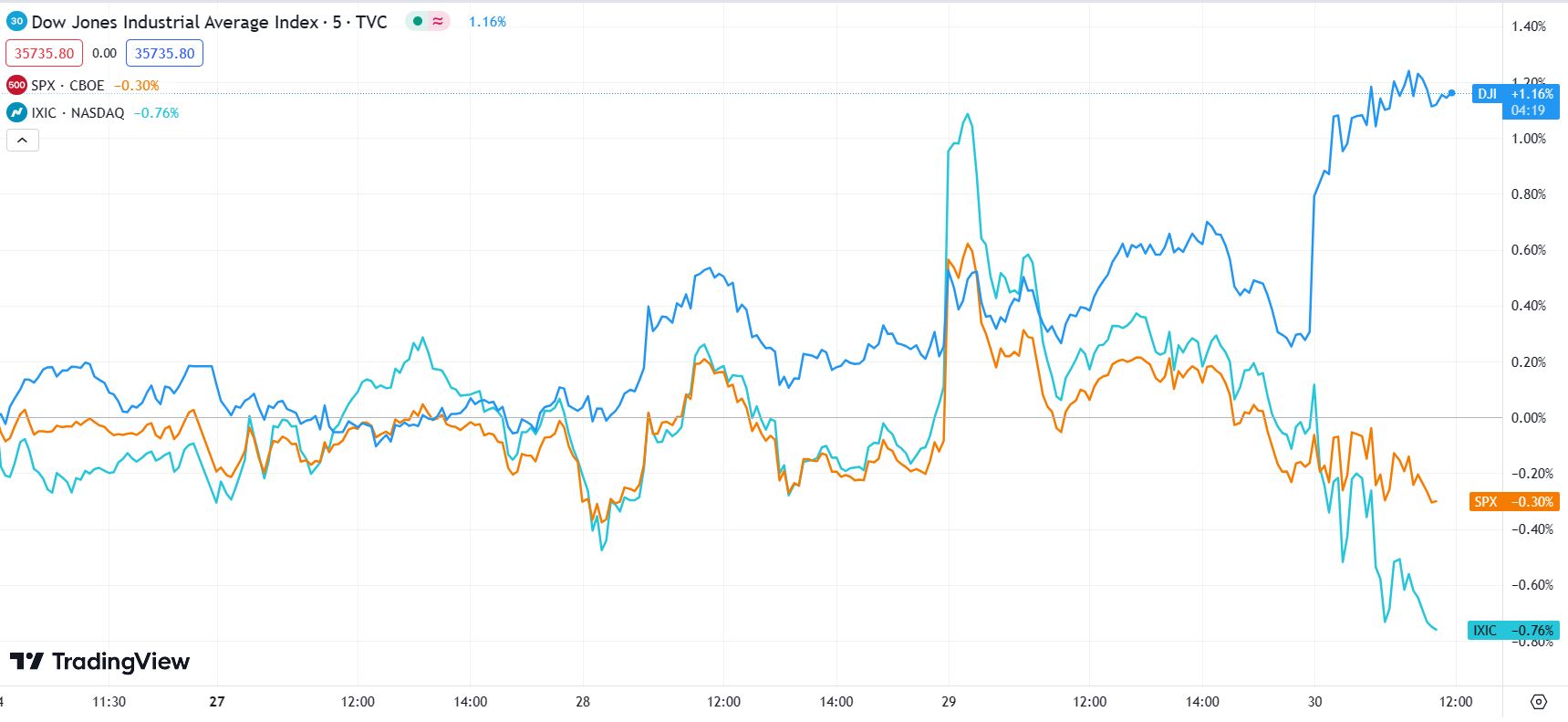
DJIA vs S&P 500 vs NASDAQ Compsosite performance since Friday, Nov 24, 2023
Premium
You have reached your limit of 3 free articles for this month.
Start your subscription and get access to all our original articles.
Author
Clay Webster
FXStreet
Clay Webster grew up in the US outside Buffalo, New York and Lancaster, Pennsylvania. He began investing after college following the 2008 financial crisis.