Pound Sterling gains against US Dollar as dovish Fed bets escalate
- The Pound Sterling gains against the US Dollar amid increasing bets that the Fed will cut interest rates by 25 bps on December 18.
- Fed Governor Michelle Bowman vowed to be cautious on interest rate cuts as price pressures are still elevated.
- Higher contributions by UK employers to the National Insurance norm in Labour’s first budget have weighed on labor demand, survey data shows.

The Pound Sterling (GBP) moves higher to near 1.2770 against the US Dollar (USD) in Monday's North American session. The GBP/USD pair rises as market participants are becoming increasingly confident that the Federal Reserve (Fed) will cut interest rates in its monetary policy meeting on December 18.
There is an 83% chance that the Fed will reduce its key borrowing rates by 25 basis points (bps) to 4.25%-4.50% next week, according to the CME FedWatch tool, up from the 62% seen a week ago. The US Dollar seems largely unbothered by increasing Fed rate cut bets, with the US Dollar Index (DXY) – which tracks the Greenback’s value against six major currencies – risinges to near 106.20.
Market speculation for the Fed to cut interest rates next week strengthened after the release of the United States (US) Nonfarm Payrolls (NFP) data for November on Friday. The report showed that the economy added 227K fresh workers, higher than estimates of 200K. The Unemployment Rate accelerated to 4.2%, as expected, from 4.1%. Average Hourly Earnings rose steadily by 0.4% and 4% on monthly and annual basis, respectively, faster than estimated.
Defying market expectations, Federal Reserve (Fed) Governor Michelle Bowman said on Friday that she would prefer “to proceed cautiously and gradually in lowering the policy rate as inflation remains elevated.”
For more cues about the current status of inflation, investors await the US Consumer Price Index (CPI) data for November, which will be released on Wednesday. Headline CPI inflation is expected to have accelerated to 2.7% from the prior release of 2.6%. The core CPI – which excludes volatile food and energy prices – is seen rising at a steady 3.3%.
Pound Sterling advances amid fears of persistent UK inflation
- The Pound Sterling trades broadly firm against its major peers, except Asia-Pacific currencies, at the start of the week as the Bank of England (BoE) is expected to be among those central banks that will follow a more gradual policy-easing cycle amid worries over price pressures remaining persistent.
- BoE Monetary Policy Committee (MPC) external member Megan Greene said on Thursday, “I suspect we'll hit our inflation target by the end of our forecast period which is three years.” Also, BoE Governor Andrew Bailey said that the central bank has still some work to do to bring inflation down below the bank’s target of 2% on Wednesday. Still, he was confident that the disinflation process is well embedded.
- On the economic front, a recent survey from the Recruitment and Employment Confederation (REC) trade body and accountants KPMG has shown a decline in the demand for workers after the release of the United Kingdom (UK) Labour’s first budget, in which the administration raised Employer’s National Insurance Contribution (NIC) to 15%. The agency reported that their index of demand for staff fell to 43.9, the lowest reading since August 2020, from 46.1 in October.
Technical Analysis: Pound Sterling aims to recapture 1.2800
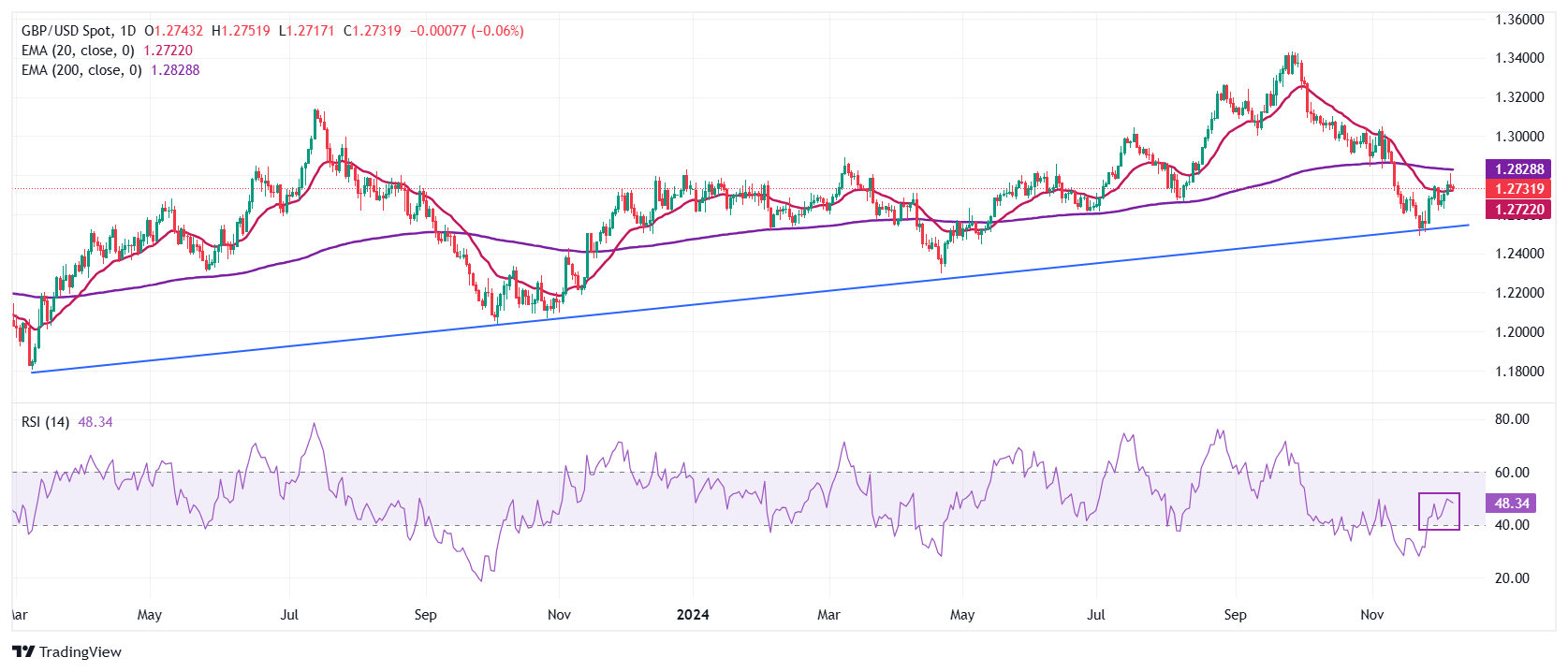
The Pound Sterling strives to reclaim the key resistance of 1.2800 against the US Dollar. The GBP/USD pair holds the 20-day Exponential Moving Average (EMA) around 1.2720.
The 14-day Relative Strength Index (RSI) oscillates in the 40.00-60.00 range, suggesting a sideways trend.
Looking down, the pair is expected to find a cushion near the upward-sloping trendline around 1.2500, which is plotted from the March 2023 low near 1.1800. On the upside, the 200-day EMA will act as key resistance.
Fed FAQs
Monetary policy in the US is shaped by the Federal Reserve (Fed). The Fed has two mandates: to achieve price stability and foster full employment. Its primary tool to achieve these goals is by adjusting interest rates. When prices are rising too quickly and inflation is above the Fed’s 2% target, it raises interest rates, increasing borrowing costs throughout the economy. This results in a stronger US Dollar (USD) as it makes the US a more attractive place for international investors to park their money. When inflation falls below 2% or the Unemployment Rate is too high, the Fed may lower interest rates to encourage borrowing, which weighs on the Greenback.
The Federal Reserve (Fed) holds eight policy meetings a year, where the Federal Open Market Committee (FOMC) assesses economic conditions and makes monetary policy decisions. The FOMC is attended by twelve Fed officials – the seven members of the Board of Governors, the president of the Federal Reserve Bank of New York, and four of the remaining eleven regional Reserve Bank presidents, who serve one-year terms on a rotating basis.
In extreme situations, the Federal Reserve may resort to a policy named Quantitative Easing (QE). QE is the process by which the Fed substantially increases the flow of credit in a stuck financial system. It is a non-standard policy measure used during crises or when inflation is extremely low. It was the Fed’s weapon of choice during the Great Financial Crisis in 2008. It involves the Fed printing more Dollars and using them to buy high grade bonds from financial institutions. QE usually weakens the US Dollar.
Quantitative tightening (QT) is the reverse process of QE, whereby the Federal Reserve stops buying bonds from financial institutions and does not reinvest the principal from the bonds it holds maturing, to purchase new bonds. It is usually positive for the value of the US Dollar.
Author
Sagar Dua
FXStreet
Sagar Dua is associated with the financial markets from his college days. Along with pursuing post-graduation in Commerce in 2014, he started his markets training with chart analysis.