Pound Sterling rallies to 1.3050 as sticky UK inflation weighs on BoE rate-cut bets
- The Pound Sterling flexes muscles against its major peers as the UK CPI report for June turned out sticky.
- UK service inflation, a key metric for BoE policymakers for decision-making on interest rates, rose steadily to 5.7%.
- Better-than-expected US Retail Sales report for June failed to weaken firm Fed rate-cut expectations.

The Pound Sterling (GBP) exhibits sheer strength in Wednesday’s New York session as the United Kingdom (UK) Office for National Statistics (ONS) has reported stubborn Consumer Price Index (CPI) data for June.
The CPI report showed that annual headline and core inflation, which excludes volatile food and energy items, rose steadily to 2.0% and 3.5%, respectively. Inflation in the service sector, which has remained a key factor in refraining Bank of England (BoE) policymakers from favoring a move to policy normalization, has remained sticky at 5.7%. On month, the headline inflation rose at a slower pace of 0.1%, as expected, from May’s reading of 0.3%.
BoE officials will likely hesitate to support the unwinding of the restrictive monetary policy stance due to sticky price pressures. Policymakers have been showing concerns about stubborn inflationary pressures in the service sector.
A stubborn UK CPI report would also diminish market speculation that the BoE will start reducing interest rates from the August meeting.
The next trigger for the Pound Sterling will be the employment data for the three-months ending in May. Economists expect the ILO Unemployment Rate to remain steady at 4.4%. The Average Earnings data, both Including and Excluding bonuses, a key measure of wage growth, is expected to have decelerated to 5.7%. Signs of easing wage growth momentum would be favorable for market expectations of BoE rate cuts.
Daily digest market movers: Pound Sterling performs strongly US Dollar, UK employment hogs limelight
- The Pound Sterling rises to a fresh annual high above the psychological resistance of 1.3000 against the US Dollar (USD). The US Dollar remains on the back foot even though the United States (US) Census Bureau reported better-than-expected Retail Sales data for June on Tuesday.
- Monthly Retail Sales remained unchanged, as expected, as higher receipts for core goods offset weak demand for automobiles. Also, May’s reading was revised higher to 0.3% from 0.1%. The Retail Sales data has slightly improved the economic outlook but cannot weigh on firm market speculation that the Federal Reserve (Fed) will start reducing interest rates from the September meeting.
- According to the CME FedWatch tool, 30-day Federal Funds futures pricing data shows that an interest rate cut in September is a done deal. The tool also shows that traders have priced in two or three rate cuts this year against one forecasted by Fed officials in the latest dot plot.
- Higher expectations for Fed rate cuts in September were boosted by the softer-than-expected CPI report for June, which signaled that the disinflation process resumed in the second quarter after stalling in the first one. Also, easing labor market conditions fuelled rate-cut prospects.
Pound Sterling Price Today:
British Pound PRICE Today
The table below shows the percentage change of British Pound (GBP) against listed major currencies today. British Pound was the strongest against the Canadian Dollar.
| GBP | EUR | USD | JPY | CAD | AUD | NZD | CHF | |
|---|---|---|---|---|---|---|---|---|
| GBP | 0.21% | 0.31% | -0.73% | 0.32% | 0.24% | -0.16% | -0.11% | |
| EUR | -0.21% | 0.12% | -0.91% | 0.12% | 0.04% | -0.35% | -0.31% | |
| USD | -0.31% | -0.12% | -1.02% | 0.00% | -0.08% | -0.43% | -0.43% | |
| JPY | 0.73% | 0.91% | 1.02% | 1.04% | 0.97% | 0.57% | 0.63% | |
| CAD | -0.32% | -0.12% | -0.00% | -1.04% | -0.09% | -0.46% | -0.43% | |
| AUD | -0.24% | -0.04% | 0.08% | -0.97% | 0.09% | -0.38% | -0.35% | |
| NZD | 0.16% | 0.35% | 0.43% | -0.57% | 0.46% | 0.38% | 0.03% | |
| CHF | 0.11% | 0.31% | 0.43% | -0.63% | 0.43% | 0.35% | -0.03% |
The heat map shows percentage changes of major currencies against each other. The base currency is picked from the left column, while the quote currency is picked from the top row. For example, if you pick the British Pound from the left column and move along the horizontal line to the US Dollar, the percentage change displayed in the box will represent GBP (base)/USD (quote).
Technical Analysis: Pound Sterling stabilizes above 1.3000
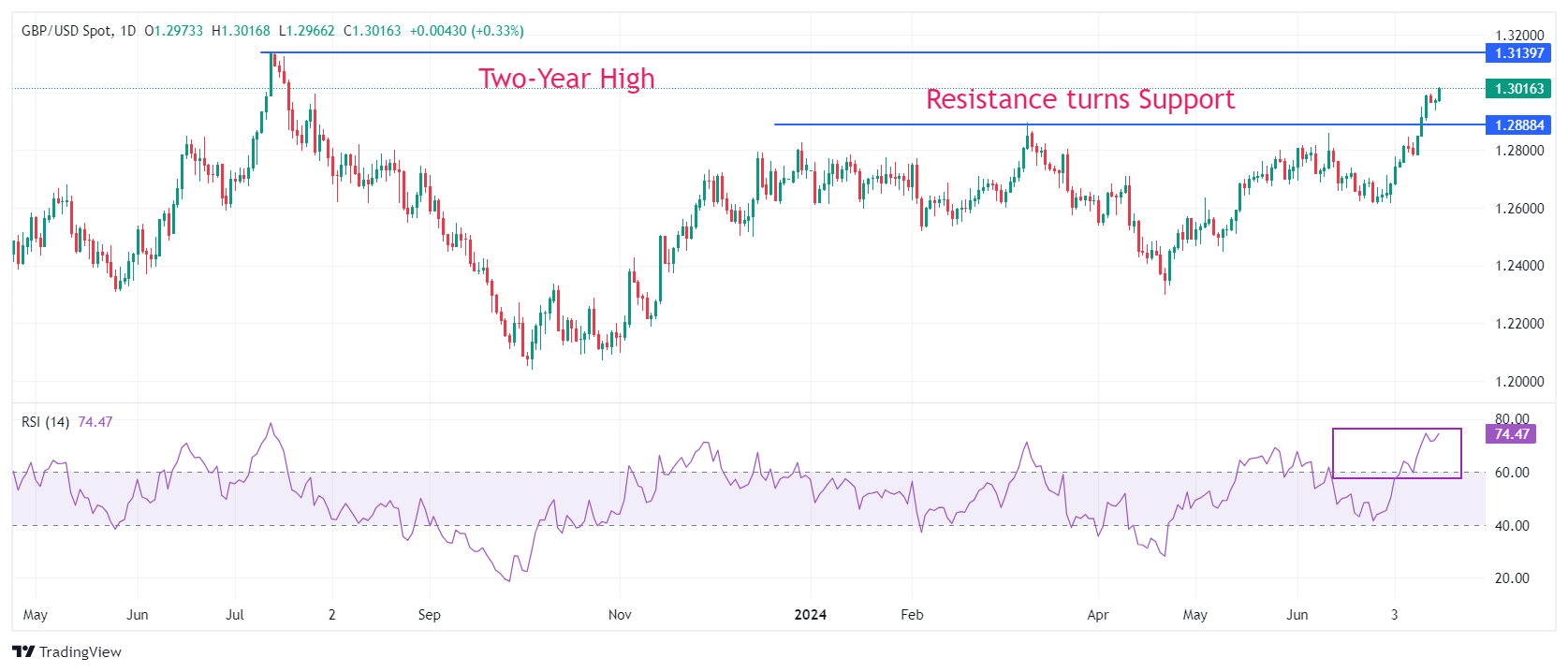
The Pound Sterling jumps above 1.3000 against the US Dollar. The near-term outlook of the GBP/USD pair remains firm as it holds the key support of the March 8 high near 1.2900, which used to be a resistance. The major is expected to extend its upside towards a two-year high near 1.3140.
All short-to-long-term Exponential Moving Averages (EMAs) are sloping higher, suggesting a strong bullish trend.
The 14-period Relative Strength Index (RSI) jumps to near 70.00 for the first time in more than a year, indicating a strong momentum towards the upside.
Inflation FAQs
Inflation measures the rise in the price of a representative basket of goods and services. Headline inflation is usually expressed as a percentage change on a month-on-month (MoM) and year-on-year (YoY) basis. Core inflation excludes more volatile elements such as food and fuel which can fluctuate because of geopolitical and seasonal factors. Core inflation is the figure economists focus on and is the level targeted by central banks, which are mandated to keep inflation at a manageable level, usually around 2%.
The Consumer Price Index (CPI) measures the change in prices of a basket of goods and services over a period of time. It is usually expressed as a percentage change on a month-on-month (MoM) and year-on-year (YoY) basis. Core CPI is the figure targeted by central banks as it excludes volatile food and fuel inputs. When Core CPI rises above 2% it usually results in higher interest rates and vice versa when it falls below 2%. Since higher interest rates are positive for a currency, higher inflation usually results in a stronger currency. The opposite is true when inflation falls.
Although it may seem counter-intuitive, high inflation in a country pushes up the value of its currency and vice versa for lower inflation. This is because the central bank will normally raise interest rates to combat the higher inflation, which attract more global capital inflows from investors looking for a lucrative place to park their money.
Formerly, Gold was the asset investors turned to in times of high inflation because it preserved its value, and whilst investors will often still buy Gold for its safe-haven properties in times of extreme market turmoil, this is not the case most of the time. This is because when inflation is high, central banks will put up interest rates to combat it. Higher interest rates are negative for Gold because they increase the opportunity-cost of holding Gold vis-a-vis an interest-bearing asset or placing the money in a cash deposit account. On the flipside, lower inflation tends to be positive for Gold as it brings interest rates down, making the bright metal a more viable investment alternative.
Author
Sagar Dua
FXStreet
Sagar Dua is associated with the financial markets from his college days. Along with pursuing post-graduation in Commerce in 2014, he started his markets training with chart analysis.

















