Pound Sterling slides as decline in UK GDP stems economic concerns
- The Pound Sterling sells off sharply after data showed the UK monthly GDP surprisingly declined by 0.1% in October.
- UK Industrial and Manufacturing Production also contracted in October compared with the previous month.
- Investors expect the Fed to pause the policy-easing spell in January after cutting interest rates next Wednesday.

The Pound Sterling (GBP) falls sharply against its major peers on Friday after the United Kingdom (UK) Office for National Statistics (ONS) reported that monthly Gross Domestic Product (GDP) and factory data surprisingly contracted in October. The report showed that the economy declined by 0.1%, as it did in September, while economists expected it to expand by 0.1%.
Both Manufacturing and Industrial Production data contracted by 0.6% month over month, posting a second consecutive monthly decline. Economists expected factory output to rebound. In the year to October, Industrial Production declined by 0.7%, while Manufacturing Production remained flat.
After the UK monthly GDP data release, Goldman Sachs has cut the UK's 2024 GDP growth forecast to 1% from the 1.2% expected previously.
Signs of consistent weakness in the factory activity suggest that producers are not operating at a high capacity on the assumption that a slowdown in the labor demand due to higher employer costs will weaken domestic consumption. The Labour Party pushed employers’ contribution to National Insurance (NI) higher to 15% from 13.8% in their first budget release, a move that led to dissatisfaction among employers.
Going forward, investors should brace for more volatility in the British currency next week, as the UK employment data for the three months ending October and the Consumer Price Index (CPI) data for November are scheduled to be released. Moreover, the Bank of England (BoE) will meet on Thursday to decide on interest rates, and markets broadly expect policymakers to leave them unchanged at 4.75%.
Daily digest market movers: Pound Sterling declines against US Dollar, Fed policy remains under spotlight
- The Pound Sterling underperforms against the US Dollar (USD) even though the latter has surrendered its intraday losses. The US Dollar Index (DXY), which tracks the Greenback’s value against six major currencies, faces selling pressure above 107.00.
- The Greenback falls back even though the hotter-than-expected United States (US) Producer Price Index (PPI) report for November adds to evidence supporting that the Federal Reserve (Fed) could pause the policy-easing cycle in January. The report showed that both headline and core producer inflation accelerated at a faster-than-expected pace to 3% and 3.4%, respectively. On month, the headline PPI surprisingly rose by 0.4%, faster than the former release of 0.3%, while the core producer inflation rose by 0.2% as expected.
- Higher producer inflation suggests rising input costs, which business owners tend to pass on to consumers, boosting overall consumer inflation and likely forcing the Fed to be cautious about cutting interest rates further.
- Traders are still fully pricing in a 25-basis-points (bps) interest-rate reduction by the Federal Reserve (Fed) in the policy meeting on Wednesday, according to the CME FedWatch tool.
Technical Analysis: Pound Sterling slides below 20-day EMA
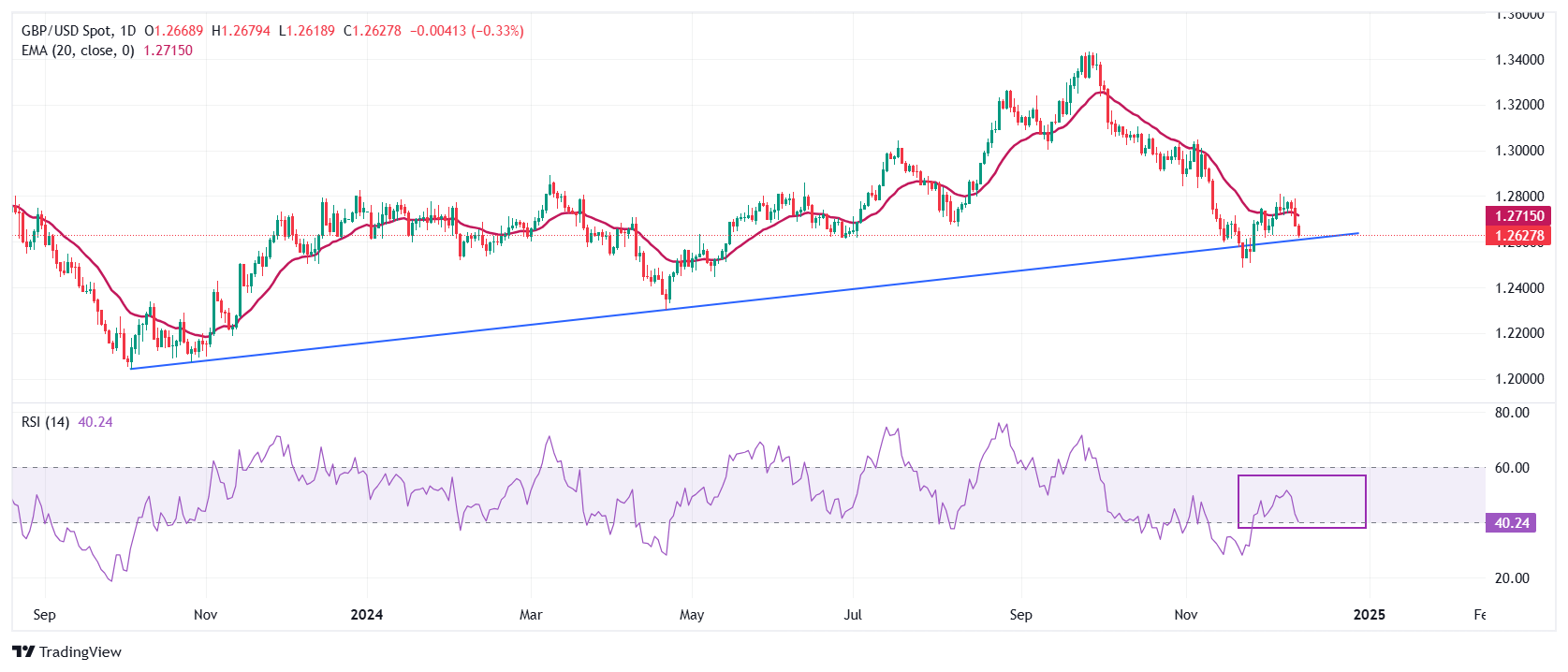
The Pound Sterling extends its downside to near 1.2625 against the US Dollar after failing to sustain above the 20-day Exponential Moving Average (EMA) around 1.2715. The GBP/USD pair drops to near the upward-sloping trendline around 1.2610, which is plotted from the October 2023 low near 1.2035.
The 14-day Relative Strength Index (RSI) slides to near 40.00. Should the RSI drops below 40.00, further bearish momentum will set off.
Looking down, the pair is expected to find a cushion near the psychological support of 1.2500. On the upside, the December 6 high of 1.2810 will act as key resistance.
Author
Sagar Dua
FXStreet
Sagar Dua is associated with the financial markets from his college days. Along with pursuing post-graduation in Commerce in 2014, he started his markets training with chart analysis.