Pound Sterling declines to 1.2700 as Fed rate-cut bets shrink
- The Pound Sterling drops to 1.2700 as delayed Fed interest rate-cut prospects dampen market sentiment.
- The strong US NFP report for May hit market speculation for Fed rate cuts.
- This week, investors will focus on UK Employment, US CPI, and the Fed’s policy decision.

The Pound Sterling (GBP) seems vulnerable against the US Dollar (USD), slightly below the round-level support of 1.2700 in Monday’s New York session. The GBP/USD pair weakens as the market sentiment turns downbeat after investors decreased their bets that leaned towards the Federal Reserve (Fed) to start reducing interest rates from the September meeting.
The CME FedWatch tool shows that 30-Day Fed Funds futures pricing data suggest a 47% chance that interest rate will be lower than the current level in September, significantly down from the 59.6% recorded a week ago.
Investors were hopeful that the Fed would commence lowering its key borrowing rates from September in the first four days of the last week. Their confidence was driven by weaker-than-expected United States (US) JOLTS Job Openings for April and ADP Employment Change data for May. However, robust labor demand and upbeat wage growth indicated by the US Nonfarm Payrolls (NFP) report for May published on Friday spooked their confidence. Strong labor market conditions suggest a stubborn inflation outlook, which would force Fed policymakers to prefer maintaining the current interest rate framework for a longer period.
Daily digest market movers: Pound Sterling remains on backfoot ahead of UK Employment
- The Pound Sterling exhibits weakness against the US Dollar as market speculation about the Fed’s interest rate path suggests that there will be only one rate cut for the entire year, in the November or December meeting. Expectations for the number of Fed rate cuts have declined to one from two after the US NFP report remained stronger than expected. The US Dollar Index (DXY), which tracks the Greenback’s value against six major currencies, rises further to 105.30.
- The next move in the US Dollar and the Pound Sterling will be guided by the US Consumer Price Index (CPI) data for May and the Fed’s monetary policy decision on Wednesday, and the United Kingdom (UK) Employment data for the February-April period on Tuesday.
- US annual core inflation, which strips off volatile food and energy prices, is estimated to have decelerated to 3.5% from the prior release of 3.6%, with headline figures growing steadily by 3.4%. Monthly headline CPI is expected to have risen at a slower pace of 0.2% from April’s reading of 0.3%, with core inflation maintaining the current pace of 0.3%.
- Meanwhile, the Fed is widely anticipated to hold interest rates steady in the range of 5.25%-5.50% for the seventh time in a row. In the press conference after the Fed’s policy decision, Fed Chair Jerome Powell may argue to keep interest rates higher until they get confidence that inflation will sustainably decline to the desired target rate of 2%.
- According to the consensus, the UK Employmnet report will show that the Unemployment Rate remained steady at 4.3%. Investors will also focus on Average Earnings, a measure of wage inflation that dictates consumer spending and is estimated to have grown steadily compared to the previous period. Bank of England (BoE) policymakers will keenly focus on the wage inflation measure, as it is a major driver of service inflation that has remained a key barrier for price pressures to return to the desired rate of 2%.
- On the political front, uncertainty over the general election in early July is expected to heat up further as the UK's opposition labor leader, Keri Starmer, announced that their party will unveil their election manifesto on Thursday. Exit polls have indicated that the Labor Party is ahead of the Conservatives.
Technical Analysis: Pound Sterling continues to hold 61.8% Fibonacci retracement support
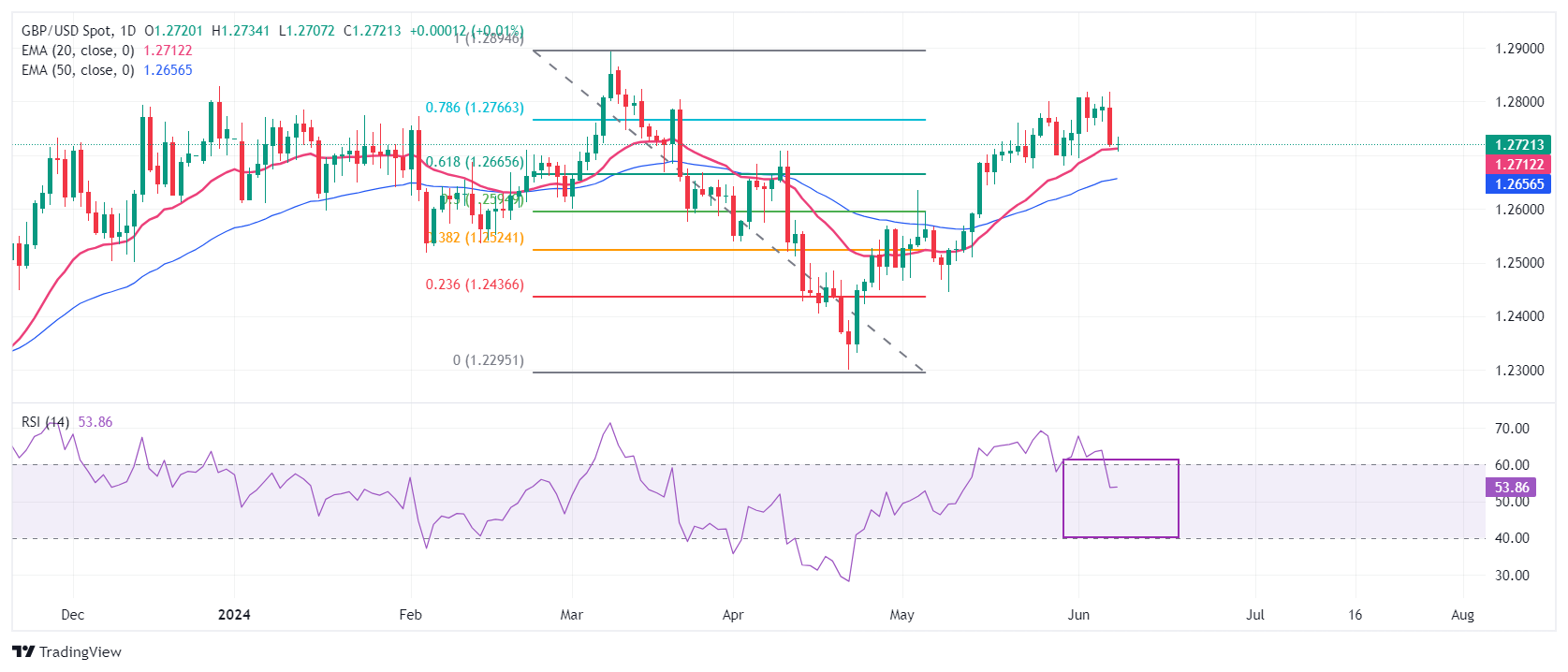
The Pound Sterling hovers below 1.2700 against the US Dollar after falling sharply from the round-level resistance of 1.2800. The GBP/USD pair falls but still holds the 61.8% Fibonacci retracement support (plotted from the March 8 high of 1.2900 to the April 22 low at 1.2300) at 1.2665.
The Cable retraces to the 20-day Exponential Moving Average (EMA), which trades near 1.2710. The 50-day EMA is still sloping higher, suggesting that the overall trend remains bullish.
The 14-period Relative Strength Index (RSI) has shifted into the 40.00-60.00 range, suggesting that the upside momentum has faded. However, the bullish bias remains intact.
Economic Indicator
Fed Interest Rate Decision
The Federal Reserve (Fed) deliberates on monetary policy and makes a decision on interest rates at eight pre-scheduled meetings per year. It has two mandates: to keep inflation at 2%, and to maintain full employment. Its main tool for achieving this is by setting interest rates – both at which it lends to banks and banks lend to each other. If it decides to hike rates, the US Dollar (USD) tends to strengthen as it attracts more foreign capital inflows. If it cuts rates, it tends to weaken the USD as capital drains out to countries offering higher returns. If rates are left unchanged, attention turns to the tone of the Federal Open Market Committee (FOMC) statement, and whether it is hawkish (expectant of higher future interest rates), or dovish (expectant of lower future rates).
Read more.Next release: Wed Jun 12, 2024 18:00
Frequency: Irregular
Consensus: 5.5%
Previous: 5.5%
Source: Federal Reserve
Author
Sagar Dua
FXStreet
Sagar Dua is associated with the financial markets from his college days. Along with pursuing post-graduation in Commerce in 2014, he started his markets training with chart analysis.