Pound Sterling rebounds as UK recession fears wane
- The Pound Sterling rebounds as the UK monthly GDP meets expectations, while factory data slumps.
- BoE rate-cut expectations for August strengthen on weak Employment data for three months ending January.
- The US Dollar falls slightly even though Fed rate cut hopes for June ease.

The Pound Sterling (GBP) rebounds in Wednesday’s early American session as the market sentiment remains cautiously optimistic. The GBP/USD pair recovered to 1.2800 as the United Kingdom Office for National Statistics (ONS) reported that the growth in the monthly Gross Domestic Product (GDP), and the Manufacturing Production data for January were broadly aligned with market expectations. For the same period, the Industrial Production data was weaker than the consensus.
The UK economy grew by 0.2% in January after reporting a technical recession in the second half of 2023. This indicates that the recession was shallow and the economic prospects are improving.
Meanwhile, the next move in the Pound Sterling will be guided by cues about when the Bank of England (BoE) will start reducing interest rates. Expectations for the BoE to cut interest rates from August rose due to cooling labor market conditions and easing inflation expectations.
Daily digest market movers: Pound Sterling revives while US Dollar slips
- The Pound Sterling recovers as the ONS reports that the United Kingdom economy expanded 0.2% in January, in line with market expectations. In December, the economy contracted by 0.1%.
- The monthly Manufacturing Production remained stagnant in January, as expected, down from the 0.8% growth seen in December. On an annual basis, the economic data grew by 2.0%, also in line with expectations, but slowing from than the prior reading of 2.3%.
- Monthly Industrial Production was surprisingly down by 0.2%, while investors projected a stagnant performance. The economic data rose by 0.6% in December. The annual factory data rose at a slower pace of 0.5% against expectations of 0.7% and the former reading of 0.6%.
- The monthly GDP growth indicates that the economic outlook is improving, which could be a tailwind for the Pound Sterling. However, factory activity continues to face pressure.
- Meanwhile, market expectations for the Bank of England reducing interest rates in August have slightly increased due to easing inflation expectations and labor market conditions cooled down in the three months ending January. US bank Citi reported that consumer inflation expectations for 12 months' time fell to 3.6% in February from 3.9% in January.
- The UK’s Unemployment Rate surprisingly climbed to 3.9%, employment levels declined, and Average Earnings excluding bonuses grew at their slowest pace since October 2022. However, wage growth is still roughly double than what required to be consistent for bringing down inflation to the 2% target.
- Meanwhile, the market sentiment remains broadly quiet as stubborn United States Consumer Price Index (CPI) data for February have uplifted expectations for the Federal Reserve keeping interest rates steady in the first half of 2024. The hot US inflation data indicated that the Fed will continue with its hawkish narrative.
- The US Dollar Index (DXY), which measures the Greenback’s value against six rival currencies, drops slightly to 102.80.
Technical Analysis: Pound Sterling trades close to 1.2800
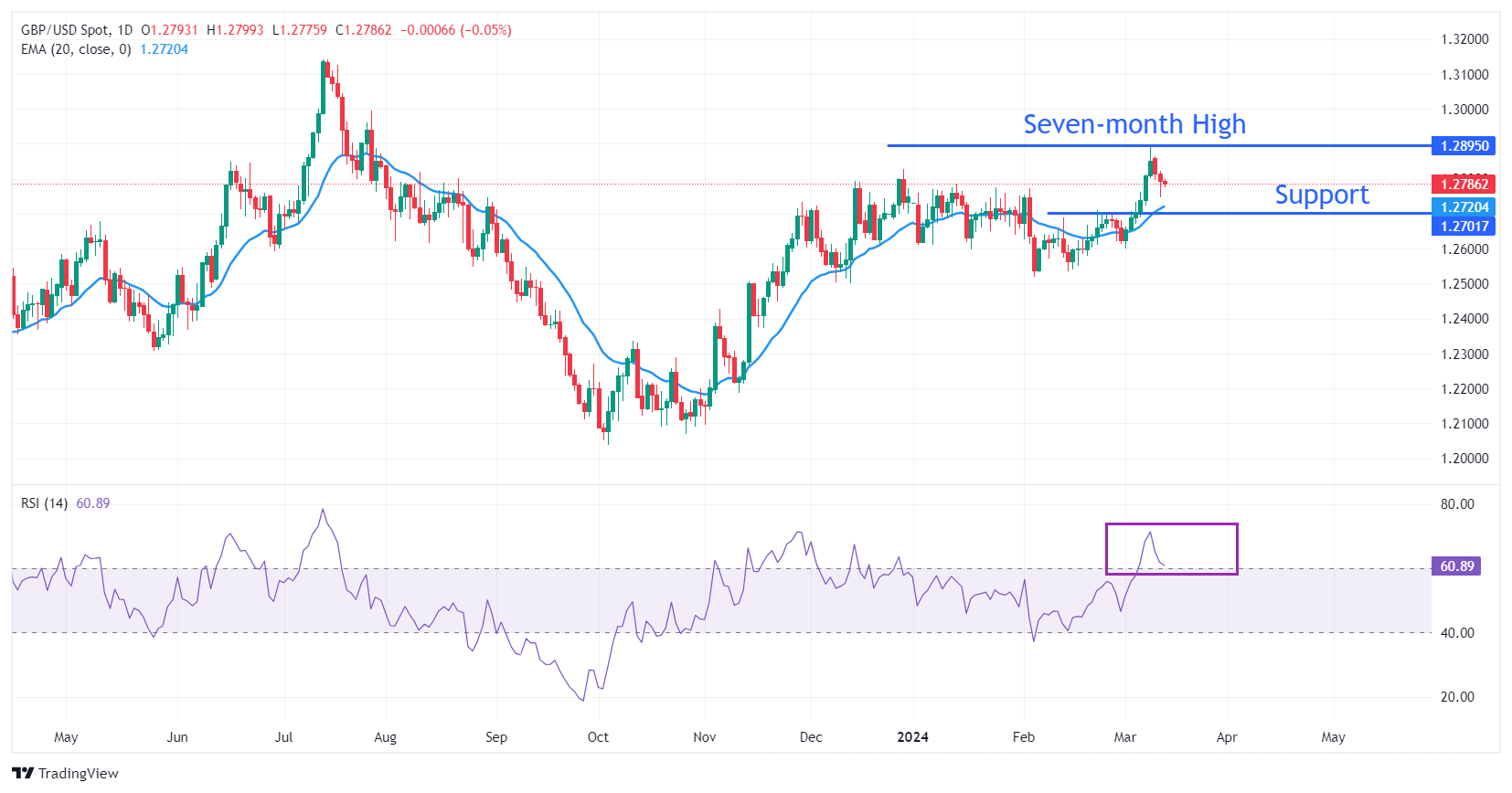
Pound Sterling continues its losing spell for the third trading session on Wednesday. The GBP/USD pair slips below the crucial support of 1.2800. The asset is expected to decline towards the 20-day Exponential Moving Average (EMA), which trades around 1.2720. The 1.2700 round-level support would be a strong cushion for the Pound Sterling bulls.
The 14-period Relative Strength Index (RSI) falls to 60.00 after turning overbought. A decisive break below 60.00 would indicate that the bullish momentum is fading.
BoE FAQs
The Bank of England (BoE) decides monetary policy for the United Kingdom. Its primary goal is to achieve ‘price stability’, or a steady inflation rate of 2%. Its tool for achieving this is via the adjustment of base lending rates. The BoE sets the rate at which it lends to commercial banks and banks lend to each other, determining the level of interest rates in the economy overall. This also impacts the value of the Pound Sterling (GBP).
When inflation is above the Bank of England’s target it responds by raising interest rates, making it more expensive for people and businesses to access credit. This is positive for the Pound Sterling because higher interest rates make the UK a more attractive place for global investors to park their money. When inflation falls below target, it is a sign economic growth is slowing, and the BoE will consider lowering interest rates to cheapen credit in the hope businesses will borrow to invest in growth-generating projects – a negative for the Pound Sterling.
In extreme situations, the Bank of England can enact a policy called Quantitative Easing (QE). QE is the process by which the BoE substantially increases the flow of credit in a stuck financial system. QE is a last resort policy when lowering interest rates will not achieve the necessary result. The process of QE involves the BoE printing money to buy assets – usually government or AAA-rated corporate bonds – from banks and other financial institutions. QE usually results in a weaker Pound Sterling.
Quantitative tightening (QT) is the reverse of QE, enacted when the economy is strengthening and inflation starts rising. Whilst in QE the Bank of England (BoE) purchases government and corporate bonds from financial institutions to encourage them to lend; in QT, the BoE stops buying more bonds, and stops reinvesting the principal maturing on the bonds it already holds. It is usually positive for the Pound Sterling.
Author
Sagar Dua
FXStreet
Sagar Dua is associated with the financial markets from his college days. Along with pursuing post-graduation in Commerce in 2014, he started his markets training with chart analysis.

















