Oil steady around weekly low while markets are unwinding risk premium over tension in Middle East
- Oil turns flat for this Friday with markets writing off Middle Eastern tensions during APAC session.
- WTI Oil prices retreat from $85.00, while Brent dips below $90.
- The US Dollar Index eases as well on a turnaround from safe haven inflows earlier on the back of headlines.

Oil prices are dropping lower with markets having assessed the situation as less risky than first expected, after Israel retaliated against Iran by attacking targets in the Western of the country, two US officials confirmed to Bloomberg. Iran restricted its airspace and confirmed together with the United Nations nuclear watchdog that no nuclear facilities were hit. The retaliatory attack adds to the possibility of a direct confrontation between Israel and Iran after years of a proxy war between the two.
The US Dollar is seeing some parts of the substantial safe haven inflow retreat from earlier, though the underlying picture does not change that much: flight to safe-haven assets is the main one as investors seek refuge amid fears that the attack could be an inflection point, dragging the whole Middle East in this dispute. Secondly, the Greenback also benefits from the recent spike in energy prices, particularly Oil, as it could cause a second-round effect in inflation in the coming months if this situation lingers on for an extended period. This opens room for even another interest-rate hike from the US Federal Reserve (Fed), although it is not the base case scenario for nearly every Fed member.
Crude Oil (WTI) trades at $82.23 and Brent Crude at $86.58 at the time of writing.
Oil news and market movers: Heading for a calm weekend
- Iran state media said attempted Israeli drone attack failed. Iran has no plans for now to strike Israel back immediatly, Reuters reported by citing a senior Iranian offical. Question though remains, if not immediate, when?
- Stephen Dainton, head of investment bank management at Barclays, said to Bloomberg that the retreat in Oil might be taking place this Friday with markets digesting the headlines, though, from now on Oil will trade in a higher range and might not slide back below $80 anytime soon
- The US Embassy in Jerusalem has issued a security alert for government officials and their families, according to Reuters.
- Iran’s communication via state television appears to be downplaying the situation, downsizing the attacks to just a few minor blasts. The New York Times, though, mentioned three Iranian officials saying that a military air base near the city of Isfahan was hit by the attack.
- Meanwhile, Israel Minister President Benjamin Netanyahu faces criticism from his National Security Minister Itamar Ben Gvir, who said in a tweet that the attack was a “weak” attempt.
Oil Technical Analysis: No pots have been broken
Oil prices rallied over 4% on the back of the headlines coming from the Middle East in early morning trading on Friday, before nosediving in the red at the start of the US session. Expect to see some easing throughout this Friday with markets assume the response from Israel was contained and Iran keeps its head cool and refrains from retaliation. Still, markets are likely to remain very headline-sensitive until Iran officially communicates.
With geopolitical tensions lingering, the $83.34 and $90 handle should remain in grasp. One small barrier in the way is $89.64, the peak from October 20. In case of further escalating tensions, expect even September’s peak at $94 to become a possibility, and a fresh 18-month high could be on the cards.
On the downside, $80.63 is the next candidate as a pivotal supportive level. A touch softer, the convergence with the 55-day and the 200-day Simple Moving Averages (SMAs) at $79.88 and $79.57 should halt any further downturn.
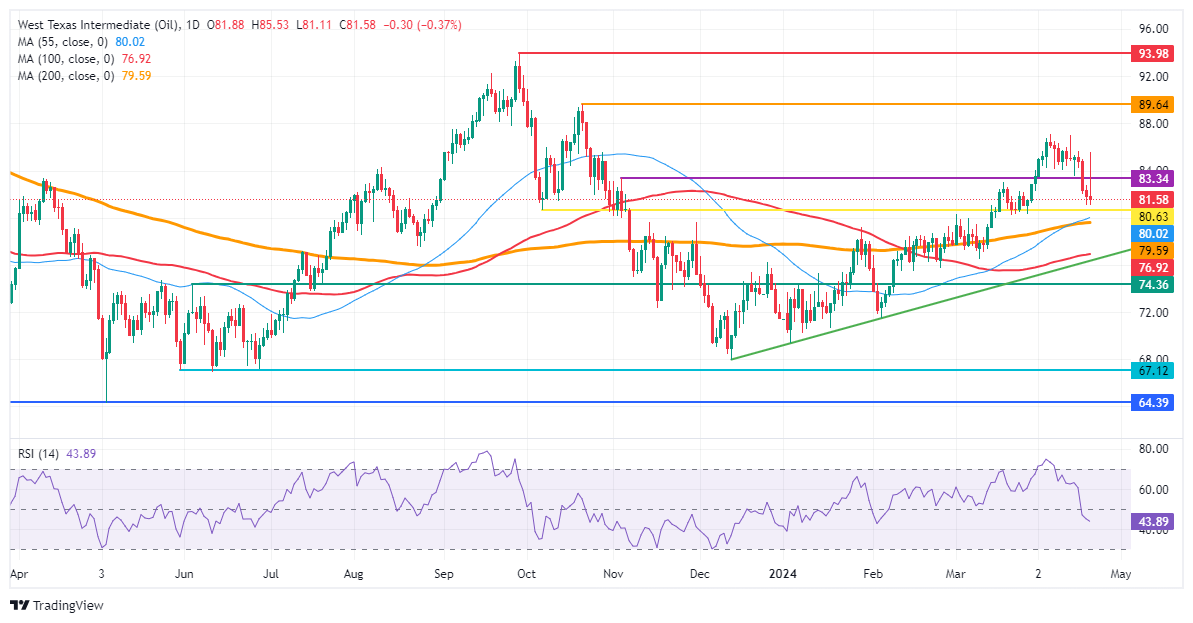
US WTI Crude Oil: Daily Chart
WTI Oil FAQs
WTI Oil is a type of Crude Oil sold on international markets. The WTI stands for West Texas Intermediate, one of three major types including Brent and Dubai Crude. WTI is also referred to as “light” and “sweet” because of its relatively low gravity and sulfur content respectively. It is considered a high quality Oil that is easily refined. It is sourced in the United States and distributed via the Cushing hub, which is considered “The Pipeline Crossroads of the World”. It is a benchmark for the Oil market and WTI price is frequently quoted in the media.
Like all assets, supply and demand are the key drivers of WTI Oil price. As such, global growth can be a driver of increased demand and vice versa for weak global growth. Political instability, wars, and sanctions can disrupt supply and impact prices. The decisions of OPEC, a group of major Oil-producing countries, is another key driver of price. The value of the US Dollar influences the price of WTI Crude Oil, since Oil is predominantly traded in US Dollars, thus a weaker US Dollar can make Oil more affordable and vice versa.
The weekly Oil inventory reports published by the American Petroleum Institute (API) and the Energy Information Agency (EIA) impact the price of WTI Oil. Changes in inventories reflect fluctuating supply and demand. If the data shows a drop in inventories it can indicate increased demand, pushing up Oil price. Higher inventories can reflect increased supply, pushing down prices. API’s report is published every Tuesday and EIA’s the day after. Their results are usually similar, falling within 1% of each other 75% of the time. The EIA data is considered more reliable, since it is a government agency.
OPEC (Organization of the Petroleum Exporting Countries) is a group of 13 Oil-producing nations who collectively decide production quotas for member countries at twice-yearly meetings. Their decisions often impact WTI Oil prices. When OPEC decides to lower quotas, it can tighten supply, pushing up Oil prices. When OPEC increases production, it has the opposite effect. OPEC+ refers to an expanded group that includes ten extra non-OPEC members, the most notable of which is Russia.
Author
Filip Lagaart
FXStreet
Filip Lagaart is a former sales/trader with over 15 years of financial markets expertise under its belt.