|

NZD/USD Price Analysis: Pair falls to 0.5800 after strong rejection at 20-day SMA

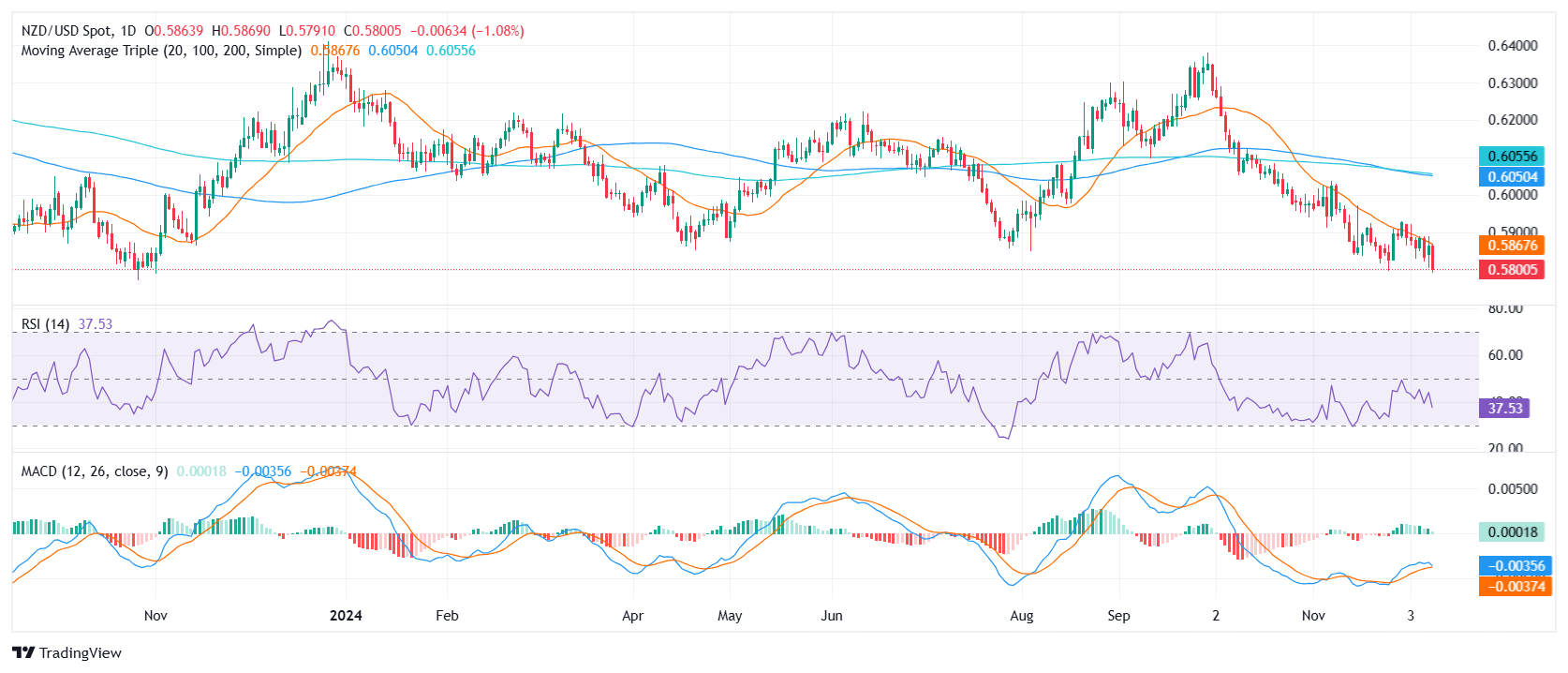
  • NZD/USD declines on Tuesday, retreating to 0.5800 after failing to reclaim the 20-day SMA.
  • Pair faces strong rejection at the 20-day SMA, falling to fresh lows not seen since November 2023.
  • RSI declines sharply in negative territory, while MACD histogram shows weakening bullish momentum with decreasing green bars.

The NZD/USD pair faced renewed selling pressure on Tuesday, dropping by 1.14% to 0.5800 after a failed attempt to reclaim the 20-day Simple Moving Average (SMA). The rejection at this key resistance level highlights the pair's inability to reverse its bearish trend, pushing it to fresh lows not seen since November 2023.

Technical indicators reinforce the bearish sentiment. The Relative Strength Index (RSI) has declined sharply to 39, remaining in negative territory and signaling intensifying selling pressure. Similarly, the Moving Average Convergence Divergence (MACD) histogram prints decreasing green bars, suggesting weakening bullish momentum and a lack of recovery signals.

With the pair now trading near the critical 0.5800 psychological support level, the downside risks remain elevated. A break below this level could pave the way for further declines, potentially targeting the 0.5770-0.5750 range. On the upside, the 20-day SMA at 0.5890 remains the key barrier, with a decisive break above it needed to shift the outlook back to neutral or bullish.

NZD/USD daily chart
Author

Patricio Martín

Patricio is an economist from Argentina passionate about global finance and understanding the daily movements of the markets.


More from Patricio Martín
Share:

Editor's Picks

EUR/USD struggles to regain momentum in the low1.1600s

EUR/USD is giving some signs of life in the aftermath of two severe days of losses on Wednesday, reclaiming the 1.1600 hurdle and above on the back of the resurgence of a mild selling bias around the US Dollar. Moving forward, the usual US weekly Claims will take centre stage on Thursday ahead of Friday’s crucial NFP data.
 

GBP/USD tests key moving averages as growth downgrade weighs

GBP/USD was nearly flat on Wednesday, edging up 0.08% to settle around 1.3370 in a quiet session. The pair has fallen sharply from its late-January high near 1.3870 and is now testing the 200-day Exponential Moving Average, with this week's one-week forex heatmap showing Pound Sterling as one of the worst performers against the US Dollar, down about 1.4% on the week.

Gold benefits from a retreating USD; reduced Fed rate cut bets cap gains

Gold attracts some buyers for the second consecutive day on Thursday amid a modest US Dollar pullback from an over three-month high, though it remains below the $5,200 mark. Wednesday's upbeat US macro data further tempered hopes for three rate cuts by the Fed in 2026. Furthermore, escalating Middle East tensions might continue to benefit the USD's status as the global reserve currency and contribute to capping the bullion.

Morgan Stanley files amended S-1 for spot Bitcoin ETF

Morgan Stanley submitted an amended S-1 filing to the US Securities and Exchange Commission on Wednesday, providing additional details on its proposed Bitcoin exchange-traded fund.

First Venezuela, now Iran: The US-China energy war escalates

At first glance, the latest escalation involving the United States with both Iran and Venezuela looks like another chapter in a long-running geopolitical story. But viewed through a broader strategic lens, something else may be unfolding: Energy.

Bittensor extends recovery despite retail demand slump

Bittensor, a leading Artificial Intelligence token, is aging up above $190 at the time of writing on Wednesday. Steady price increases characterise the broader crypto market, with Bitcoin holding above $71,000 and Ethereum above $2,000.