|

NZD/USD continues to cycle 0.5880, lacking momentum as broader market focuses elsewhere

  • NZD/USD remains trapped as Kiwi bulls seek upside momentum.
  • Broader market remains very much a USD game.
  • Upcoming Japan data could provide a bump for the Antipodeans if numbers deviate.

The NZD/USD finds itself range-bound as the week continues, trapped between yesterday’s high and low as the US Dollar (USD) refuses to give up ground against most of its major competitors. US Initial Jobless Claims came in better than expected, providing support for the Greenback, and a notable lack of recovery momentum leaves the Antipodeans in a slump after the USD’s bumper start to the week.

US Initial Jobless claims printed at 216K, below the previous period’s 229K, reversing the market’s forecasted increase to 234K. Several speaking notes are expected from members of the Federal Reserve (Fed) over the remainder of the day, and traders will want to keep an eye out for any fresh comments about monetary policy that could shift USD sentiment.

Things are notably light on the Kiwi (NZD) side. During the Asian session, traders will want to keep an eye on upcoming Japanese data that could produce some volatility if the numbers have any surprises. Japan's quarterly Gross Domestic Production figures are expected to show a slight decline; market forecasts are calling for a printing of 1.3%, down from the previous reading of 1.5%. 

NZD/USD: 0.5900 is the new resistance 

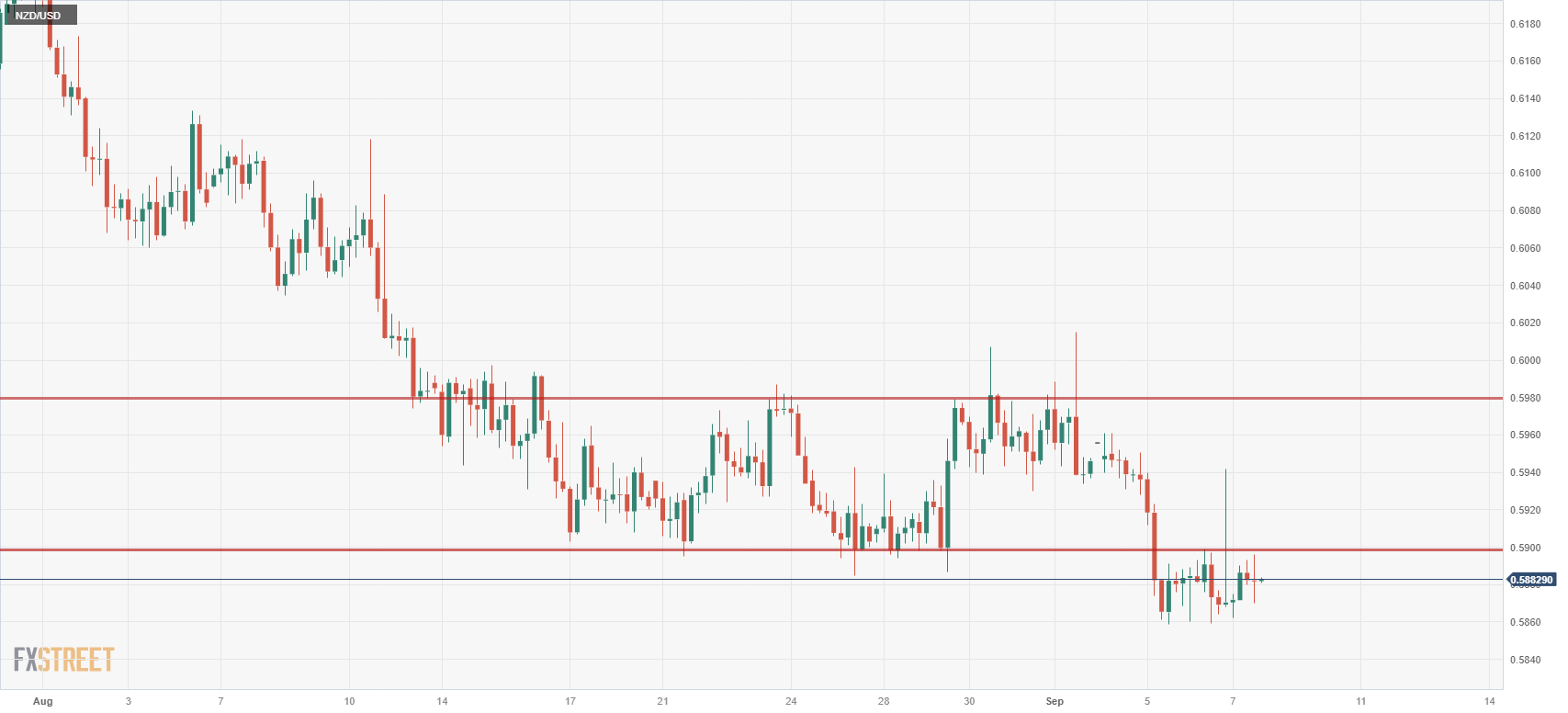
Looking out over the longer-term horizon, the Kiwi is tapping into the lowest prices for the year, touching ten-month lows near 0.5880. Continued selling pressure will see the NZD/USD pair at risk of free-falling to 2022’s lows near 0.5560, and the upside looks resistance-heavy as the NZD has clocked losses against the Greenback for six of the past seven trading weeks. 

With the Kiwi’s recent slump to the downside of the sideways channel from the last three weeks, there’s a risk the previous support from 0.5900 could now act as a near-term resistance level.

NZD/USD 4-hour chart
Author

More from FXStreet Team
Share:

Editor's Picks

EUR/USD slumps below 1.1750 as USD benefits from risk-aversion

EUR/USD comes under renewed bearish pressure in the European session and trades below 1.1750 following a recovery attempt earlier in the day. The US Dollar gathers strength and weighs on the pair as investors seek refuge in the wake of Israel and the United States' joint attack on Iran.

GBP/USD targets 1.3500 barrier near moving averages

GBP/USD rebounds from the daily losses, trading around 1.3450 during the Asian hours on Monday. The technical analysis of the daily chart indicates an ongoing bearish bias, as the pair trades within a descending channel pattern.

Gold surges on safe-haven demand, rises above $5,400

Gold benefits from intense risk-aversion on Monday and climbs above $5,400, setting a fresh monthly-high in the process. Tensions in the Middle East remain high as Israel and Hezbollah continue to exchange strikes following the US-Israel joint attack on Iran over the weekend.

Bitcoin, Ethereum and Ripple under pressure as key supports face breakdown risk

Bitcoin, Ethereum, and Ripple prices trade on the back foot at the start of this week on Monday, after extending losses in the previous week. BTC is on the brink of a breakdown, ETH is capped below key resistance, and XRP risks a crack of the trendline.

The market is paying for insurance, not apocalypse

As expected, this morning felt less like a Monday market open and more like a fire drill. Futures screens flickered red. S&P contracts down almost 1%. Nasdaq off 1.2%. Brent leaped 13% through $80. Gold rose 1.6% toward $5350 before paring some gains. The dollar is strutting mildly. The Swiss franc is quietly doing what it always does in a storm, catching some safe-haven flows.

Pi Network Price Forecast: Core team offloads supply, weighing on PI recovery

Pi Network  hovers below $0.1700, broadly steady at press time on Monday, attempting a recovery after a 2% loss the previous day. Sunday’s decline aligned with nearly 49 million PI tokens offloaded by the Pi Foundation, implying a spike in supply pressure that capped the prevailing four-day recovery.