Nvidia Stock News and Forecast: Hedge funds charge back into semis
- Hedge funds filed their Q1 13Fs with the SEC this week.
- Many of the largest funds bought Nvidia stock and other semis.
- NVDA stock is up 104% YTD.
- Nvidia bulls only have $313 level between them and the all-time high.

Amidst Monday’s brouhaha over Wedbush’s downgrade of SoFi (SOFI), which appeared to draw most eyes in the market, a more sought-after quarterly occasion transpired in the background. Hedge funds large and small reported their 13F filings with the Securities & Exchange Commission (SEC), which show what they bought and sold in the first quarter.
A noticeable development this time around was the heavy move into semiconductors by many of the most well-known hedge fund operators. Major firms started new positions and added to old positions in Nvidia (NVDA), Intel (INTC), Advanced Micro Devices (AMD), Micron (MU), Analog Devices (ADI) and Taiwan Semiconductor (TSM).
Semiconductors have mostly fared poorly over the past year as inventories from the supply-constrained pandemic period led to hoarding. Now that the drop in chip demand has pushed many semiconductor stocks to lows in late 2022 and early 2023, it appears that successful funds and managers are once again buying back into the industry.
Nvidia stock news: Focus on artificial intelligence leads to heavy demand for NVDA
As Nvidia’s share price has climbed 104% since the beginning of the year, it became clear that institutional investors were behind the enormous price gain. NVDA shares have ballooned in price as the market views its H100 GPU as the top chip in the burgeoning AI race.
Now we know who to blame.
Point72 Asset Management, the family office run by SAC Capital founder Steve Cohen, added a brand new position in NVDA stock. In the first quarter, Point72 added 980,638 shares of NVDA – a position worth more than $272 million. Though it accounts for slightly less than 1% of the overall portfolio, it is already Point72’s 12 largest investment. Point72’s largest allocation goes to S&P 500 ETF (SPY) puts that amount to 4.27% of the portfolio.
In addition to Nvidia, Point 72 added a new position in Intel of 10,407,413 shares, added 65,605 shares of Taiwan Semiconductor, and raised its stake in Analog Devices by 2%. The family office cuts its Broadcom (AVGO) stake by 11% and cut STMicroelectronics (STM) by 12%.
Famed trader Stanley Druckenmiller’s Duquesne Family Office also raised its Nvidia stake by nearly 36% to more than 791,000 shares.
Daniel Loeb’s Third Point hedge fund added new positions in Advanced Micro Devices and Micron. The fund acquired 1 million shares of AMD stock and 1.2 million of MU stock during Q1.
Nvidia stock forecast
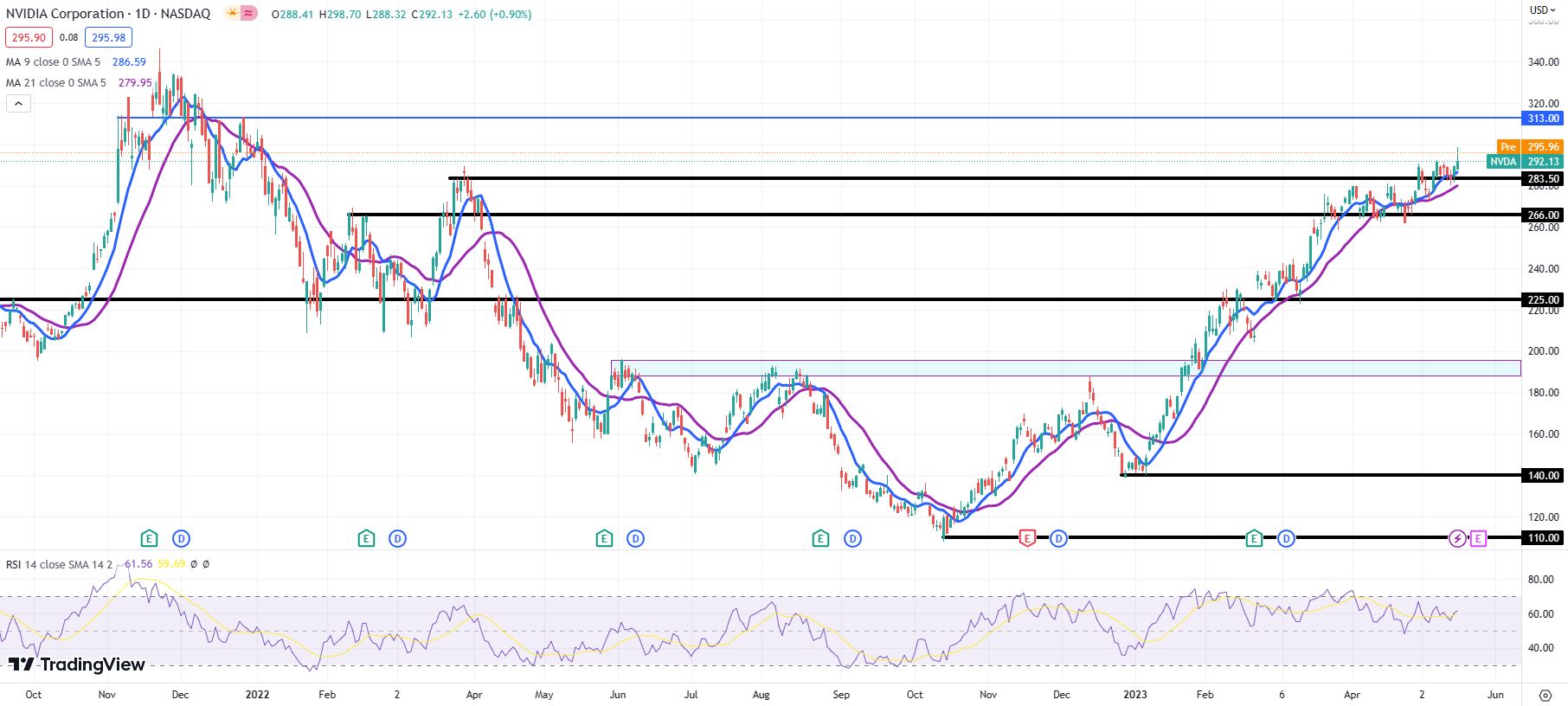
Just since this March, two months ago, Nvidia stock easily broke through resistance stemming from February 2022 at $266 and the $283.50 resistance point from March 2022. Now bulls must have their sights set on shoulder formation at $313 from late 2021. This is the only historical point of resistance from Nvidia’s all-time high at $346.47.
The AI freight train seems to have a direction of its own as the broader market has traded sideways for a few months now. Currently stuck at $289 in Wednesday’s premarket, the odds are on for it to break $300 soon enough as it is clearly a leader in the current market. The Relative Strength Index (RSI) is not yet in overbought territory. If a sell-off does emerge at some point soon, expect the region between $260 and $266 to hold up as it has been quite reliable for more than a year.
Premium
You have reached your limit of 3 free articles for this month.
Start your subscription and get access to all our original articles.
Author
Clay Webster
FXStreet
Clay Webster grew up in the US outside Buffalo, New York and Lancaster, Pennsylvania. He began investing after college following the 2008 financial crisis.