Nvidia Stock Forecast: NVDA lets go of 5% on Friday after Thursday's all-time high
- US NFP revisions worry the market on Friday.
- Unemployment Rate rises to 3.9%, above 3.7% consensus.
- China raises $27 billion investment vehicle to produce advanced chips.
- NASDAQ drops a full percentage point, while Nvidia loses 5%.

Nvidia (NVDA) stock fell more than 5% on Friday after the US Nonfarm Payrolls (NFP) data for February distressed the market. February hiring was ahead of consensus, but January data saw a large-scale revision lower, while the Unemployment Rate rose to match the two-year high at 3.9%.
Nvidia closed Friday down 5.6% at $875.28, while the S&P 500 fell 0.65% and the NASDAQ dropped 1.16% in an unusually volatile session. Arm Holdings (ARM), Advanced Micro Devices (AMD) and Super Micro Computer (SMCI) all ended the session lower as well.
Nvidia stock news: February NFP, Unemployment leads market lower
On Friday morning, the US Bureau of Labor Statistics reported that the US economy added 275K jobs in the month of February. That figure was well above the 200K that was previously estimated.
However, the market focused on the deep revision to January’s figure. Arguably, January’s spike to 353K was the primary cause for Wall Street and the Federal Reserve (Fed) pushing out the schedule for the first cut to interest rates to June. In this report, the January figure was trimmed all the way to 229K. That makes the market wonder if February’s 275K figure won’t eventually be revised much lower as well.
At the same time, the Unemployment Rate rose to 3.9%, which was a large-scale difference from the previous month’s 3.7% print. Investors compared the jump in unemployment to the month’s Average Hourly Earnings data, which only rose 0.1% from January. That rate was well below the 0.3% consensus and January rate of 0.5%. Together some analysts view the February report as a sign that the US economy is dimming.
Less dynamism in the economy and a looser labor market should give the Fed more reason to cut rates sooner, but the market on Friday seems worried that the data might be telling a more worrisome story. US Treasury yields fell for all tenures besides the 30-year as investors stormed into the safe asset at a strong pace.
In other news, the National Integrated Circuit Industry Investment Fund, called the Big Fund, in China has proposed raising another $27 billion for a third semiconductor investment vehicle. The Big Fund has already put $45 billion to work in the domestic chip industry in order to build up Chinese self-sufficiency in the realm of semiconductors.
The Biden administration has ramped up sanctions against supplying the leading chips like Nvidia's H100 to Chinese corporations, so this fund would aim its sights on investments that could counter the Western sanctions by producing AI-enabled chips at home.
Nvidia stock forecast
Nvidia stock is pulling back on Friday in what seems quite necessary since the stock has been on the warpath north all year. Just on Thursday, NVDA stock reached an all-time high of $927.67, reaching a $2.3 trillion market cap. The Relative Strength Index (RSI) has been overbought for some time, which typically requires a period of consolidation, otherwise known as a cooling-off period.
Nvidia's intraday low was at $865. If it drops below here, both $840 and $800 are the next levels to watch. March 4 and March 5 experienced bottoms near $840, while $800 buffered the price action from February 26 through March 1, acting as both resistance and support. The 20-day Simple Moving Average (SMA) is also gunning for the $800 level, which provides its with more significance. Otherwise, a major pullback could send NVDA stock back to retouch the top of the upper trendline at $730 that held Nvidia stock down from 2020 through February of this year.
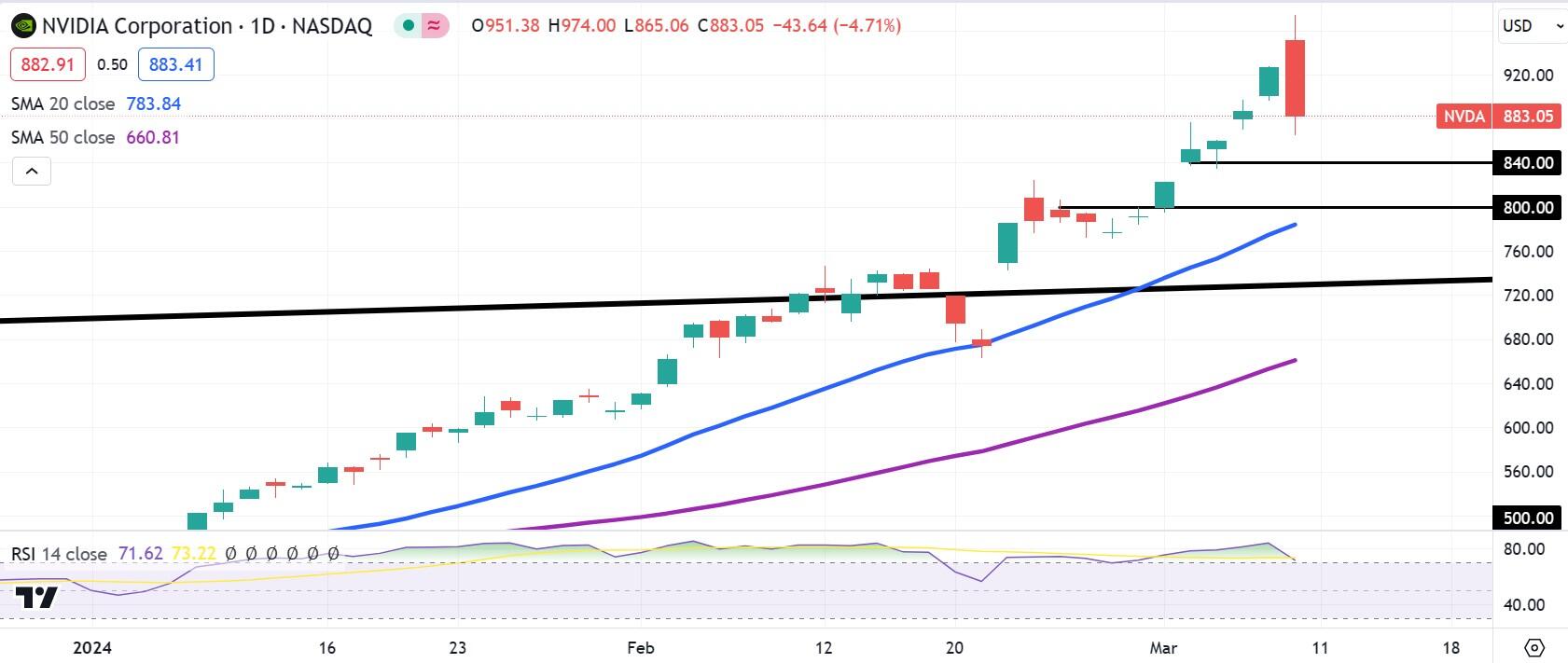
NVDA daily stock chart
Premium
You have reached your limit of 3 free articles for this month.
Start your subscription and get access to all our original articles.
Author
Clay Webster
FXStreet
Clay Webster grew up in the US outside Buffalo, New York and Lancaster, Pennsylvania. He began investing after college following the 2008 financial crisis.