Nvidia moves back toward $3 trillion as Barclays slaps NVDA with bullish $145 price target
- Nvidia trades at new split-adjusted price on Monday.
- NVDA underwent a 10-for-1 split last Friday.
- Nvidia regained $3 trillion valuation following Barclays client note.
- Advanced Micro Devices receives downgrade from Morgan Stanley.

Nvidia (NVDA) is enjoying its first session following its 10-for-1 stock split on Monday with shares rising more than 1% midday to push the semiconductor powerhouse back to a $3 trillion market cap.
Barclays bank produced a client note calling $145 per share its 12-month price target, a 20% premium on the current price.
The US equity market gained in the afternoon following a morning sell-off. Most traders look forward to Wednesday’s twofer with the Consumer Price Index (CPI) and Fed’s interest rate decision/dot plot arriving in the same session.
Nvidia stock news
Shares of Nvidia stock closed last Friday at $1208.88 and opened on Monday at the new split-adjusted price at $120.38. NVDA shares then crested toward $123 on the Barclays news.
Barclays analyst Tom O'Malley said that Nvidia was first in line for a $25 billion opportunity from sovereign nations intent on fortifying their own national capabilities using Nvidia’s artificial intelligence-focused GPU chips.
O’Malley said this could be a $25 billion opportunity and that he foresees $157.1 billion in fiscal 2026 revenue, as well as $0.61 in additional earnings per share. Nvidia’s fiscal calendar is a year ahead of the calendar, so this would refer to next year’s prospects.
Compared with existing analysts, O’Malley expects Nvidia to earn 7 cents better than the existing $3.55 per share consensus for fiscal 2026.
Nvidia’s positive review from Barclays was matched with a reticent one from Morgan Stanley in regard to Advanced Micro Devices (AMD). The analysts at the bank said projections were too rosy for AMD’s AI business.
"We like the AMD story, but investor expectations for the AI business still seem too high to us," wrote analysts in the investor note. "AMD looks expensive relative to other large cap AI plays NVDA and AVGO where we have more confidence on upward revisions to AI forecasts."
Morgan Stanley retained its $176 price target on AMD but moved it from Overweight to Equal Weight. AMD stock traded down more than 4% on Monday.
Semiconductor stocks FAQs
A semiconductor is a term for various types of computer chips. Officially called semiconductor devices, these computer chips rely on semiconductor materials like silicon and gallium arsenide to process the electrical current that produces the modern world of computing. They come in many shapes, sizes, enhancements and configurations such as diodes, transistors and integrated circuits to more complicated applications like DRAM memory, simple processors and even GPUs.
First, there are the pure chip designers, such as Nvidia, AMD, Broadcom and Qualcomm. These companies use sophisticated software to design and test chips. Second, there are the equipment manufacturers that provide the machines necessary to build computer chips. These include ASML and Lam Research. Then, there are foundries that manufacture the chips. These include Taiwan Semiconductor and GlobalFoundries. Last of all are the integrated device manufacturers who design their own chips and additionally manufacture themselves. These include Samsung and Intel.
It is the observation that the number of transistors in an integrated circuit doubles every two years. The “law” is named after Gordon Moore, who founded Fairchild Semiconductor and later Intel. The doubling is possible due to the shrinking size of process nodes or parts in the computer chip. In 1971 the advanced commercial manufacturing had reached 10 microns in width. In 1987 semiconductor technology had advanced to 800 nanometers in width. By 1999, this process had moved to 180 nanometers. By 2007, the size had dropped to 32 nanometers, and this fell all the way to 3 nanometers in 2022, which is close to the size of human DNA.
In 2022, the global semiconductor industry had revenues just under $600 billion. In total, the industry shipped 1.15 trillion semiconductor units in 2021. The leading nations involved in the semiconductor supply chain are Taiwan, the United States, China, the Netherlands, South Korea, Japan and Israel.
Nvidia stock forecast
Nvidia stock is a bit overextended, based on the Relative Strength Index (RSI) on the daily chart below. It's largely remained that way for the past three weeks. When you account for appoximately 90% of the AI chip market, things can stay that way.
There's a resistance level at $96 that could turn into support if need be, as well as stronger, long-term support from February and April in the $74 to $77 range. Most traders will buy the dip, however, at least until NVDA breaks below the 20-day Exponential Moving Average (EMA), which is now in the high $108s.
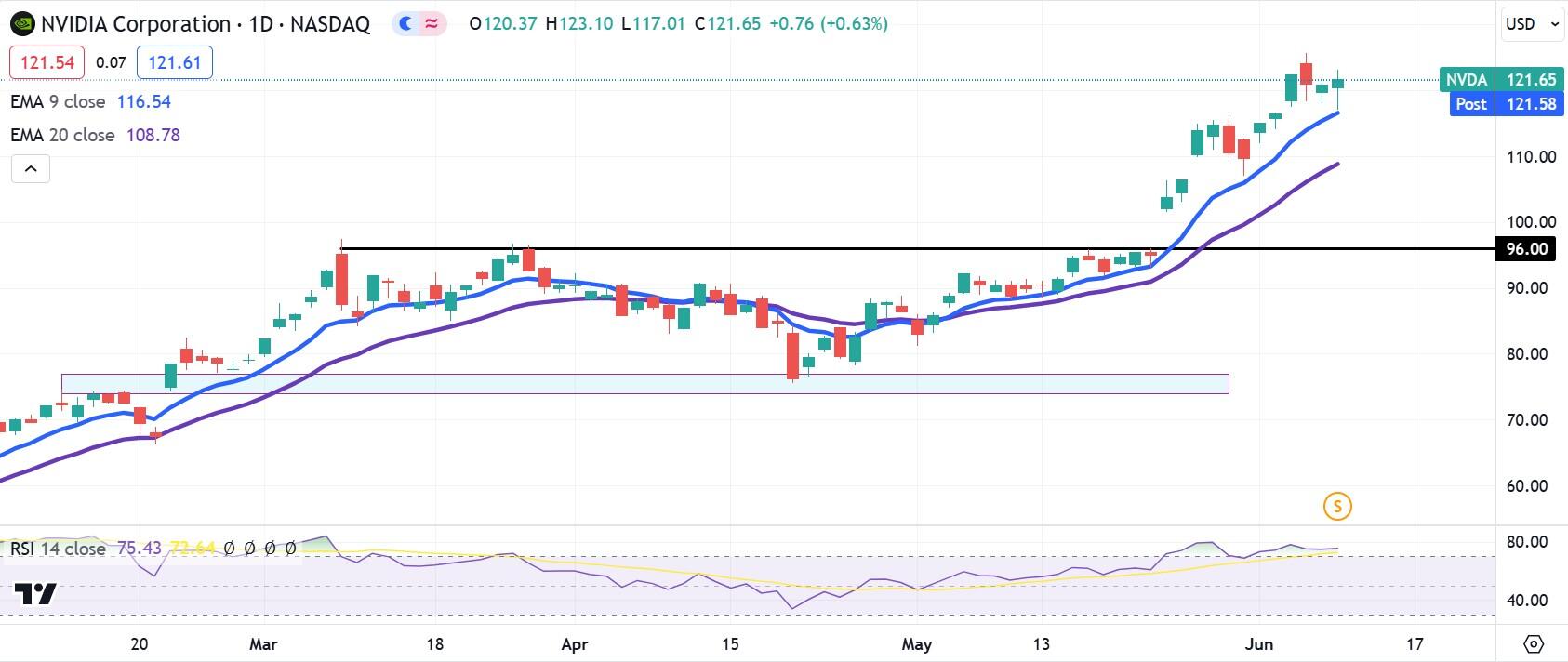
NVDA daily stock chart
Premium
You have reached your limit of 3 free articles for this month.
Start your subscription and get access to all our original articles.
Author
Clay Webster
FXStreet
Clay Webster grew up in the US outside Buffalo, New York and Lancaster, Pennsylvania. He began investing after college following the 2008 financial crisis.