New Zealand Dollar jumps as Chinese CPI inflation rises faster than expected
- The New Zealand Dollar edges higher in Friday’s Asian session.
- The hotter Chinese CPI inflation data and lower expectations of the RBNZ interest rate cut support the Kiwi.
- A stronger US Dollar might cap the pair’s upside.


The New Zealand Dollar (NZD) trades in positive territory on Friday. The latest upbeat Chinese economic data spurs another bullish run for the Kiwi. It’s worth noting that any signs of recovery in the Chinese economy generally lift the NZD as China is New Zealand's largest trading partner. Furthermore, a stronger-than-expected New Zealand employment report earlier this week threw cold water on expectations of the Reserve Bank of New Zealand (RBNZ) interest rate cut in the near term, which might continue to underpin the Kiwi in the near term.
On the other hand, the renewed demand for the US Dollar (USD) might cap the upside for NZD/USD as the recent US Initial Jobless Claims ease some fears about the US labor market. Additionally, the heightened geopolitical risks in the Middle East could weigh on riskier assets like the Kiwi and create a headwind for NZD/USD.
Daily Digest Market Movers: New Zealand Dollar gains momentum amid hotter Chinese inflation data
- China’s Consumer Price Index (CPI) climbed 0.5% YoY in July, compared to a 0.2% increase in June, hotter than the expectations of a 0.3% rise, the National Bureau of Statistics of China reported on Friday.
- On a monthly basis, Chinese CPI inflation came in at 0.5% MoM in July versus -0.2% prior, beating the estimation of 0.3%.
- Chinese Producer Price Index (PPI) declined by 0.8% YoY in July, at the same pace as seen in June. The figure was above the market consensus of -0.9%.
- According to RBNZ's latest monetary conditions survey, the two-year inflation expectations fell from 2.33% seen in Q2 2024 to 2.03% in Q3 of this year. The average one-year inflation expectations declined to 2.40% in Q3 versus 2.73% seen in Q2.
- The US Initial Jobless Claims for the week ending August 3 rose by 233K, compared to the previous week of 250K (revised from 249K), the US Department of Labor (DoL) reported on Thursday. This figure came in below the consensus of 240K.
- Continuing Claims increased by 6K to 1.875M in the week ended July 27, beating the estimation of 1.870M.
- Federal Reserve (Fed) Bank of Chicago President Austan Goolsbee said on Thursday that the Fed needs to see more than payrolls and more than one month.
- Richmond Fed President Thomas Barkin noted that cooling in the US labor market is coming from slower hiring rather than a rise in layoffs, giving the Fed time to figure out its next move.
- Kansas City Fed President Jeffrey Schmid said on Thursday that lowering monetary policy would be "appropriate" should inflation continue to come in low, per Reuters.
Technical Analysis: New Zealand Dollar remains bearish in the longer term
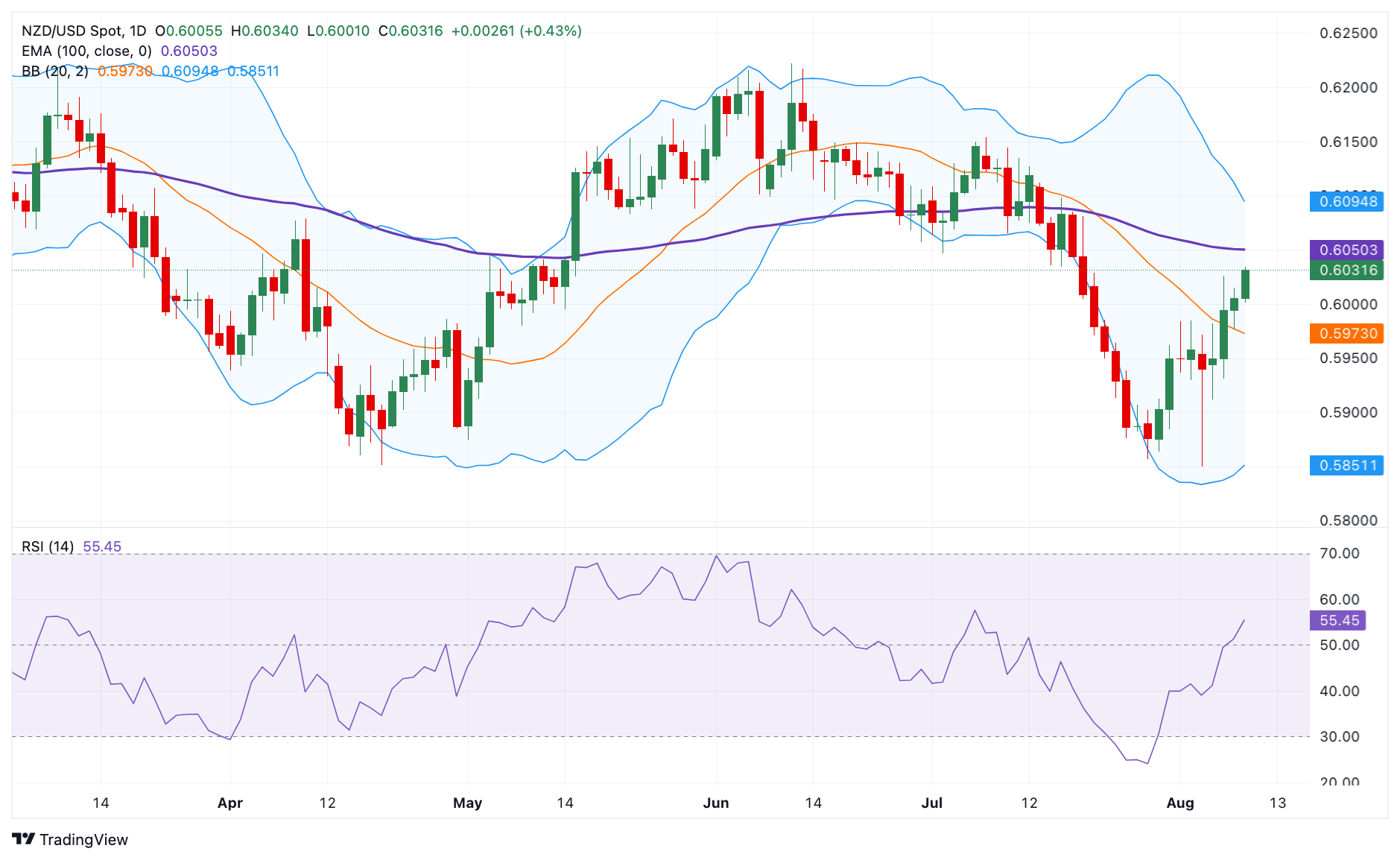
The New Zealand Dollar trades stronger on the day. However, the bearish stance of the NZD/USD pair prevails on the daily chart, with the price remaining below the key 100-day Exponential Moving Average (EMA). Nonetheless, the RSI hovers around the 50-midline, suggesting a potential for consolidation cannot be ruled out.
The 100-period EMA near 0.6050 could act as a potential upside barrier for NZD/USD. If the price manages to break above this level, it would indicate the possibility of further upside. The next hurdle is seen at 0.6112, the upper boundary of the Bollinger Band.
On the downside, the initial support level emerges at 0.5912, a low of August 6. Further south, the additional downside filter to watch is the 0.5850-0.5840 region, representing a low of April 19 and the lower limit of the Bollinger Band.
US Dollar price in the last 7 days
The table below shows the percentage change of US Dollar (USD) against listed major currencies in the last 7 days. US Dollar was the weakest against the Australian Dollar.
| USD | EUR | GBP | CAD | AUD | JPY | NZD | CHF | |
| USD | -1.25% | -0.21% | -1.10% | -1.61% | -1.18% | -1.59% | -0.74% | |
| EUR | 1.22% | 1.03% | 0.14% | -0.37% | 0.09% | -0.34% | 0.50% | |
| GBP | 0.21% | -1.04% | -0.90% | -1.40% | -0.94% | -1.38% | -0.53% | |
| CAD | 1.09% | -0.14% | 0.89% | -0.47% | -0.05% | -0.48% | 0.37% | |
| AUD | 1.59% | 0.36% | 1.38% | 0.49% | 0.46% | 0.02% | 0.86% | |
| JPY | 1.23% | -0.11% | 0.92% | 0.09% | -0.38% | -0.45% | 0.41% | |
| NZD | 1.57% | 0.34% | 1.37% | 0.48% | -0.02% | 0.41% | 0.85% | |
| CHF | 0.72% | -0.51% | 0.52% | -0.37% | -0.87% | -0.41% | -0.85% |
The heat map shows percentage changes of major currencies against each other. The base currency is picked from the left column, while the quote currency is picked from the top row. For example, if you pick the Euro from the left column and move along the horizontal line to the Japanese Yen, the percentage change displayed in the box will represent EUR (base)/JPY (quote).
Inflation FAQs
Inflation measures the rise in the price of a representative basket of goods and services. Headline inflation is usually expressed as a percentage change on a month-on-month (MoM) and year-on-year (YoY) basis. Core inflation excludes more volatile elements such as food and fuel which can fluctuate because of geopolitical and seasonal factors. Core inflation is the figure economists focus on and is the level targeted by central banks, which are mandated to keep inflation at a manageable level, usually around 2%.
The Consumer Price Index (CPI) measures the change in prices of a basket of goods and services over a period of time. It is usually expressed as a percentage change on a month-on-month (MoM) and year-on-year (YoY) basis. Core CPI is the figure targeted by central banks as it excludes volatile food and fuel inputs. When Core CPI rises above 2% it usually results in higher interest rates and vice versa when it falls below 2%. Since higher interest rates are positive for a currency, higher inflation usually results in a stronger currency. The opposite is true when inflation falls.
Although it may seem counter-intuitive, high inflation in a country pushes up the value of its currency and vice versa for lower inflation. This is because the central bank will normally raise interest rates to combat the higher inflation, which attract more global capital inflows from investors looking for a lucrative place to park their money.
Formerly, Gold was the asset investors turned to in times of high inflation because it preserved its value, and whilst investors will often still buy Gold for its safe-haven properties in times of extreme market turmoil, this is not the case most of the time. This is because when inflation is high, central banks will put up interest rates to combat it. Higher interest rates are negative for Gold because they increase the opportunity-cost of holding Gold vis-a-vis an interest-bearing asset or placing the money in a cash deposit account. On the flipside, lower inflation tends to be positive for Gold as it brings interest rates down, making the bright metal a more viable investment alternative.
Author
Lallalit Srijandorn
FXStreet
Lallalit Srijandorn is a Parisian at heart. She has lived in France since 2019 and now becomes a digital entrepreneur based in Paris and Bangkok.

















