Microsoft earnings send share price plunging


Microsoft’s earnings for last quarter were always going to be a major test of market sentiment and patience for capex spend on AI infrastructure. Microsoft may have delivered hefty revenues for last quarter at $64.73bn, vs. estimates of $64.52bn, however, the breakdown of these revenues concerned investors and sent the share price tumbling more than 7% at one stage on Tuesday evening. As the night has progressed, Microsoft’s share price has clawed back some losses and is down some 6%.
Non-AI business still an important part of Microsoft revenue streams
The problem for Microsoft is not generating revenues, it’s where they are coming from. Over half of its revenues are still from its nuts-and-bolts businesses that do not include heavy AI features, including $20.32bn from its business processes segment, and more than $15bn from its personal computing businesses. While these may have some elements of AI within them, it’s the cloud revenues that are the ‘AI’ stars at Microsoft, and they failed to deliver stand out results.
Cloud services generated revenues of $36.8bn, a touch less than the $36.84bn expected. Intelligent cloud services generated revenues of $28.52bn vs. estimates of $28.72bn. Is the market expecting too much from Microsoft and co? Probably, these are still amazing revenues and AI is obviously impacting Microsoft’s revenue streams. However, with a 12-month forward P/E ratio of more than 32 times earnings, the market is getting tired of paying up for AI.
This is reflected in the share price reaction to this earnings report. Microsoft's share price usually rises on average by more than 3.5% in the 24 hours after the last 8 quarterly earnings reports. However, Tuesday's reaction suggests that investors' reactions to Microsoft's earnings reports are shifting and the bar is getting higher, since the share price has sold off even though overall revenues were stronger than expected.
Azure revenue growth slows – a warning sign for investors
Microsoft disclosed that AI had boosted its Azure cloud services revenues by 8 points, total revenue growth was up 29%, or 30% on a constant currency basis. This compares with a 7-point increase in the prior quarter, however overall revenue growth was slower in this quarter relative to the prior period, where Azure revenues grew by 31%. The fact that Microsoft and co. feel the need to break out the impact that AI is having on revenue is interesting – they must justify their investment in AI to try and keep investors on board. Capex spend was also bigger than expected last quarter, at $13.87bn vs. $13.27bn. Thus, AI is getting more expensive for mega cap tech stocks as they embed it in their products and sell them to consumers. The selling is not the problem, Microsoft can generate revenues from selling services embedded with AI, however, the cost is a cause of concern for investors.
Why bad news for Microsoft could be good news for Nvidia
This is why mega cap tech stocks sold off on Tuesday. The market was expecting bad news from Microsoft and the Nasdaq 100 closed down more than 1.2% on Tuesday, Nvidia fell more than 7%. In after hours trading Nvidia’s stock price rose by more than 2%. This could be a reaction to the market having oversold Nvidia stock on Tuesday, but it may also be the market weighing up the increasing capex spend at Microsoft. Since Microsoft makes up approx. 20% of demand for Nvidia’s highest quality AI chips, increasing capex spend at Microsoft is good news for Nvidia’s bottom line. Since Nvidia remains the leading hardware producer for AI technology, increasing capex spend by its biggest customers bodes well for Nvidia’s results, which are released next month.
Microsoft is likely to maintain its guidance for the rest of this year, however, the disappointing cloud revenues are the story of Microsoft’s earnings report.
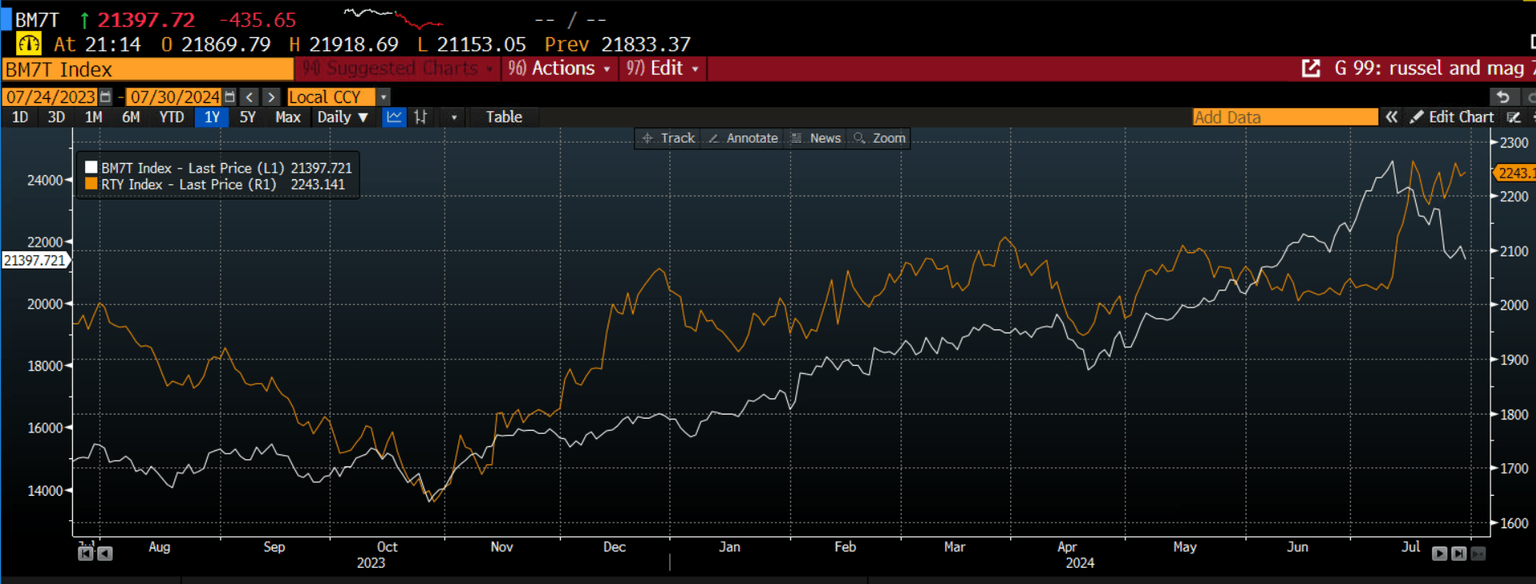
The woes for the mega cap tech sector could help the great rotation into value stocks. The sell-off in tech this week has seen the Russell 2000 outperform the Magnificent 7, as you can see below.
Chart 1: The Russel 2000 and the Magnificent 7 tech stocks
Microsoft’s results do not bode well for Meta or Amazon, who release results on Wednesday. In after-market trading on Tuesday night, Meta’s share price is lower by 3.2% and Amazon’s share price is down 2.9%.
Author
Kathleen Brooks
XTB UK
Kathleen has nearly 15 years’ experience working with some of the leading retail trading and investment companies in the City of London.