Microsoft delivers steady growth, but MSFT stock drifts lower on slowing Azure growth
- Micrsoft stock fell as much as 6% on Thursday after reporting fiscal Q1 earnings.
- CEO Satya Nadella's company easily beat Wall Street consensus for revenue and net income.
- GAAP EPS climbed 10% YoY, and revenue rose 16%.
- MSFT stock fell due to lower projected Azure cloud growth in Q2.


Microsoft (MSFT) skittered off the ledge on Thursday following the previous evening’s earnings release that showed a marginally lower forecast for the next quarter’s Azure cloud growth.
Microsoft’s poor showing sent shares down close to 6% on Thursday morning, which brought down the Dow Jones Industrial Average (DJIA) with it. The Dow has backtracked 0.66% near lunchtime, while the NASDAQ plunged a much worse 2.25%.
Microsoft stock earnings news
Microsoft’s stock price seems to turn entirely these days on how well its Azure cloud unit grows. For the first fiscal quarter of 2025, which ended on September 30, Azure grew revenue 33% YoY or 34% in constant currency.
"In Azure, we expect Q2 revenue growth to be 31% to 32% in constant currency, driven by strong demand for our portfolio of services," said Microsoft CFO Amy Hood on the company's earnings call.
Analysts seemed to think that the sell-off allowed for a good entry point since Azure is still growing impressively at such a large level. Additionally, the top and bottom lines showed the quality execution from the C suite that the market has grown used to.
The Washington-state firm run by CEO Satya Nadella earned $3.30 per share on a GAAP basis, rising 10% YoY. Operating income of $30.6 billion rose 14% YoY.
Revenue of $65.59 billion was more than $1 billion above the Wall Street consensus estimate and rose more than 16% from a year ago.
The Productivity & Business Processes division reported $28.3 billion in revenue, up 12% YoY. The Intelligent Cloud segment reported $24.1 billion in revenue, an increase of 20% YoY. The More Personal Computing division saw $13.2 billion in sales, which was an increase of 17%.
Microsoft, a company valued near $3.2 trillion, paid out dividends and repurchased MSFT shares for a grand total of $9 billion in fiscal Q1.
Analysts were undeterred by the sell-off. JPMorgan notably lowered its price target from $470 to $465 but retained its Overweight rating. Barclays kept its $475 price target and Overweight rating. The Buy rating at Jefferies stayed put, and the investment bank maintained its $550 price target. Wedbush stuck to its $550 price target, and Evercore ISI kept its $500 price target.
"We believe the long-term trends in the commercial business remain intact as MSFT continues to take share in cloud and its AI services continue to scale," said Evercore analysts led by Kirk Materne.
Microsoft stock forecast
Microsoft stock has already faced serious resistance at $466 and $441.50 these past few months, so it's not terribly surprising that MSFT requires further consolidation. No one questions Microsoft's value, but they do question its valuation. Microsoft was already trading at 32 times fiscal 2025 EPS, so a pullback is maybe what the stock requires at this juncture.
Additionally, the Nonfarm Payrolls number for October comes out on Friday, and next Tuesday sees the US election. Jittery institutional investors may want to hold cash until these events are behind them.
Clear support for MSFT lies in the $385 to $390 range that held up in April and again during the August 5 crash. However, many traders will see Microsoft shares trading at a $25 discount and begin buying this week.
It does look bad, however, that MSFT's 200-day Simple Moving Average (SMA) is poised to break below the 50-day SMA in what would be termed a bearish Death Cross. Both moving averages sail near the $420 mark on Thursday.
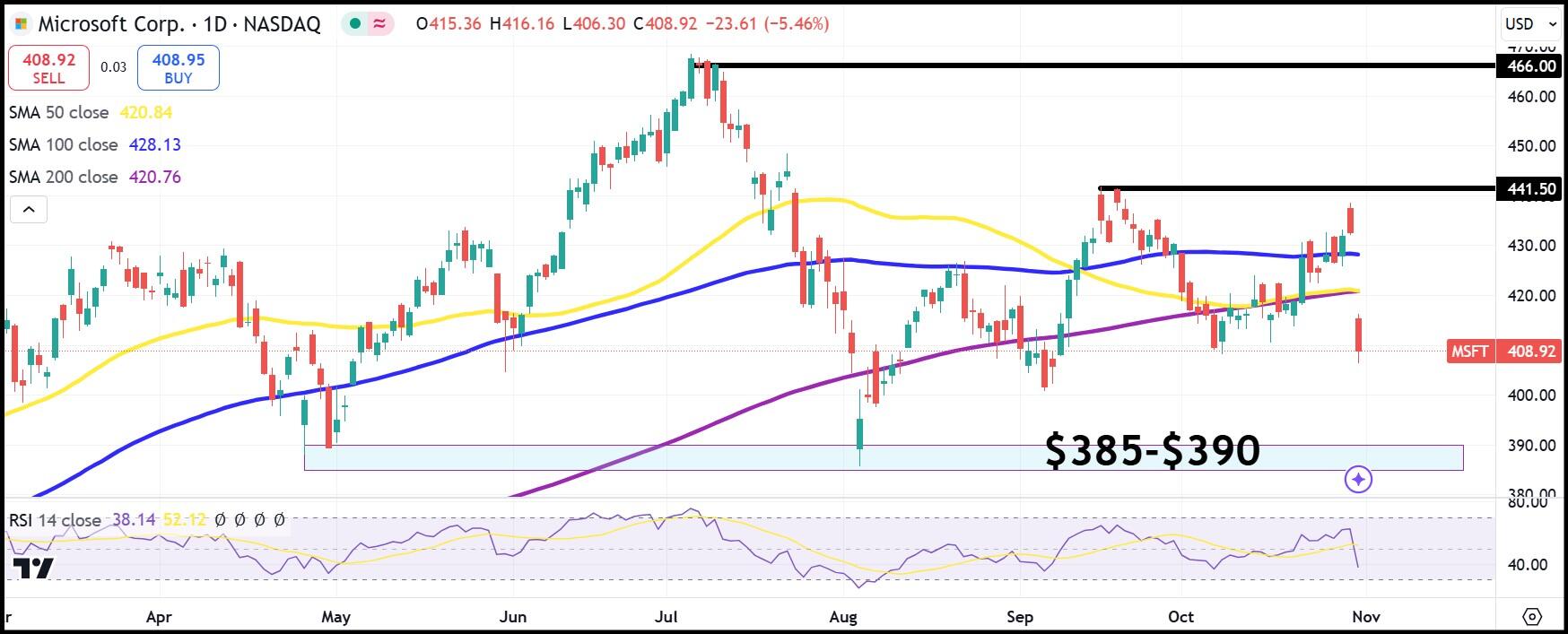
MSFT daily stock chart
Premium
You have reached your limit of 3 free articles for this month.
Start your subscription and get access to all our original articles.
Author
Clay Webster
FXStreet
Clay Webster grew up in the US outside Buffalo, New York and Lancaster, Pennsylvania. He began investing after college following the 2008 financial crisis.

















