Mexican Peso loses value as investors unwind the carry trade
- The Mexican Peso is weakening as international investors unwind the Peso-favorable “carry trade”.
- A negative spell of data has further weakened the Peso as Banxico sets its sights on an interest-rate cut in August.
- USD/MXN extends its short-term uptrend and closes in on the June 28 high at 18.60.

The Mexican Peso (MXN) falls to a roughly four-week low on Thursday in its most traded pairs as investors rotate out of the carry trade, which favors currencies where interest rates are high, such as in Mexico (11.00%), at the expense of currencies with lower interest rates like the Japanese Yen (JPY), where the Bank of Japan (BoJ) has set base rates at 0.10%, according to analysts at ING Bank.
Other factors pushing down the Mexican Peso is the string of mostly lower-than-expected macroeconomic data releases, including Q1 Gross Domestic Product (GDP), Retail Sales, and the 1st half-month Core Inflation for July.
At the time of writing, one US Dollar (USD) buys 18.39 Mexican Pesos, EUR/MXN trades at 19.64, and GBP/MXN at 23.68.
Mexican Peso slumps amid inflation data and economic concerns
The Mexican Peso extended its downtrend on Wednesday after the release of inflation data for the first half of July, showing little change in core inflation despite a rise in the headline rate. This reinforced Mexican monetary policymakers' views that while core inflation — excluding volatile food and energy prices — is gradually decreasing, headline inflation remains high due to temporary factors. Consequently, the central bank, Banxico, is expected to cut interest rates soon, with many investors earmarking August as the month when the bank will make a move.
In July, Mexican 1st half-month Core Inflation rose 0.18%, slightly above both the previous month and estimates of 0.17%. Mid-month Core Inflation stood at 4.02% year-over-year, aligning with analysts' expectations but down from 4.17% the previous month.
On the other hand, mid-month headline inflation surged 0.71% month-over-month in July, significantly surpassing consensus estimates of 0.38% and the prior month’s 0.21%. Year-over-year, headline inflation reached 5.61%, well above June’s 4.78% and economists' predictions of 5.27%. The rise in headline inflation, however, is unlikely to change Banxico’s easing bias as it will be put down to fluctuating Oil and food prices.
ING highlighted the current low volatility environment as unfavorable for a rotation back to the carry trade. They noted, "Markets appear to be unwinding positions in high-yielding currencies like MXN and ZAR, while the funding JPY continues to perform well."
The latest Economic Activity Indicator from the Instituto Nacional de Estadistica, Geografia e Informatica (INEGI) indicates ongoing economic challenges. In May, Mexico’s economy expanded by 1.6% year-over-year, a significant deceleration from the near-two-year-high of 5.4% in the previous month. Despite this slowdown, the growth exceeded market expectations of 1.4%, driven by strong performance in the services sector.
Retail sales in May grew by 0.3% year-over-year, a marked decline from April’s 3.2% increase. Seasonally adjusted monthly retail sales edged up by 0.1% after a 0.5% rise in April.
Adding to the economic uncertainty, Fitch Ratings reaffirmed Mexico’s BBB- rating but warned of potential impacts from proposed judicial reforms. The International Monetary Fund (IMF) also revised Mexico’s 2024 GDP growth forecast down from 2.4% to 2.2%, citing a manufacturing slowdown linked to reduced US economic activity, pressuring Banxico towards a more accommodative monetary policy.
Furthermore, the Mexican Congress is set to discuss President Andrés Manuel López Obrador's judicial reform on August 1, ahead of the new Congress term starting on September 1, adding complexity to Mexico’s economic landscape.
Technical Analysis: USD/MXN closes in on June 28 high at 18.60
USD/MXN has rebounded higher after completing an ABC correction in early July. It appears to be trending higher and targeting the June 28 high at 18.60.
USD/MXN Daily Chart
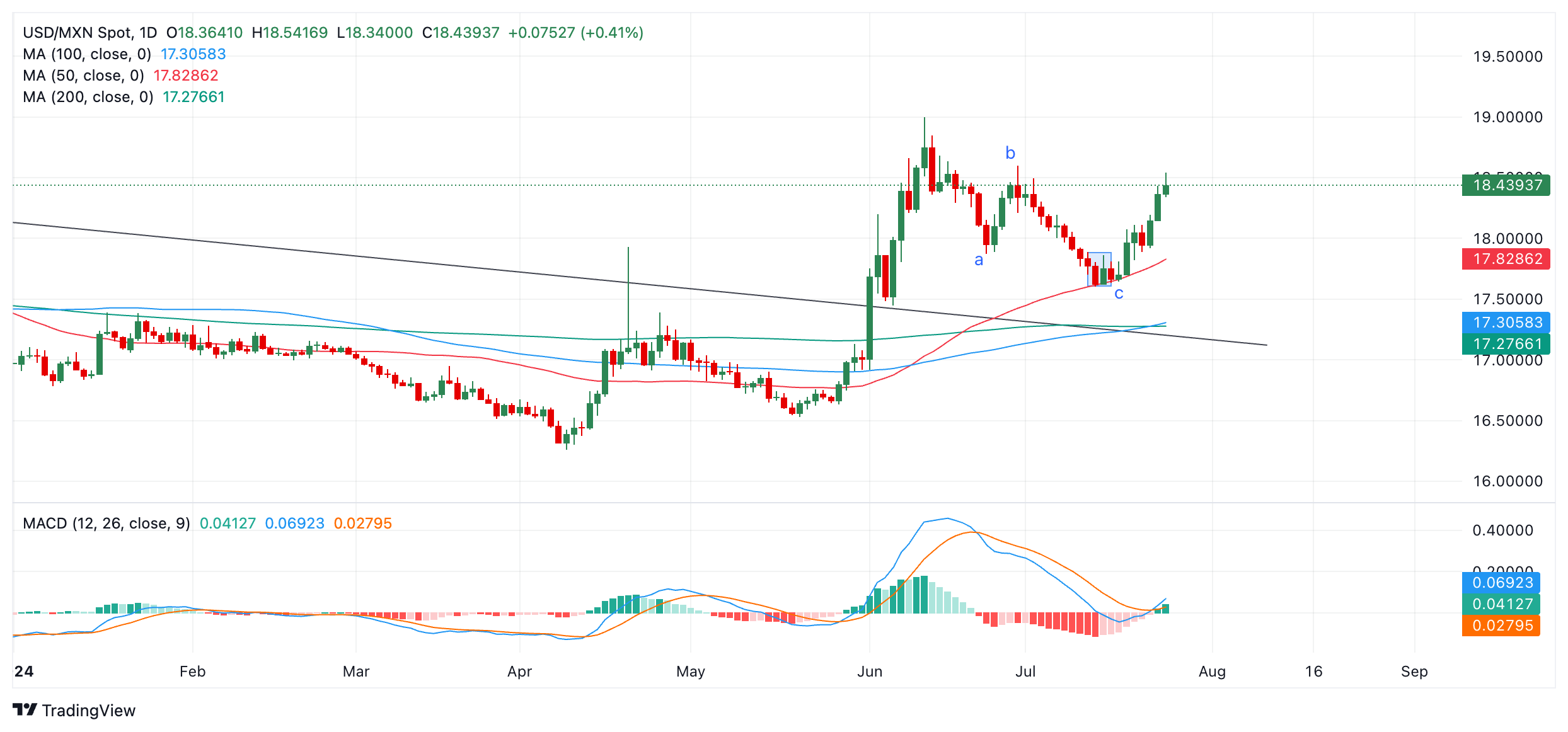
From a short-term perspective, the trend appears to be bullish for USD/MXN, and given the “trend is your friend,” this still technically favors bullish bets over that timeframe.
The next target higher for the pair is the key June 28 swing high at 18.60. At that level it is likely to encounter resistance and may pull back down or consolidate. A close above 18.60 would probably indicate a continuation up to the next target at 19.00 (June 12 high).
Meanwhile, the direction of the medium and long-term trends remain in doubt.
Economic Indicator
Retail Sales (MoM)
The Retail Sales released by INEGI measures the total receipts of retail stores. Monthly percent changues reflect the rate of changes of such sales. Changes in retail sales are widely followed as an indicator of consumer spending. Generally speaking, a high reading is seen as positive or bullish for the Mexican peso, while a low reading is seen as negative or bearish.
Read more.Author
Joaquin Monfort
FXStreet
Joaquin Monfort is a financial writer and analyst with over 10 years experience writing about financial markets and alt data. He holds a degree in Anthropology from London University and a Diploma in Technical analysis.