Mexican Peso falls as disinflation boosts Banxico rate cuts odds


Most recent article: Mexican Peso slips amid Trump’s tariffs and Banxico policy divergence
- Mexican Peso slips as monetary policy divergence with Fed fuels further upside.
- USD/MXN climbs 0.14% to 20.43 as Banxico signals additional 50-bps rate cuts.
- Mexico’s Q4 GDP contracts by 0.6%, raising recession concerns.
- Traders eye Mexico’s Current Account, Balance of Trade, and jobs data this week.
The Mexican Peso (MXN) slipped against the US Dollar (US) for the second consecutive day after inflation data for the first half of February rose as expected, yet justified Banco de Mexico's (Banxico) latest 50 basis points (bps) rate cut. At the time of writing, USD/MXN trades at 20.43, up 0.14%.
Mexico’s inflation report revealed that Banxico could continue to recalibrate monetary policy. According to February’s 6 meeting minutes, Banxico is expected to continue reducing rates at a 50-bps size.
Last week’s Gross Domestic Product (GDP) figures confirmed that Mexico’s economy is closing to a technical recession. GDP shrank by -0.6% QoQ in the fourth quarter of 2024, down from a 1.1% expansion and matching estimates of a Reuters poll. This and monetary policy divergence, with Banxico lowering rates and the Federal Reserve (Fed) keeping them unchanged, suggests further upside in the USD/MXN pair.
Ahead this week, Mexico’s economic docket will feature the Current Account, Balance of trade, and jobs data.
Daily digest market movers: Mexican Peso depreciates as inflation data justifies Banxico’s dovish tilt
- Mid-month headline inflation in February rose by 0.15% as expected. On annual terms, it jumped 3.74%, as expected by most economists.
- Core inflation for the same period expanded by 0.27% MoM, slightly above estimates of 0.24%. Yearly, underlying prices increased by 3.63%, up from 3.61%.
- Last week, US President Donald Trump reiterated tariffs of 25% on cars, effective on April 2.
- The swaps markets hint that the Federal Reserve might cut rates 25 basis points twice in 2025 via data from the Chicago Board of Trade (CBOT). Traders had priced in 51 bps of easing.
- Trade disputes between the US and Mexico remain front and center. Although the countries found common ground previously, USD/MXN traders should know that there is a 30-day pause and that tensions could arise toward the end of February.
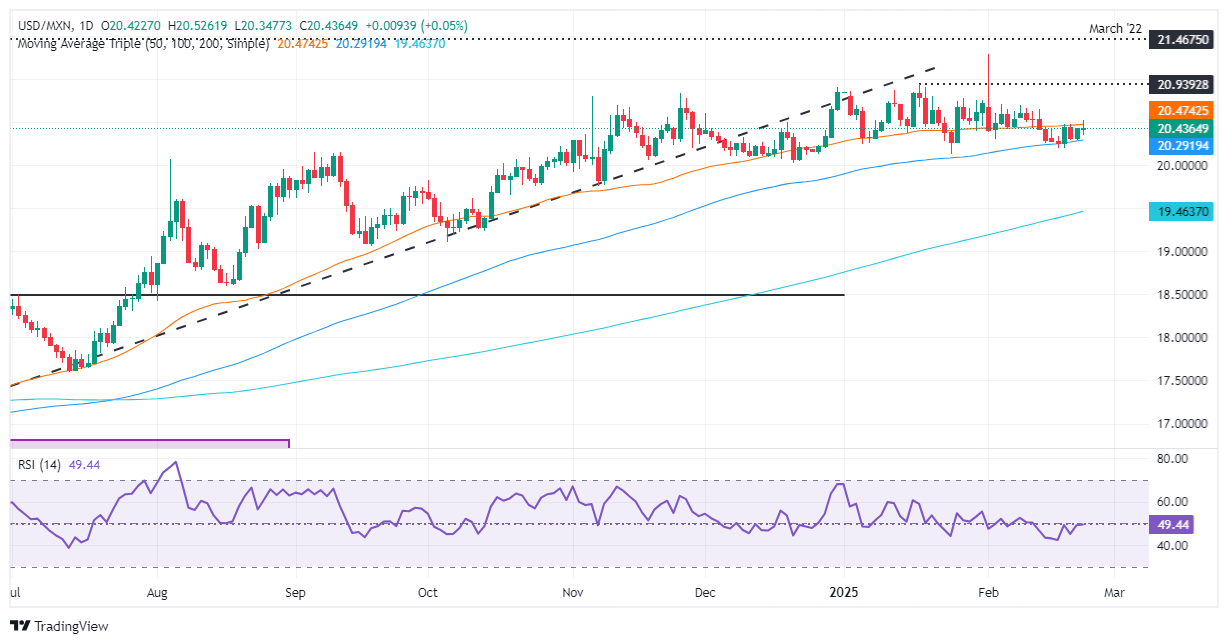
USD/MXN technical outlook: Mexican Peso drops as USD/MXN challenges 50-day SMA
The trend remains tilted to the upside, with the USD/MXN pair testing the 50-day Simple Moving Average (SMA) at 20.44 at the time of writing. Momentum, as depicted by the Relative Strength Index (RSI), suggests that buyers are gathering steam. Therefore, if USD/MXN climbs past 20.50, the exotic pair would be poised to challenge the January 17 20.93 high, followed by 21.00 and the year-to-date (YTD) high of 21.28.
Conversely, if sellers outweigh buyers, USD/MXN could test the 100-day SMA at 20.24. On further weakness, the pair might surpass that dynamic support and head towards the 20.00 figure.
Mexican Peso FAQs
The Mexican Peso (MXN) is the most traded currency among its Latin American peers. Its value is broadly determined by the performance of the Mexican economy, the country’s central bank’s policy, the amount of foreign investment in the country and even the levels of remittances sent by Mexicans who live abroad, particularly in the United States. Geopolitical trends can also move MXN: for example, the process of nearshoring – or the decision by some firms to relocate manufacturing capacity and supply chains closer to their home countries – is also seen as a catalyst for the Mexican currency as the country is considered a key manufacturing hub in the American continent. Another catalyst for MXN is Oil prices as Mexico is a key exporter of the commodity.
The main objective of Mexico’s central bank, also known as Banxico, is to maintain inflation at low and stable levels (at or close to its target of 3%, the midpoint in a tolerance band of between 2% and 4%). To this end, the bank sets an appropriate level of interest rates. When inflation is too high, Banxico will attempt to tame it by raising interest rates, making it more expensive for households and businesses to borrow money, thus cooling demand and the overall economy. Higher interest rates are generally positive for the Mexican Peso (MXN) as they lead to higher yields, making the country a more attractive place for investors. On the contrary, lower interest rates tend to weaken MXN.
Macroeconomic data releases are key to assess the state of the economy and can have an impact on the Mexican Peso (MXN) valuation. A strong Mexican economy, based on high economic growth, low unemployment and high confidence is good for MXN. Not only does it attract more foreign investment but it may encourage the Bank of Mexico (Banxico) to increase interest rates, particularly if this strength comes together with elevated inflation. However, if economic data is weak, MXN is likely to depreciate.
As an emerging-market currency, the Mexican Peso (MXN) tends to strive during risk-on periods, or when investors perceive that broader market risks are low and thus are eager to engage with investments that carry a higher risk. Conversely, MXN tends to weaken at times of market turbulence or economic uncertainty as investors tend to sell higher-risk assets and flee to the more-stable safe havens.
Author
Christian Borjon Valencia
FXStreet
Christian Borjon began his career as a retail trader in 2010, mainly focused on technical analysis and strategies around it. He started as a swing trader, as he used to work in another industry unrelated to the financial markets.