Mexican Peso rebounds off daily lows, eyes yearly highs amid strong USD

Most recent article: Mexican Peso soars to highest value in over eight years against US Dollar
- Mexican Peso ticks down as US Durable Goods Orders jump and Consumer Confidence steadies.
- Banxico’s dovish stance remains with Governor Rodriguez hinting at possible future rate cuts amidst inflation concerns.
- USD/MXN tests key support levels with potential for further movement on Banxico actions and US data insights.
The Mexican Peso (MXN) pares earlier losses against the US Dollar on Tuesday as the North American session begins. The Greenback continues to recover amid a slightly busy economic docket in the United States (US). An improvement in US Durable Goods Orders increasing the most since 2022, prompted traders to buy the US Dollar, while consumer confidence remained steady. The USD/MXN trades at 16.67, almost flat.
Mexico’s economic schedule is scarce, but it will gather pace on Wednesday. According to the consensus, the Balance of Trade is expected to show a narrower deficit in February, from $-4.31 billion to $-0.2 billion. The Unemployment Rate is foreseen dipping from 2.9% to 2.8% for the same period.
Banxico Governor Victoria Rodriguez Ceja remained dovish via an interview with El Financiero. Rodriguez commented that the battle against inflation hasn’t been concluded, though adding that in upcoming meetings, they would discuss further rate cuts to the main reference rate.
Daily digest market movers: Mexican Peso trims losses as USD/MXN is unchanged
- Banxico Governor Victoria Rodriguez Ceja said, “When macroeconomic conditions and the inflationary outlook allow us to make additional adjustments to the reference rate to the one we already have, I consider that they would be gradual.”
- Mexico’s economy contracted for the fourth time in January. The Indicator of General Economic Activity plunged -0.6% MoM, below estimates of a 0.3% expansion, and slowed compared to December, missing estimates of 2.6% to print at 2%. Inflation in Mexico exceeded estimates of 4.45%, increasing by 4.48%, while core figures jumped above the consensus of 4.62% YoY to 4.69%.
- The outlook in Mexico suggests the economy is stagnating. A weak retail sales report, private spending falling sharply, and a contraction in economic activity justified Banxico’s rate cut. Nevertheless, they face stubbornly stickier inflation, keeping policymakers on their toes.
- Federal Reserve policymakers had been crossing the wires. Atlanta Fed President Raphael Bostic remains hawkish by supporting just one rate cut in 2024. Fed Governor Lisa Cook echoed Bostic’s comments and added that cutting too soon increases the risk of inflation becoming entrenched.
- Chicago Fed President Austan Goolsbee remains dovish, expecting three cuts, though he said he needs more evidence of inflation “coming down.”
- US Durable Goods Orders rose for the first time in three months from -0.3% MoM to 0.6% in February, an indication that companies are slightly optimistic about the economy.
- The Conference Board (CB) showed that Consumer Confidence in March deteriorated from 104.8 to 104, below estimates.
Technical analysis: Mexican Peso is subdued as USD/MXN oscillates around 16.60/70
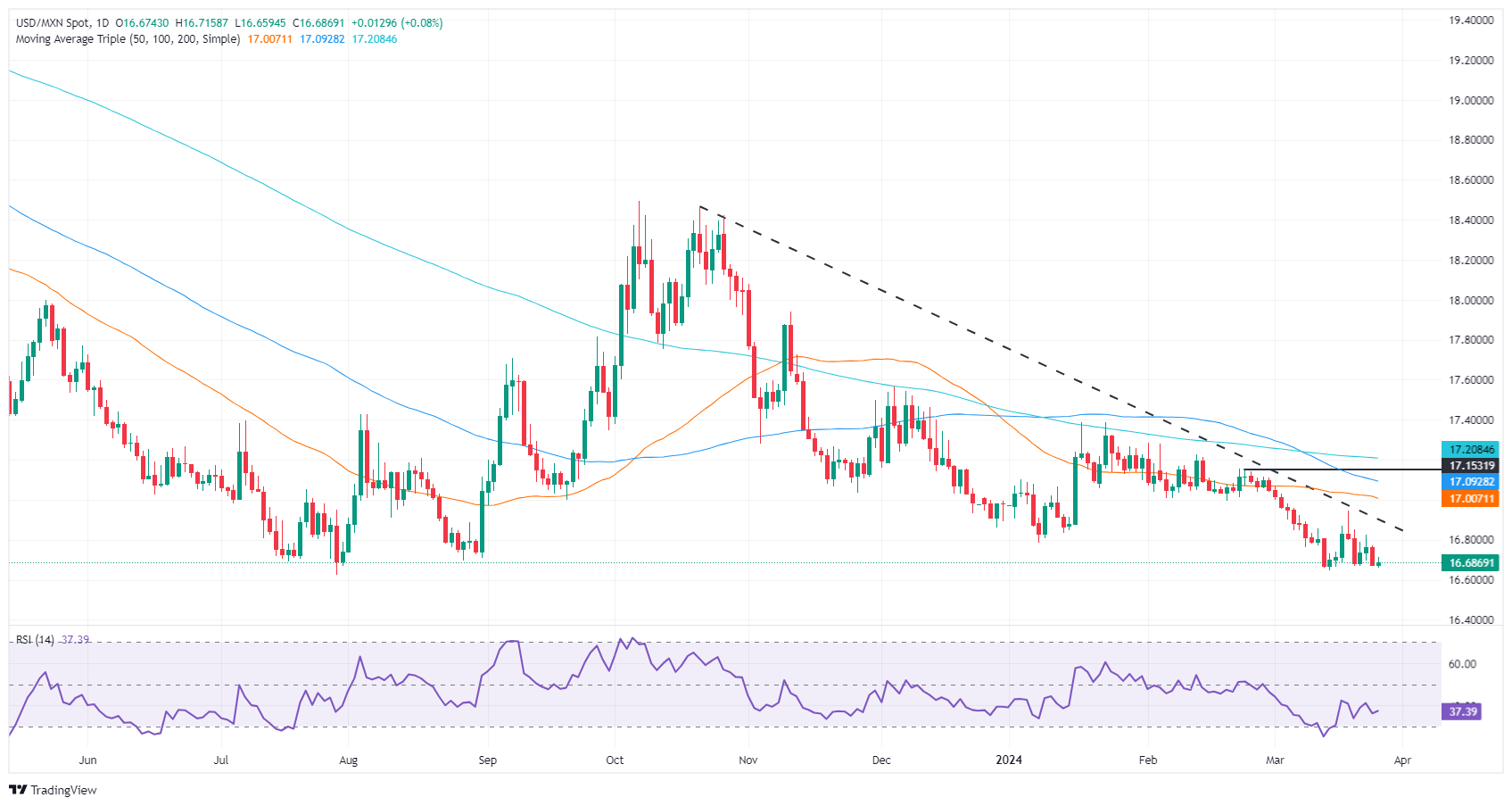
The USD/MXN downtrend remains intact, though it seems the exotic pair is consolidating within the 16.60/16.70 area. If sellers push prices below last year’s 16.62, that could exacerbate a drop to challenge October’s 2015 low of 16.32. Further support lies in the psychological 16.00 figure.
For a bullish scenario, traders must reclaim the last week’s high of 16.94, ahead of the 17.00 figure. Up next would be the 50-day Simple Moving Average (SMA) at 17.00, the 100-day SMA at 17.09, and the 200-day SMA at 17.20.
USD/MXN Price Action – Daily Chart
Mexican Peso FAQs
The Mexican Peso (MXN) is the most traded currency among its Latin American peers. Its value is broadly determined by the performance of the Mexican economy, the country’s central bank’s policy, the amount of foreign investment in the country and even the levels of remittances sent by Mexicans who live abroad, particularly in the United States. Geopolitical trends can also move MXN: for example, the process of nearshoring – or the decision by some firms to relocate manufacturing capacity and supply chains closer to their home countries – is also seen as a catalyst for the Mexican currency as the country is considered a key manufacturing hub in the American continent. Another catalyst for MXN is Oil prices as Mexico is a key exporter of the commodity.
The main objective of Mexico’s central bank, also known as Banxico, is to maintain inflation at low and stable levels (at or close to its target of 3%, the midpoint in a tolerance band of between 2% and 4%). To this end, the bank sets an appropriate level of interest rates. When inflation is too high, Banxico will attempt to tame it by raising interest rates, making it more expensive for households and businesses to borrow money, thus cooling demand and the overall economy. Higher interest rates are generally positive for the Mexican Peso (MXN) as they lead to higher yields, making the country a more attractive place for investors. On the contrary, lower interest rates tend to weaken MXN.
Macroeconomic data releases are key to assess the state of the economy and can have an impact on the Mexican Peso (MXN) valuation. A strong Mexican economy, based on high economic growth, low unemployment and high confidence is good for MXN. Not only does it attract more foreign investment but it may encourage the Bank of Mexico (Banxico) to increase interest rates, particularly if this strength comes together with elevated inflation. However, if economic data is weak, MXN is likely to depreciate.
As an emerging-market currency, the Mexican Peso (MXN) tends to strive during risk-on periods, or when investors perceive that broader market risks are low and thus are eager to engage with investments that carry a higher risk. Conversely, MXN tends to weaken at times of market turbulence or economic uncertainty as investors tend to sell higher-risk assets and flee to the more-stable safe havens.
Author
Christian Borjon Valencia
FXStreet
Christian Borjon began his career as a retail trader in 2010, mainly focused on technical analysis and strategies around it. He started as a swing trader, as he used to work in another industry unrelated to the financial markets.