Mexican Peso defies rising US yields, advances against US Dollar
- Mexican Peso dips, USD/MXN rises 0.12% as market eyes key economic data and Banxico rate decision.
- Anticipated April inflation drop may prompt Banxico to consider cutting rates from 11.00% to 10.75%.
- US Fed officials, including Susan Collins and Neel Kashkari, urge caution in rate policy, impacting cross-border sentiment.

The Mexican Peso remains on the defensive against the US Dollar on Wednesday as investors brace for the Bank of Mexico (Banxico) monetary policy decision on Thursday. Before that, April’s inflation in Mexico is expected to dip in headline and core figures, which could weigh on the central bank’s decision. The USD/MXN trades at 16.91, gains 0.12%.
Data revealed during the week suggests that Mexico’s economy remains solid. This could prompt Banxico’s Governing Council members to evaluate the chance of slashing rates from around 11.00% to 10.75% at the next meeting. Nevertheless, market participants expect Banxico to remain on hold, with Bank of America’s analysts foreseeing at least four more rate cuts, which could drive the main reference interest rate to 10.00% in 2024.
Elsewhere, Federal Reserve (Fed) officials continued to grab headlines across the border. Boston Fed President Susan Collins said she expects demand to slow down to bring inflation to 2%, adding that there are risks of cutting rates “too soon.” She said that the current policy is well-positioned and that it is “moderately restrictive.”
On Tuesday, Minnesota Fed President Neel Kashkari said that rates would stay put for an extended period, adding that if rates need to be raised, they will do so.
Daily digest market movers: Mexican Peso appreciates ahead of busy schedule
- Last week, Banxico’s April poll showed that private economists estimate inflation to end the year at 4.2% in 2024, underlying prices at 4.1%, and the economy to grow by 2.25%. Regarding the USD/MXN, analysts revised their projections downward from 18.10 to 17.
- Mexico’s economic calendar will feature the release of the Consumer Price Index (CPI) for April, estimated at 0.18% MoM, below March’s reading. In the twelve months to April, the CPI is foreseen climbing from 4.42% to 4.63%.
- Most bank analysts predict that Banxico will keep interest rates steady with a unanimous decision expected from the Governing Council. However, future meetings are anticipated to be more contentious, potentially leading to divided votes. This expectation arises from comments by two Deputy Governors, Irene Espinosa and Jonathan Heath, who have stated that inflation is still elevated, necessitating that interest rates stay at higher levels.
- The softer-than-expected US jobs data has heightened the likelihood that the Fed may reduce interest rates later in the year. April,Nonfarm Payrolls showed an addition of only 175,000 workers, falling short of expectations and significantly below March's revised figure of 315,000.
- Fed officials acknowledged that risks to achieving its dual mandate on employment and inflation “moved toward better balance over the past year,” which signals that if labor market data is weak, it could pave the way for cutting rates.
- Data from the futures market see odds for a quarter percentage point Fed rate cut in September at 86%, versus 55% ahead of last week’sFOMC decision.
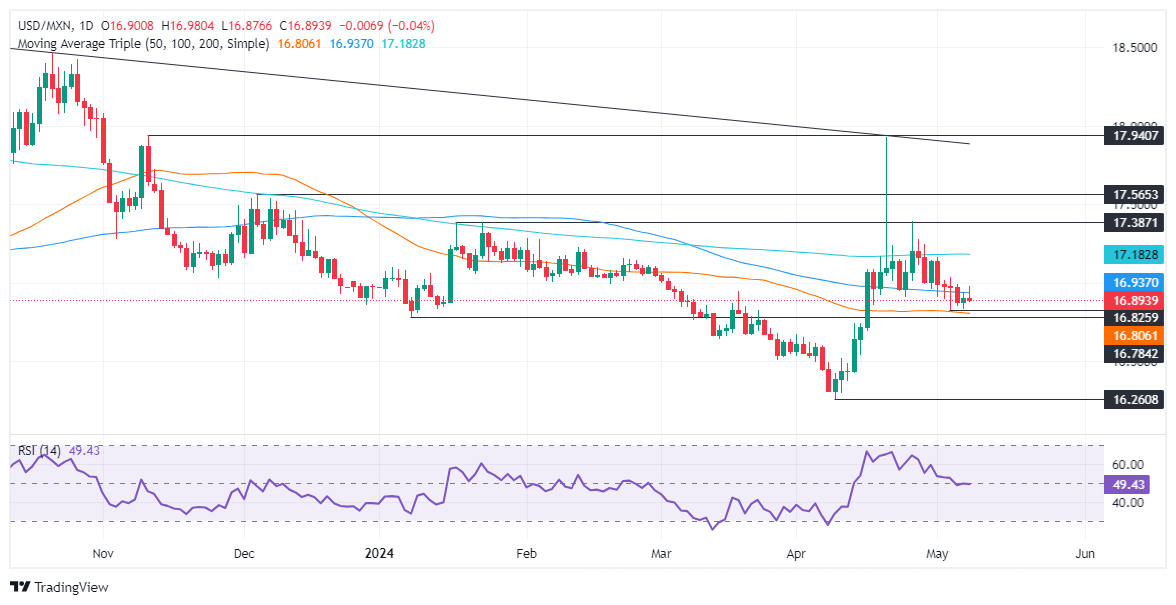
Technical analysis: Mexican Peso treads water as USD/MXN clings to 16.90
The USD/MXN downtrend remains in place, as stir resistance lies above the current exchange rate. Even though the Relative Strength Index (RSI) suggests that buyers are gathering momentum, they must clear key supply zones before the pair turns bullish.
The first resistance would be the 100-day Simple Moving Average (SMA) at 16.93, followed by the 17.00 mark. Once cleared, the next supply level would be the 200-day Simple Moving Average at 17.17, followed by the January 23 swing high of 17.38 and the year-to-date high of 17.92.
On the other hand, If USD/MXN tumbles below the 50-day Simple Moving Average (SMA) at 16.80, that could pave the way to challenge the 2023 low of 16.62, followed by the current year-to-date low of 16.25.
Mexican Peso FAQs
The Mexican Peso (MXN) is the most traded currency among its Latin American peers. Its value is broadly determined by the performance of the Mexican economy, the country’s central bank’s policy, the amount of foreign investment in the country and even the levels of remittances sent by Mexicans who live abroad, particularly in the United States. Geopolitical trends can also move MXN: for example, the process of nearshoring – or the decision by some firms to relocate manufacturing capacity and supply chains closer to their home countries – is also seen as a catalyst for the Mexican currency as the country is considered a key manufacturing hub in the American continent. Another catalyst for MXN is Oil prices as Mexico is a key exporter of the commodity.
The main objective of Mexico’s central bank, also known as Banxico, is to maintain inflation at low and stable levels (at or close to its target of 3%, the midpoint in a tolerance band of between 2% and 4%). To this end, the bank sets an appropriate level of interest rates. When inflation is too high, Banxico will attempt to tame it by raising interest rates, making it more expensive for households and businesses to borrow money, thus cooling demand and the overall economy. Higher interest rates are generally positive for the Mexican Peso (MXN) as they lead to higher yields, making the country a more attractive place for investors. On the contrary, lower interest rates tend to weaken MXN.
Macroeconomic data releases are key to assess the state of the economy and can have an impact on the Mexican Peso (MXN) valuation. A strong Mexican economy, based on high economic growth, low unemployment and high confidence is good for MXN. Not only does it attract more foreign investment but it may encourage the Bank of Mexico (Banxico) to increase interest rates, particularly if this strength comes together with elevated inflation. However, if economic data is weak, MXN is likely to depreciate.
As an emerging-market currency, the Mexican Peso (MXN) tends to strive during risk-on periods, or when investors perceive that broader market risks are low and thus are eager to engage with investments that carry a higher risk. Conversely, MXN tends to weaken at times of market turbulence or economic uncertainty as investors tend to sell higher-risk assets and flee to the more-stable safe havens.
Author
Christian Borjon Valencia
FXStreet
Markets analyst, news editor, and trading instructor with over 14 years of experience across FX, commodities, US equity indices, and global macro markets.