Mexican Peso surges as buyers target a new nine-year low below 16.60

Most recent article: Mexican Peso dips slightly as strong US economic data boosts US Dollar
- Mexican Peso strengthens to a YTD high amid light US economic data.
- Banxico Deputy Governor hints at possible rate cuts despite maintaining a restrictive policy outlook.
- Near-term momentum favors Peso, pushing USD/MXN to new lows despite dovish Banxico remarks.
The Mexican Peso registered a new year-to-date (YTD) high against the US Dollar on Wednesday amid a scarce economic schedule in the United States (US). Traders shrugged off a warm US inflation report announced on Tuesday, while Mexican Industrial Production was aligned with estimates. Therefore, the USD/MXN exchanges hands at 16.68, down 0.68%.
Mexico’s economic docket featured Bank of Mexico (Banxico) Deputy Governor Omar Mejia crossing the newswires. Mejia said it’s not premature to consider lowering interest rates set at 11.25%, though he warned that future rate cuts should remain restrictive. He added that the challenge going forward is to adjust policy as the disinflation process evolves.
Despite Mejia’s dovish remarks, the USD/MXN extended its losses toward new YTD lows as the pair accelerated below the 16.70 figure during the midweek session.
Daily digest market movers: Mexican Peso shrugs off warm US inflation data
- The National Statistics Agency (INEGI) revealed that Mexico’s Industrial Production in January rose by 0.4% MoM as expected, up from -0.7%. In the twelve months to January, production increased by 2.9%, above estimates, smashing December’s 0% reading.
- The latest Consumer Price Index (CPI) report in the United States justified the Federal Reserve’s decision to keep interest rates unchanged as inflation seems anchored above the 3% threshold. Fed Chair Jerome Powell and his colleagues stated they need more evidence before lowering borrowing costs, adding that they’re in no rush. Further data is eyed, as Retail Sales are expected to improve, while the Producer Price Index (PPI) is estimated to deliver mixed readings, with core seen at 1.9% YoY, down from 2% and headline at 1.1% YoY, up from 0.9%. The next Fed meeting is scheduled for March 19-20 next week.
- Business activity in the sector segment in the US remained mixed as Factory Orders plummeted. According to the ADP Employment Change report, the labor market cooled further, even though private hiring remained solid. January’s Nonfarm Payrolls report was revised downward, which triggered a reaction in the swaps market.
- A Reuters poll showed investors estimate the Fed to be the first central bank to cut rates in June.
- Meanwhile, 52 of 108 economists expect the Fed to cut rates by 75 basis points in 2024, with 26 saying 100 bps.
- A Reuters poll sees the Mexican Peso depreciating 7% to 18.24 in 12 months from 16.96 on Monday, according to the median of 20 FX strategists polled between March 1-4. The forecast ranged from 15.50 to 19.00.
- A Reuters poll shows 15 analysts estimate that inflation will slow down in February, corroborating bets that Banxico could cut rates as soon as the March 21 meeting.
- Banxico’s private analyst poll projections for February were revealed. They expect inflation at 4.10%, core CPI at 4.06%, and the economy to grow by 2.40%, unchanged from January. Regarding monetary policy, they see Banxico lowering rates to 9.50% and the USD/MXN exchange rate at 18.31, down from 18.50.
- During Banxico’s quarterly report, policymakers acknowledged the progress on inflation and urged caution against premature interest rate cuts. Governor Victoria Rodriguez Ceja said adjustments would be gradual, while Deputy Governors Galia Borja and Jonathan Heath called for prudence. The latter specifically warned against the risks of an early rate cut.
- Banxico updated its economic growth projections for 2024 from 3.0% to 2.8% YoY and maintained 1.5% for 2025. The slowdown is blamed on higher interest rates at 11.25%, which sparked a shift from three of Banxico’s five governors, who are eyeing the first rate cut at the March 21 meeting.
- The CME FedWatch Tool shows traders decreased their bets for a 25-basis-point rate cut in June, down from 72% a day ago to 64%.
Technical analysis: Mexican Peso rally accelerates as USD/MXN edges toward 16.70
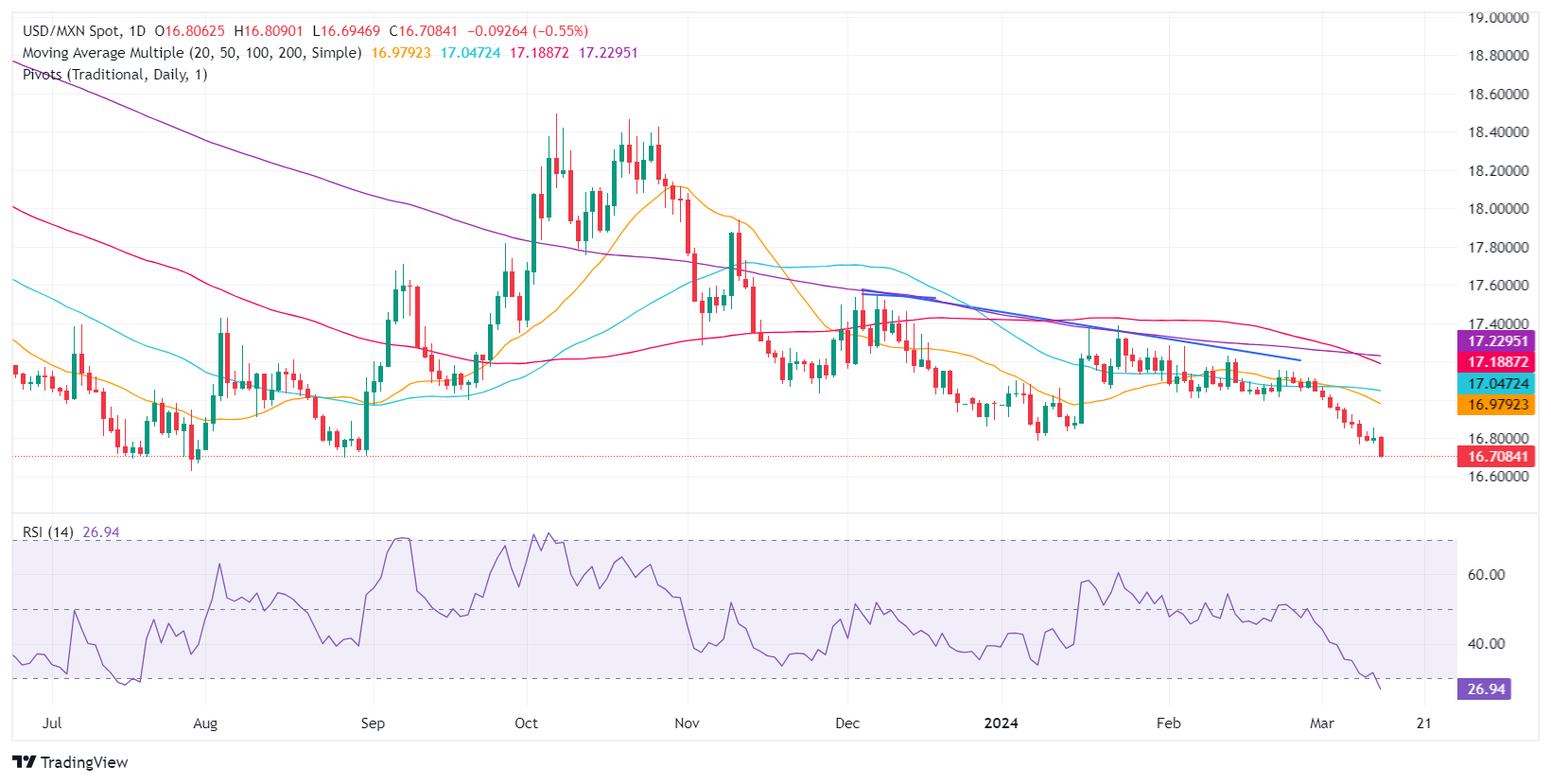
The USD/MXN downtrend is gathering momentum, even though the Relative Strength Index (RSI) indicator displays the pair as oversold. However, due to the strength of the move, traders look for oversold RSI readings at 20.00 as the exotic pair dives to test last year’s low of 16.62. Once that level is surpassed, the next stop would be October 2015’s low of 16.32.
Despite that, they need to reclaim the 17.00 figure, which could open the door to testing the 50-day Simple Moving Average (SMA) at 17.04, followed by the confluence of the 200-day SMA and the 100-day SMA at 17.23.
USD/MXN Price Action – Daily Chart
Mexican Peso FAQs
The Mexican Peso (MXN) is the most traded currency among its Latin American peers. Its value is broadly determined by the performance of the Mexican economy, the country’s central bank’s policy, the amount of foreign investment in the country and even the levels of remittances sent by Mexicans who live abroad, particularly in the United States. Geopolitical trends can also move MXN: for example, the process of nearshoring – or the decision by some firms to relocate manufacturing capacity and supply chains closer to their home countries – is also seen as a catalyst for the Mexican currency as the country is considered a key manufacturing hub in the American continent. Another catalyst for MXN is Oil prices as Mexico is a key exporter of the commodity.
The main objective of Mexico’s central bank, also known as Banxico, is to maintain inflation at low and stable levels (at or close to its target of 3%, the midpoint in a tolerance band of between 2% and 4%). To this end, the bank sets an appropriate level of interest rates. When inflation is too high, Banxico will attempt to tame it by raising interest rates, making it more expensive for households and businesses to borrow money, thus cooling demand and the overall economy. Higher interest rates are generally positive for the Mexican Peso (MXN) as they lead to higher yields, making the country a more attractive place for investors. On the contrary, lower interest rates tend to weaken MXN.
Macroeconomic data releases are key to assess the state of the economy and can have an impact on the Mexican Peso (MXN) valuation. A strong Mexican economy, based on high economic growth, low unemployment and high confidence is good for MXN. Not only does it attract more foreign investment but it may encourage the Bank of Mexico (Banxico) to increase interest rates, particularly if this strength comes together with elevated inflation. However, if economic data is weak, MXN is likely to depreciate.
As an emerging-market currency, the Mexican Peso (MXN) tends to strive during risk-on periods, or when investors perceive that broader market risks are low and thus are eager to engage with investments that carry a higher risk. Conversely, MXN tends to weaken at times of market turbulence or economic uncertainty as investors tend to sell higher-risk assets and flee to the more-stable safe havens.
Author
Christian Borjon Valencia
FXStreet
Markets analyst, news editor, and trading instructor with over 14 years of experience across FX, commodities, US equity indices, and global macro markets.