Mexican Peso edges higher as President Sheinbaum takes office
- The Mexican Peso closed Monday slightly higher in its key pairs – it continues the trend on Tuesday.
- President-elect Claudia Sheinbaum takes over from outgoing President Andres Manuel Lopez Obrador on Tuesday.
- USD/MXN pauses in its uptrend, but the bias remains bullish.

The Mexican Peso (MXN) edges higher in its key pairs on Tuesday, continuing the previous day's performance which saw USD/MXN, EUR/MXN and GBP/MXN all decline.
The news flow out of Mexico is mainly concerned with the outgoing President Andres Manuel Lopez Obrador’s (AMLO) handover of power to his successor, President-elect Claudia Sheinbaum, who officially takes office on October 1. Global investors will probably watch her inauguration speech with interest in an attempt to discern the broad policy trajectory of her administration. On Monday, news of her cabinet reshuffle indicated she is keeping some of AMLO’s old personnel alongside some new hires.
The new Minister of the Economy is Marcelo Ebrard, who was previously the Secretary of Foreign Affairs for Mexico. His background in international relations will be useful when it comes to renegiotiating the T-MEC free trade agreement with the US and Canada in 2026, according to El Financiero. He has also been tasked with actively encouraging Mexico as a nearshoring destination, making company registration cheaper and providing support to all Mexican businesses.
However, Sheinbaum has always made it clear she supports most of AMLO’s contentious constitutional reforms, which rocked the Peso after her election win in June.
Mexican Peso closed marginally higher as currency peers weaken
The Mexican Peso strengthened slightly versus the Euro (EUR) on Monday after German inflation data came out lower than estimated in September. Eurozone-wide inflation also fell according to data released on Tuesday.
The Eurozone Harmonized Index of Consumer Prices (HICP) came out at 1.8% in September from 2.2% previously and 1.9% forecast, according to Eurostat. Core HICP fell to 2.7% from 2.8% previously and the same expected.
The disinflationary trend could pressure the European Central Bank (ECB) to accelerate cuts to interest rates. Lower interest rates tend to lead to capital outflows and a weaker Euro.
The ECB President, Christine Lagarde hinted that inflation was falling back to the central bank’s 2.0% target, as expected, in her speech to the European Parliament's Committee on Economic and Monetary Affairs on Monday. "The latest developments strengthen our confidence that inflation will return to target in a timely manner," she said, suggesting a greater chance the ECB would move to ease policy in its next meeting.
The Mexican Peso closed Monday marginally higher against the US Dollar (USD) despite a relatively hawkish speech from the Federal Reserve (Fed) Chairman Jerome Powell. The Fed chair struck a cautious tone, advocating a data-driven, meeting-by-meeting approach to monetary policy. The market-based probability of the Fed cutting interest rates by 0.50% again in November fell to around the mid-30% mark from being over 60% at one point last week, according to the CME FedWatch tool. On the economic data front, Tuesday sees the release of September’s US ISM Manufacturing Purchasing Managers Index (PMI) data and August’s JOLTS Job Openings.
With GBP/MXN, it was a similar story as the Peso closed a few pips higher on Monday. The Pound Sterling (GBP) was sold after the UK Gross Domestic Product (GDP) growth data’s final reading for Q2 revealed a downward revision to 0.7% YoY from its previous 0.9% estimate. That said, other UK data showed Business Investment growing and UK borrowing data revealed consumers continuing to access credit.
Technical Analysis: USD/MXN pauses within uptrend
USD/MXN pauses and consolidates during its steady climb within a rising channel. The pair is in a short, medium and long-term bullish trend, and according to technical analysis theory, it is more likely to resume its bullish momentum eventually.
USD/MXN Daily Chart
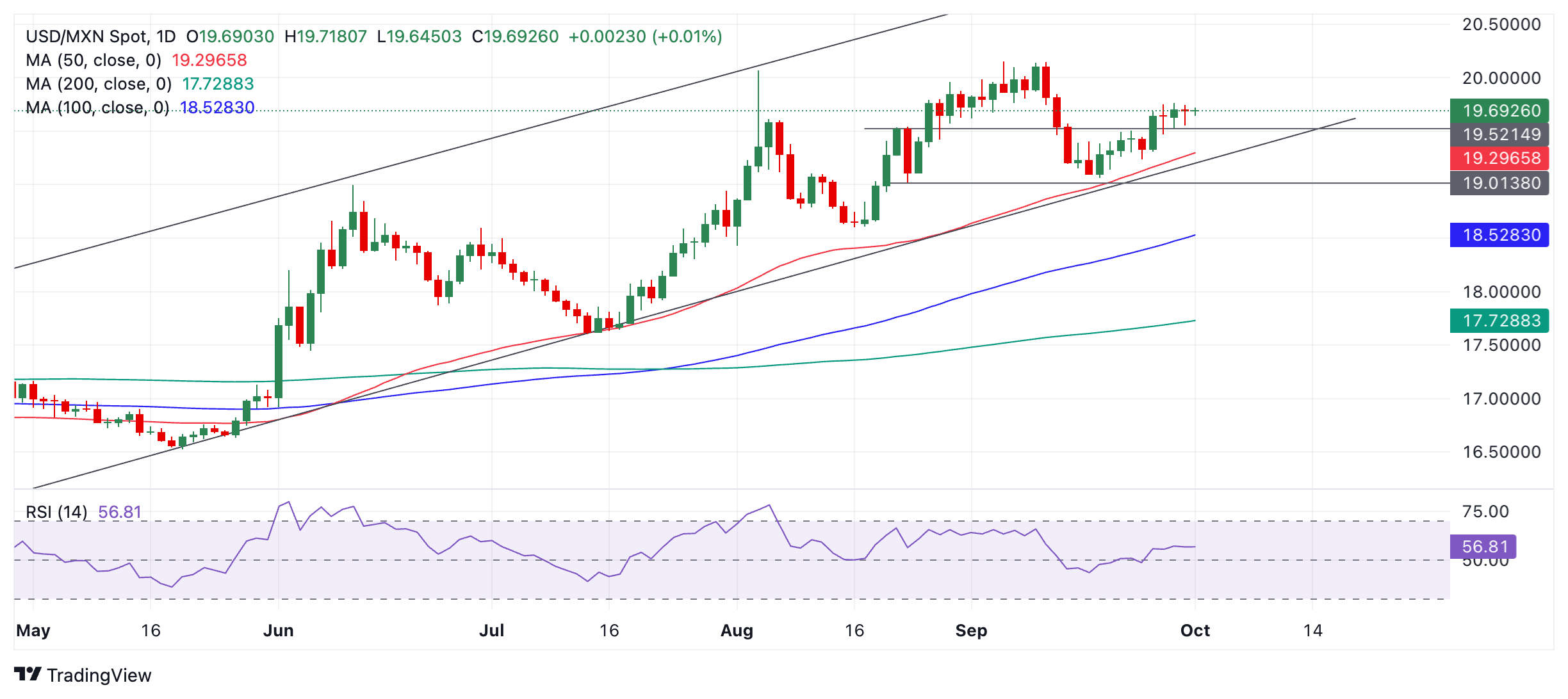
Friday’s close above 19.68 (September 25 high) provided more bullish certainty of the pair’s near-term upside bias towards a target at 20.15, the high of the year reached in early September.
A further break above 19.76 (the September 27 high) would create a higher high and provide yet more proof of an extension of the uptrend.
Mexican Peso FAQs
The Mexican Peso (MXN) is the most traded currency among its Latin American peers. Its value is broadly determined by the performance of the Mexican economy, the country’s central bank’s policy, the amount of foreign investment in the country and even the levels of remittances sent by Mexicans who live abroad, particularly in the United States. Geopolitical trends can also move MXN: for example, the process of nearshoring – or the decision by some firms to relocate manufacturing capacity and supply chains closer to their home countries – is also seen as a catalyst for the Mexican currency as the country is considered a key manufacturing hub in the American continent. Another catalyst for MXN is Oil prices as Mexico is a key exporter of the commodity.
The main objective of Mexico’s central bank, also known as Banxico, is to maintain inflation at low and stable levels (at or close to its target of 3%, the midpoint in a tolerance band of between 2% and 4%). To this end, the bank sets an appropriate level of interest rates. When inflation is too high, Banxico will attempt to tame it by raising interest rates, making it more expensive for households and businesses to borrow money, thus cooling demand and the overall economy. Higher interest rates are generally positive for the Mexican Peso (MXN) as they lead to higher yields, making the country a more attractive place for investors. On the contrary, lower interest rates tend to weaken MXN.
Macroeconomic data releases are key to assess the state of the economy and can have an impact on the Mexican Peso (MXN) valuation. A strong Mexican economy, based on high economic growth, low unemployment and high confidence is good for MXN. Not only does it attract more foreign investment but it may encourage the Bank of Mexico (Banxico) to increase interest rates, particularly if this strength comes together with elevated inflation. However, if economic data is weak, MXN is likely to depreciate.
As an emerging-market currency, the Mexican Peso (MXN) tends to strive during risk-on periods, or when investors perceive that broader market risks are low and thus are eager to engage with investments that carry a higher risk. Conversely, MXN tends to weaken at times of market turbulence or economic uncertainty as investors tend to sell higher-risk assets and flee to the more-stable safe havens.
Author
Joaquin Monfort
FXStreet
Joaquin Monfort is a financial writer and analyst with over 10 years experience writing about financial markets and alt data. He holds a degree in Anthropology from London University and a Diploma in Technical analysis.