Mexican Peso climbs on strong data, risk-on mood weighing on US Dollar
- Mexican Peso set for 0.89% weekly gain as economic resilience surprises markets.
- Trump’s mixed tariff comments stir volatility, but risk appetite lifts emerging market currencies.
- Traders brace for Mexico’s Q1 GDP release next week to gauge recession risks.


The Mexican Peso extended its gains against the US Dollar for the second consecutive day, poised to finish the week with gains of 0.89%, sponsored by an improvement in risk appetite and better-than-expected Mexico economic data. At the time of writing, the USD/MXN trades at 19.52, down 0.32%.
Wall Street closed with gains in Friday’s session, even though US President Donald Trump delivered contradictory remarks about China. Overnight news for American traders revealed Beijing’s willingness to reduce tariffs on US products. Despite this, Trump said he won’t lower tariffs unless “they give us something substantial.”
The Instituto Nacional de Estadistica Geografia e Informatica (INEGI) revealed that the Mexican economy grew in February, contrary to forecasts, which expected a moderate expansion.
Meanwhile, in the US, the University of Michigan (UoM) ’s April Consumer Sentiment index deteriorated sharply, posting its fourth lowest reading since the late 1970s, an indication that Americans grew doubtful about the economic outlook.
Therefore, the USD/MXN edged lower, propelled by goodish Mexico’s data. However, next week, INEGI will release the Gross Domestic Product (GDP) Growth Rate for the first quarter of 2025. A negative reading would confirm that the economy is in a technical recession.
Daily digest market movers: Mexican Peso appreciated during the week despite Banxico’s dovish posture
- Divergence between Banxico and the Fed favors further upside in USD/MXN. Banxico’s Governing Council expressed its decision to continue easing the policy. Conversely, the Fed is considered cautious, as some officials have shown concerns about a reacceleration of inflation spurred by tariffs.
- Mexico’s Economic Activity in February expanded by 1% MoM, above forecasts for a 0.6% growth. On a yearly basis, activity dipped from 0% to -0.7%, better than expected.
- Economic data revealed during the week witnessed a reacceleration on inflation in the first half of April, revealed INEGI. Retail Sales in February were lower than expected, showcasing the ongoing economic slowdown.
- Banxico’s Deputy Governor Omar Mejia Castelazo revealed that the economy has been undergoing a slowdown since Q4 2023, he said in Washington.
- Citi Mexico's expectations survey shows that economists expect Banxico to cut its rate by 50 basis points at the May meeting. For the full year, they project the main reference rate to end near 7.75%.
- Regarding the USD/MXN exchange rate, private analysts see the exotic pair finishing at 20.93, up from 20.90. Inflation in 2025 is projected to finish at 3.78% with core figures at 3.80% mostly aligned with the previous poll.
- Mexico’s economy is expected to grow 0.2% in 2025, below the 0.3% projected in the prior survey.
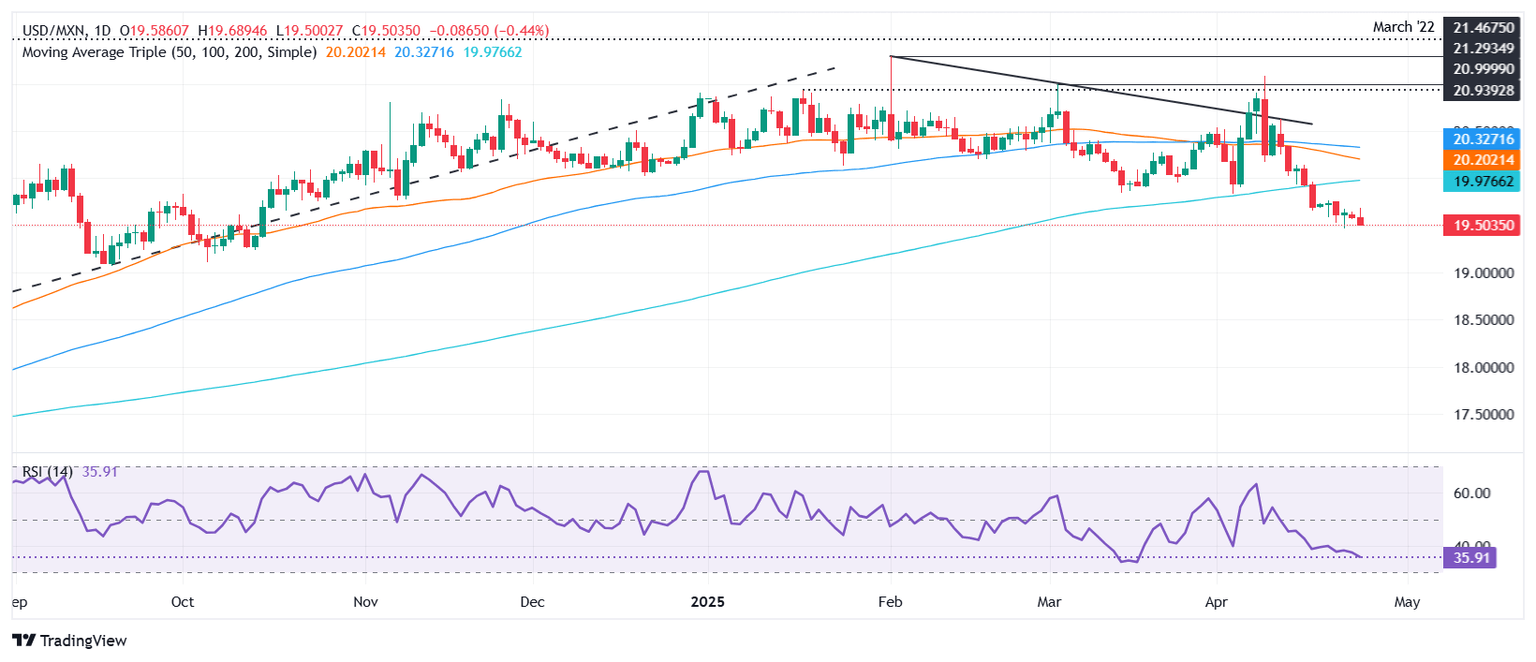
USD/MXN technical outlook: Mexican Peso remains bullish as USD/MXN stays below key technical level
Price action suggests the USD/MXN is bearishly biased and might continue its downtrend, once it registers a daily close below 19.50. In that outcome, the next support would be 23’s low of 19.46, the current year-to-date (YTD) low, followed by the 19.00 psychological figure.
If buyers want to push prices higher, they must reclaim the 200-day SMA at 19.93, followed by the 20.00 figure. A breach of the latter will expose the confluence of the April 14 high and the 50-day SMA near 20.25-20.29 before testing the 100-day SMA at 20.33.
Mexican Peso FAQs
The Mexican Peso (MXN) is the most traded currency among its Latin American peers. Its value is broadly determined by the performance of the Mexican economy, the country’s central bank’s policy, the amount of foreign investment in the country and even the levels of remittances sent by Mexicans who live abroad, particularly in the United States. Geopolitical trends can also move MXN: for example, the process of nearshoring – or the decision by some firms to relocate manufacturing capacity and supply chains closer to their home countries – is also seen as a catalyst for the Mexican currency as the country is considered a key manufacturing hub in the American continent. Another catalyst for MXN is Oil prices as Mexico is a key exporter of the commodity.
The main objective of Mexico’s central bank, also known as Banxico, is to maintain inflation at low and stable levels (at or close to its target of 3%, the midpoint in a tolerance band of between 2% and 4%). To this end, the bank sets an appropriate level of interest rates. When inflation is too high, Banxico will attempt to tame it by raising interest rates, making it more expensive for households and businesses to borrow money, thus cooling demand and the overall economy. Higher interest rates are generally positive for the Mexican Peso (MXN) as they lead to higher yields, making the country a more attractive place for investors. On the contrary, lower interest rates tend to weaken MXN.
Macroeconomic data releases are key to assess the state of the economy and can have an impact on the Mexican Peso (MXN) valuation. A strong Mexican economy, based on high economic growth, low unemployment and high confidence is good for MXN. Not only does it attract more foreign investment but it may encourage the Bank of Mexico (Banxico) to increase interest rates, particularly if this strength comes together with elevated inflation. However, if economic data is weak, MXN is likely to depreciate.
As an emerging-market currency, the Mexican Peso (MXN) tends to strive during risk-on periods, or when investors perceive that broader market risks are low and thus are eager to engage with investments that carry a higher risk. Conversely, MXN tends to weaken at times of market turbulence or economic uncertainty as investors tend to sell higher-risk assets and flee to the more-stable safe havens.
Author
Christian Borjon Valencia
FXStreet
Markets analyst, news editor, and trading instructor with over 14 years of experience across FX, commodities, US equity indices, and global macro markets.