Mexican Peso finds a floor after an 8.0% decline last week
- The Mexican Peso fell over 8.0% in its key pairs last week as a result of election volatility.
- The Peso further weakens after a speech by outgoing president Obrador argues radical reforms are required to cure endemic corruption.
- USD/MXN keeps marching higher and now trades well above 18.00.

The Mexican Peso (MXN) makes a marginal recovery on Monday after losing over 8.0% in the previous week in its most heavily traded pairs. The slight bounce is probably driven by bears covering their shorts and taking profits after the outsized move in the previous week.
All the votes have been counted for the Mexican election and reveal that the Morena party has won a supermajority in the Congress, as expected, but are two seats short of one in the Senate. Morena and its allies won 372 of the 500 seats in the Congress and 83 of the 128 seats in the Senate, according to Reuters.
The result will still enable President-elect Claudia Sheinbaum’s administration to push through a controversial package of reforms that are rattling markets and leading to a depreciation of the Peso. However, they will have to win over some opposition senators to get their reforms through both houses.
USD/MXN is 18.34 at the time of writing, EUR/MXN is trading at 19.75 and GBP/MXN at 23.34.
Mexican Peso weakens after AMLO tirade
The Mexican Peso’s post-election sell-off gained fresh momentum on Friday on the back of comments from the outgoing President Andres Manuel Lopez Obrador (AMLO) during his daily morning press conference.
It was essential to push through reforms of the judiciary and dissolve autonomous bodies, like the INAI – the government’s transparency agency – because, in the words of AMLO, “The judicial power is hijacked, the service is taken over by a minority of those at the top. I have already said it here, and they know it very well. It is even shameful, but there are ministers who are like employees of large corporations,” according to El Financiero.
Inflation data, also out at the end of last week, was mixed, showing a rise in headline inflation to 4.69% YoY in May from 4.65% in April, but a fall in core inflation to 4.21% YoY from 4.37%.
Technical Analysis: USD/MXN marches ever higher
USD/MXN – the value of one US Dollar in Mexican Pesos – pushes above the 18.00 mark and peaks at 18.46, close to the 18.49 of October 2023.
USD/MXN Daily Chart
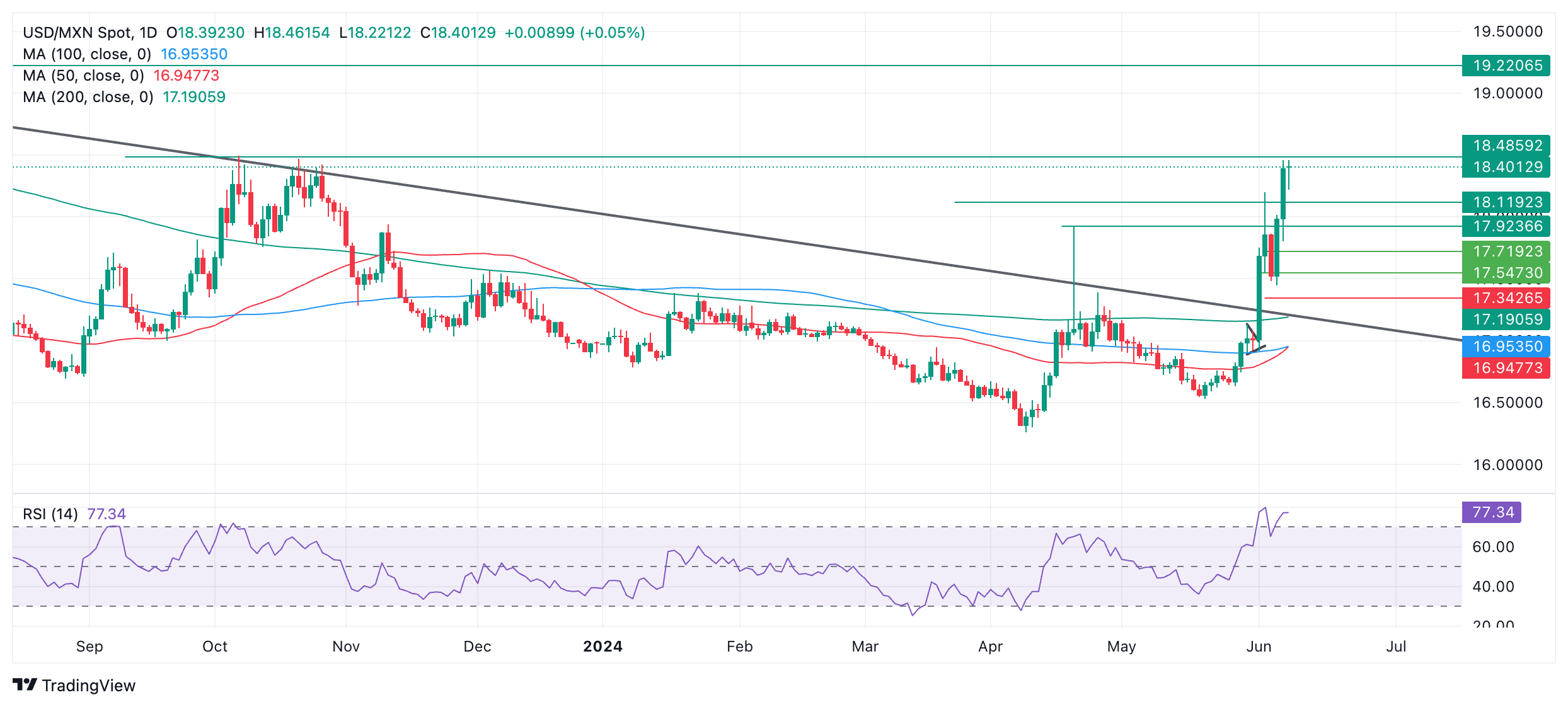
The extension higher suggests the short and intermediate-term trends are bullish, and given that “the trend is your friend”, price is likely to continue rising.
The pair is now close to touching the key resistance level at 18.49, the October 2023 highs. A break above that level will probably see it go even higher, with the next target potentially situated at 19.22 (March 2023 high).
The long-term trend is probably still bearish, suggesting moderate background risks continue.
Mexican Peso FAQs
The Mexican Peso (MXN) is the most traded currency among its Latin American peers. Its value is broadly determined by the performance of the Mexican economy, the country’s central bank’s policy, the amount of foreign investment in the country and even the levels of remittances sent by Mexicans who live abroad, particularly in the United States. Geopolitical trends can also move MXN: for example, the process of nearshoring – or the decision by some firms to relocate manufacturing capacity and supply chains closer to their home countries – is also seen as a catalyst for the Mexican currency as the country is considered a key manufacturing hub in the American continent. Another catalyst for MXN is Oil prices as Mexico is a key exporter of the commodity.
The main objective of Mexico’s central bank, also known as Banxico, is to maintain inflation at low and stable levels (at or close to its target of 3%, the midpoint in a tolerance band of between 2% and 4%). To this end, the bank sets an appropriate level of interest rates. When inflation is too high, Banxico will attempt to tame it by raising interest rates, making it more expensive for households and businesses to borrow money, thus cooling demand and the overall economy. Higher interest rates are generally positive for the Mexican Peso (MXN) as they lead to higher yields, making the country a more attractive place for investors. On the contrary, lower interest rates tend to weaken MXN.
Macroeconomic data releases are key to assess the state of the economy and can have an impact on the Mexican Peso (MXN) valuation. A strong Mexican economy, based on high economic growth, low unemployment and high confidence is good for MXN. Not only does it attract more foreign investment but it may encourage the Bank of Mexico (Banxico) to increase interest rates, particularly if this strength comes together with elevated inflation. However, if economic data is weak, MXN is likely to depreciate.
As an emerging-market currency, the Mexican Peso (MXN) tends to strive during risk-on periods, or when investors perceive that broader market risks are low and thus are eager to engage with investments that carry a higher risk. Conversely, MXN tends to weaken at times of market turbulence or economic uncertainty as investors tend to sell higher-risk assets and flee to the more-stable safe havens.
Author
Joaquin Monfort
FXStreet
Joaquin Monfort is a financial writer and analyst with over 10 years experience writing about financial markets and alt data. He holds a degree in Anthropology from London University and a Diploma in Technical analysis.