Japanese Yen lacks firm intraday direction as traders await Trump's reciprocal tariffs
- The Japanese Yen attracts some intraday sellers, though it lacks any follow-through.
- Concerns that Trump’s tariffs would impact Japan’s industries undermine the JPY.
- The divergent BoJ-Fed expectations favor the JPY bulls and should cap USD/JPY.


The Japanese Yen (JPY) struggles to capitalize on a modest intraday uptick against its American counterpart amid reduced bets that the Bank of Japan (BoJ) would raise the policy rate at a faster pace. Investors remain worried about the potential economic fallout from US President Donald Trump's impending reciprocal tariffs, which could force the BoJ to keep the policy steady for the time being. Apart from this, a generally positive tone around the equity markets undermines the safe-haven JPY, which, along with a modest US Dollar (USD) uptick, assists the USD/JPY pair to hold near the 150.00 psychological mark.
Meanwhile, the BoJ's Tankan survey showed that Japanese enterprises raised their inflation forecasts for one year, three years, and five years ahead. This comes on top of strong consumer inflation figures from Tokyo – Japan's national capital – and backs the case for more rate increases from the BoJ. This marks a big divergence in comparison to the growing acceptance that the Federal Reserve (Fed) will resume its rate-cutting cycle soon on the back of a tariff-driven US economic slowdown. The resultant narrowing of the US-Japan rate differential supports the lower-yielding JPY and caps the USD/JPY pair.
Japanese Yen bulls remain on the sidelines amid worries about the impact of Trump's tariffs
- The Bank of Japan’s Tankan survey released earlier this Tuesday showed that business confidence at large manufacturers in Japan eased in the first quarter (Q1) of 2025. The headline large Manufacturers' Sentiment Index came in at 12.0 in Q1 from the previous reading of 14.0, in line with consensus estimates. Additional details revealed that the large Manufacturing Outlook for the first quarter arrived at 12.0 versus 13.0 prior and the 9.0 expected.
- Furthermore, Japanese enterprises projected consumer prices to rise 2.5% in one year and 2.4% in three years versus 2.4% and 2.3% increase, respectively, in the prior survey. They also forecast inflation to rise 2.3% in five years compared to a 2.2% increase in the prior survey. This comes on top of Friday's strong consumer inflation figures from Tokyo – Japan's capital city – and reaffirms bets that the BoJ might continue raising interest rates in 2025.
- US President Donald Trump last week unveiled a 25% tariff on imported cars and will announce reciprocal tariffs later today, at 19:00 GMT. Investors remain worried that the new levies would have a far-reaching impact on Japan's key industries and force the BoJ to keep the policy steady for the time being. Apart from this, a positive tone around the Asian equity markets might hold traders from placing bullish bets around the safe-haven Japanese Yen.
- The US Dollar, on the other hand, continues with its struggle to attract any meaningful buyers amid concerns that Trump's trade tariffs would dent economic growth. Furthermore, the global flight to safety and expectations of multiple rate cuts from the Federal Reserve drag the US Treasury bond yields lower. The resultant narrowing of the US-Japan rate differential lends additional support to the lower-yielding JPY during the Asian session on Tuesday.
- Traders now look forward to this week's important US macro releases, scheduled at the beginning of a new month, starting with the JOLTS openings and ISM Manufacturing PMI on Tuesday. This will be followed by the ADP report on Wednesday, the US ISM Services PMI on Thursday, and the closely-watched US Nonfarm Payrolls (NFP) on Friday. This will play a key role in influencing the USD and provide some meaningful impetus to the USD/JPY pair.
USD/JPY might struggle to move beyond the overnight swing high, around the 150.25 region
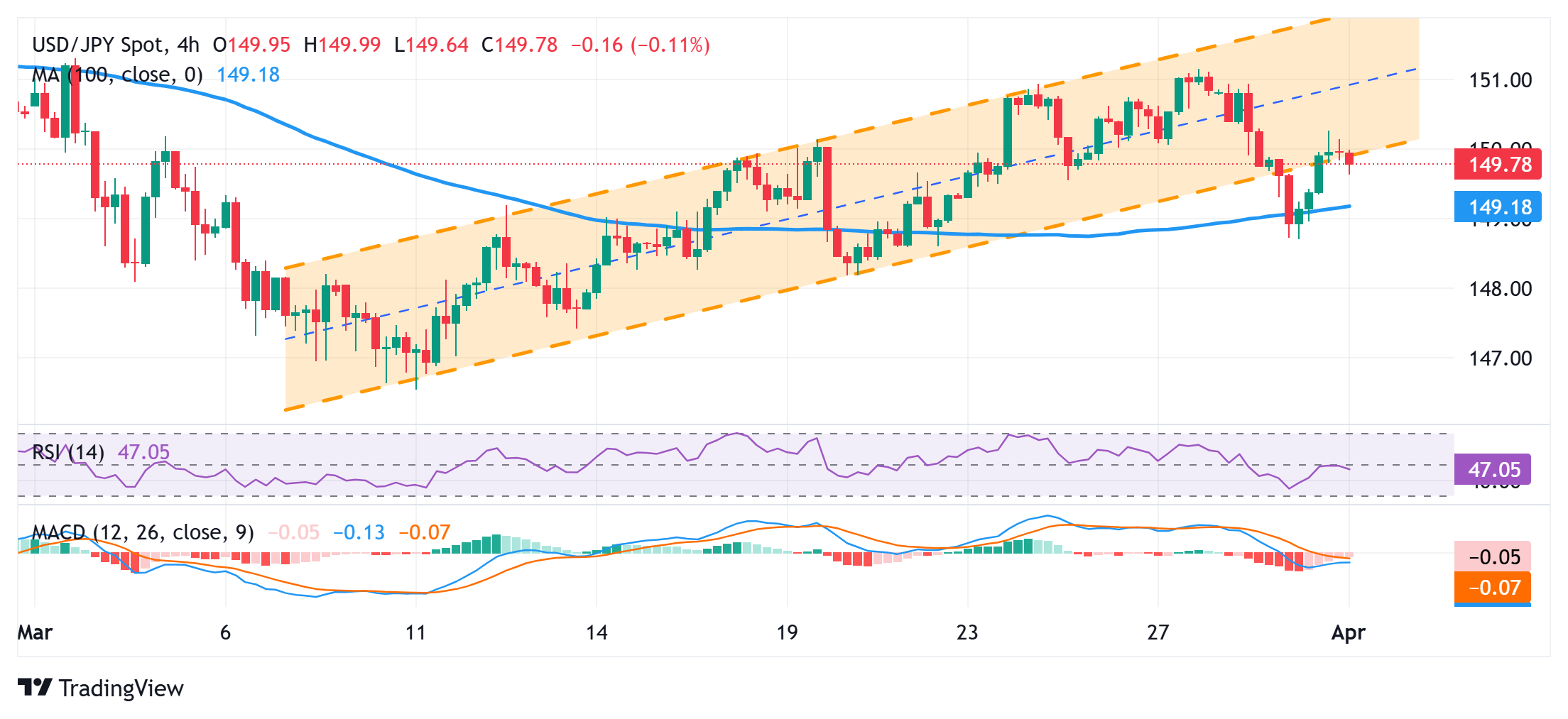
From a technical perspective, the overnight breakdown below the lower end of a multi-week-old ascending trend channel was seen as a key trigger for the USD/JPY bears. However, neutral oscillators on the daily chart and the overnight resilience below the 100-period Simple Moving Average (SMA) on the daily chart warrant caution before positioning for further losses. Hence, any subsequent slide could find some support near the 149.00 mark ahead of the overnight swing low, around the 148.70 area. Some follow-through selling will reaffirm the negative bias and make spot prices vulnerable to resuming a well-established downtrend witnessed over the past three months or so.
On the flip side, momentum beyond the previous day's peak, around the 150.25 area, could lift the USD/JPY pair beyond the 150.75-150.80 hurdle and allow bulls to reclaim the 151.00 mark. This is followed by the March monthly swing high, around the 151.30 region and a technically significant 200-day SMA, currently pegged near the 151.60 zone. A sustained strength beyond the latter might shift the bias in favor of bulls and lift the pair to the 152.00 mark en route to the 152.45-152.50 region and the 100-day SMA, around the 153.00 round figure.
Economic Indicator
JOLTS Job Openings
JOLTS Job Openings is a survey done by the US Bureau of Labor Statistics to help measure job vacancies. It collects data from employers including retailers, manufacturers and different offices each month.
Read more.Next release: Tue Apr 01, 2025 14:00
Frequency: Monthly
Consensus: 7.63M
Previous: 7.74M
Source: US Bureau of Labor Statistics
Author
Haresh Menghani
FXStreet
Haresh Menghani is a detail-oriented professional with 10+ years of extensive experience in analysing the global financial markets.